5 sneaky ways stores get you to spend more
B2
60 min
Premium
1

Think about these questions before watching.

  1. Describe a time you felt you got an amazing deal on something. What made it feel like such a great bargain, and did you really need it?
  2. When you're shopping, what do you think influences your purchasing decisions the most – is it always logic, or do other factors like emotions, advertising, or even the store layout play a role?
  3. Do you believe retailers use specific strategies to encourage customers to spend more, and if so, can you think of any examples you've noticed?
2

Watch the video carefully. Pay attention to the main ideas and key details.

Video script85 segments · click a timestamp to jump

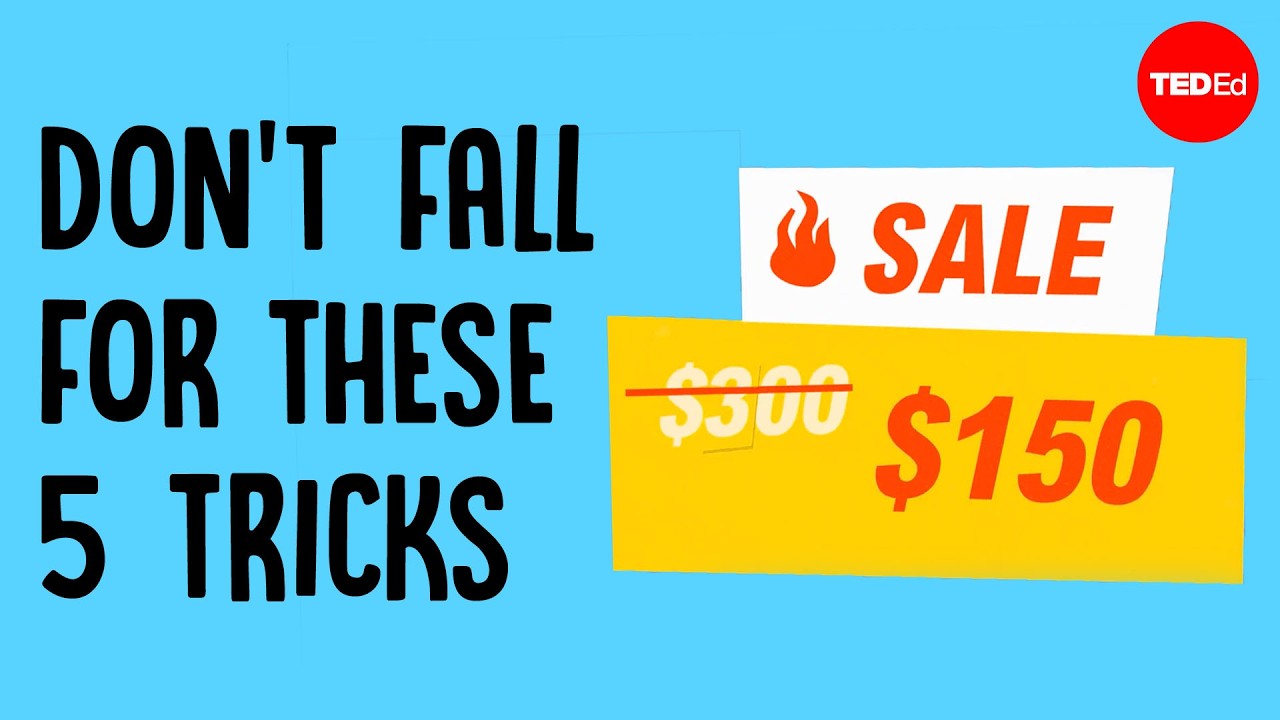
You're about to buy some bargain bin headphones when you spot a real bargain.

This pair is more expensive, but it's selling for half its usual price.

Surely this is the better buy, right?

It’s possible!

However, it’s also possible you’re falling for a psychological trick

retailers use to influence what you buy and what you’re willing to pay.

From the late 1800s, economic theory often assumed that consumers

were rational actors who pursued the optimal financial choice.

But while consumers are reasonably rational on average,

they’re also vulnerable to impulse purchases, savvy salespeople,

and other external factors that make them, well, irrational.

20th century psychologists investigating these factors

learned that human decision making is rarely perfectly logical.

And by the 1970s, this research informed the birth of behavioral economics,

a new field exploring the intersection of economics and psychology.

Behavioral economics operated off a new assumption,

introduced by economic sciences laureate Herbert Simon.

His model, called “bounded rationality,”

argued that consumers have limited information, limited time,

and various psychological constraints

that lead them not to the optimal financial choice,

but simply one they feel good about.

So how do we decide what's good enough?

Rather than using logic,

behavioral economists say we fall back on heuristics—

mental shortcuts for making decisions easier and faster.

For example, the anchoring heuristic

suggests that the first piece of information you get

becomes your baseline for future decision making.

So if a menu's first item costs $50,

you'll compare other prices against that reference point.

Psychologists like Daniel Kahneman thought heuristics predict many consumer choices—

which means they can be manipulated to control them.

Case in point, while those discounted headphones might be 50% off,

it’s also possible the original price was inflated to begin with.

Anchoring is just one of many heuristics retailers exploit.

Consider this: which of these cleaning products would you buy?

How about now?

Both are equally effective and basically cost the same,

but careful language and pricing makes one more appealing.

This is the framing effect,

and it’s one of several psychological phenomena

that short circuit our ability to assign value.

Here’s an example of another:

some American grocery stores tried encouraging customers

to bring reusable shopping bags by offering a 5 cent credit.

But this proved less effective than charging a 5 cent fee

for using disposable bags.

In other words,

the desire to avoid losing 5 cents was more motivating than gaining 5 cents.

This is called loss aversion,

and retailers trigger this fear of losing value

by emphasizing a sale’s scarcity or looming deadline.

All these tactics suggest our perception of value is more important

than what something is actually worth.

And that effect goes deeper than you might think.

In a 2008 study, subjects were put into MRI machines

and treated to samples from five bottles of increasingly expensive wine.

Participants reported preferring the expensive samples,

and MRI images confirmed this claim.

But in reality they only tasted three bottles,

with the two cheapest pulling double duty as the two priciest.

Of course, retailers don’t just manipulate your perception,

they control the spaces you shop.

Supermarkets often place high-margin items at eye level

and design stores to guide you past them.

Behavioral economist Richard Thaler and legal scholar Cass Sunstein

call this subtle product placement “nudge theory,”

and it works online as well.

Sites might nudge you by suggesting related items to purchase

or by pre-selecting add-ons.

So if retailers are boxing you in, what can you do about it?

First, shop slower.

Heuristic-based decision making is quick and instinctive,

so slowing down to run the numbers can pull back the curtain on a flashy deal.

Deciding what a product is worth to you before shopping

can help set your own anchors.

And always ask yourself why you want this deal.

Buying something just because it’s a bargain

means you might not be in control of your choice.

Above all, remember that retailers and advertisers aren’t just selling products—

they’re designing your choices.

And once you understand the psychology behind their designs,

you might gain something even more valuable than a discount:

the ability to choose on your own terms.

3

Answer these questions in your own words. Support your answers with evidence from the video.

01What new understanding of consumer behavior did behavioral economics introduce, contrasting with earlier economic theories?
Sample answerEarlier theories thought people were always rational when buying things, but behavioral economics, especially with Herbert Simon's 'bounded rationality,' said that consumers have limited information and time. This means they often choose things they feel good about, rather than always finding the absolute best financial option.
02How does the 'anchoring heuristic' influence consumer choices, and what example does the video provide?
Sample answerThe anchoring heuristic means that the first piece of information you get becomes your reference point for future decisions. The video explains that if the first item on a menu costs $50, you'll compare all other prices against that high starting point, making them seem more reasonable.
03In what way does the 'loss aversion' principle demonstrate that the fear of losing something can be more motivating than the desire to gain?
Sample answerThe video showed that giving a 5-cent credit for using reusable bags was less effective than charging a 5-cent fee for disposable ones. This means people were more motivated to avoid losing 5 cents by paying a fee than they were to gain 5 cents by getting a credit, highlighting that the fear of loss is a stronger driver.
04According to the video, what three practical strategies can consumers use to make more independent purchasing decisions?
Sample answerTo make more independent choices, the video suggests three things. First, shop slower to avoid quick, instinctive decisions. Second, decide what a product is truly worth to you before you start shopping. And finally, always ask yourself why you actually want a deal, instead of just buying it because it's on sale.
4

Vocabulary

Vocabulary
These expressions will help you communicate more naturally about this topic.
fall for a trick/tactic — to be deceived or tricked by something, often something clever or misleading.
Usage note: This phrasal verb is commonly used when someone is fooled by a scam, a lie, or a clever marketing strategy. For example, 'Don't fall for that limited-time offer; it's just a way to make you buy quickly.'
impulse purchase/buy — an item bought suddenly and without careful thought, often on a whim.
Usage note: This noun phrase describes spontaneous, unplanned spending. You can also say 'buy on impulse.' For instance, 'I made an impulse purchase of a new gadget I didn't really need.'
perceived value — the worth that a customer believes a product or service has, rather than its actual monetary cost.
Usage note: This collocation is often used in discussions about marketing and pricing strategies. It highlights how a customer's perception can differ from the objective value. For example, 'Retailers often try to increase the perceived value of their products through branding and presentation.'
resist the urge to (do something) — to successfully stop yourself from doing something you want to do, especially something impulsive.
Usage note: This phrase is useful when talking about self-control and avoiding temptation. It's often followed by an infinitive, such as 'resist the urge to spend' or 'resist the urge to buy.' For instance, 'It's hard to resist the urge to grab a snack at the checkout counter.'
savvy consumer/shopper — a consumer who is knowledgeable, experienced, and clever, especially in making good purchasing decisions.
Usage note: 'Savvy' is an adjective meaning practical knowledge and ability. A 'savvy consumer' is someone who understands how stores operate and can avoid common traps. For example, 'A savvy consumer always compares prices before making a big purchase.'
5

Complete the sentences with words from the box. One word is extra.

Word bank
01Many shoppers when they see a "buy one, get one free" sign, believing they're getting a great deal.
02That brightly colored gadget near the checkout counter is designed to encourage an .
03A higher price tag can sometimes increase a product's , making customers believe it's of superior quality.
04It takes strong willpower to to grab those tempting snacks while waiting in line.
05An experienced always compares prices and reads reviews before making a significant investment.
6

Use the word in brackets to form a new word that fits each gap.

01
Many shoppers make decisions when faced with attractive discounts, often buying things they don't truly need.
02
Retailers often try to increase the value of their products through clever marketing and branding.
03
It can be difficult to the temptation of a 'buy one, get one free' offer, even for items you wouldn't normally purchase.
04
A truly consumer always compares prices and reads reviews before making a significant purchase.
05
Some marketing strategies are designed to be intentionally , making it hard for consumers to understand the real cost.
06
The video highlights how stores influence our habits, often without us even realizing it.
7

Grammar: Modal perfects for past situations

Grammar
Modal perfects like 'must have', 'should have', and 'could have' followed by a past participle help us talk about past events. We use them to make deductions about what probably happened, express regret or criticism about past actions, or discuss possibilities that didn't occur, often in the context of consumer choices and retail strategies.
Retailers must have studied consumer psychology extensively to design such effective sales tactics.
Use 'must have + past participle' to make a strong deduction about something that almost certainly happened in the past.
I should have compared prices online before making that impulse purchase; I probably paid too much.
Use 'should have + past participle' to express regret or to say that a different action would have been better in the past.
They could have offered a clearer discount, but they chose to use confusing pricing to make it seem like a better deal.
Use 'could have + past participle' to talk about a past possibility that didn't happen, or an alternative action that was available but not taken.
If I had known about these sneaky tricks, I wouldn't have been so easily persuaded.
Modal perfects often appear in the result clause of third conditional sentences, discussing hypothetical past outcomes.
  • Must have + past participle: A strong deduction about a past event.
  • Should have + past participle: Regret or criticism about a past action.
  • Could have + past participle: A past possibility that did not happen.
  • Always use the past participle (e.g., 'bought', 'seen', 'done') after 'have'.
8

Rewrite each sentence using the structure indicated.

01I regret not checking the price online before buying that expensive gadget.
Express regret about a past action using 'should have'.
Hint: Think about what you *ought* to have done.
02The store had the option to clearly label the 'limited time offer' as a common sales tactic, but they didn't.
Express this missed opportunity or alternative past action using 'could have'.
Hint: What was possible but didn't happen?
03I am certain that the clever display of products influenced my decision to buy more than I needed.
Make a strong deduction about the past using 'must have'.
Hint: What is almost certainly true about the past?
04It's possible that the customer didn't manage to resist the urge to make an impulse purchase.
Express this past possibility or uncertainty using 'might have'.
Hint: What was a possible outcome, but we're not sure?
05Buying that extended warranty was unnecessary; I now realize it added little to the product's perceived value.
Express regret about a past action using 'shouldn't have'.
Hint: What was a bad decision you made?
06Even a savvy consumer would have found it impossible to detect the subtle pricing trick without prior knowledge.
Express this past impossibility using 'couldn't have'.
Hint: What was absolutely not possible in the past?
9

Spot the spending trap: correct the errors

The video discusses how stores influence our spending. Read each sentence below, identify the single error, and correct it.

Each sentence contains one error. Find and correct it.

01I should have resist the urge to make that impulse purchase, but the discount was too good to pass up.
Corrected version
I should have resist resisted the urge to make that impulse purchase, but the discount was too good to pass up.
02Retailers often manipulate the perceiving value of a product to make it seem more attractive to buyers.
Corrected version
Retailers often manipulate the perceiving perceived value of a product to make it seem more attractive to buyers.
03Many shoppers fall at clever marketing tactics without even realizing they are being influenced.
Corrected version
Many shoppers fall at for clever marketing tactics without even realizing they are being influenced.
04To be a savvily consumer, you need to research products carefully before making purchasing decisions.
Corrected version
To be a savvily savvy consumer, you need to research products carefully before making purchasing decisions.
05A variety of psychological tricks is used by stores to encourage customers to spend more than intended.
Corrected version
A variety of psychological tricks is are used by stores to encourage customers to spend more than intended.
06If I had known about their tactics, I might have been able resisting that impulse buy altogether.
Corrected version
If I had known about their tactics, I might have been able resisting to resist that impulse buy altogether.
07The video explained how stores create a sense of urgency, making it harder to resist the urge of buying.
Corrected version
The video explained how stores create a sense of urgency, making it harder to resist the urge of buying. to buy.
08The perceived value of product is often more important than its actual cost for many consumers.
Corrected version
The perceived value of a product is often more important than its actual cost for many consumers.
10

Words to take with you

Vocabulary
These expressions are not in the video but will help you discuss this topic more fluently.
To be susceptible to (something) — easily influenced or affected by something, often in a negative way.
Use this phrase to describe how consumers can be vulnerable to certain marketing tactics. For example: "Many shoppers are susceptible to 'limited-time offer' promotions, even if they don't truly need the product."
Psychological pricing — marketing strategies that use pricing to influence customers' perceptions and buying decisions, often by making prices seem lower than they are.
This refers to techniques like setting prices at $9.99 instead of $10, or displaying a higher original price next to a discounted one. For example: "Stores often use psychological pricing, like ending prices in .99, to make a product seem more affordable."
Upselling — a sales technique where a seller encourages the customer to purchase more expensive items, upgrades, or other add-ons in order to make a more profitable sale.
This often happens when you're already committed to buying something. For example: "When you buy a phone, the salesperson might try upselling you to a model with more storage or a better camera."
To entice customers — to attract or tempt someone by offering pleasure or advantage.
Use this verb phrase to talk about how businesses draw people in or persuade them to buy. For example: "Supermarkets often use appealing displays and special offers to entice customers to buy more items than they originally planned."
Buyer's remorse — the feeling of regret or anxiety after making a purchase, especially a large or expensive one.
This often follows an impulse buy or falling for a marketing trick. For example: "After buying the expensive gadget, she felt a strong sense of buyer's remorse, wondering if she really needed it."
11

Match each word on the left with its natural partner on the right.

A
B
12

Useful phrases: Discussing shopping habits and consumer psychology

Vocabulary
The video explores how stores influence our spending. These phrases will help you discuss consumer behavior, marketing tactics, and your own shopping habits with more fluency and precision.
It's quite eye-opening how much consumer psychology influences our purchasing decisions. — This phrase introduces the topic, expressing a general observation about the impact of psychological tactics on shopping.
Register: Neutral. Use when starting a conversation about marketing strategies or consumer behavior, or when reflecting on a new insight.
I have to admit, I sometimes fall for those clever marketing tricks, especially when there's a good discount. — This allows you to share a personal experience of being influenced by a sales tactic.
Register: Neutral to slightly informal. Use when admitting personal susceptibility to marketing ploys or discussing common shopping pitfalls.
It's amazing how stores can manipulate our perception of value, making us think something is worth more than it is. — This phrase comments on the concept of 'perceived value' and how it's used in retail.
Register: Neutral. Use when analyzing how products are priced, presented, or advertised to influence buyer perception.
It takes a lot of discipline to resist the urge to make an impulse purchase, especially with online shopping. — This highlights the challenge of avoiding unplanned buys and uses key vocabulary.
Register: Neutral. Use when discussing self-control in shopping, the difficulty of avoiding spontaneous buys, or the impact of e-commerce.
I try to be a savvy consumer by doing my research and not rushing into decisions. — This describes an ideal approach to shopping, emphasizing being knowledgeable and thoughtful.
Register: Neutral. Use when talking about smart shopping strategies, giving advice, or describing your own cautious approach to buying.
What strategies do you use to avoid falling for common retail tricks? — This is a direct question to engage others in the discussion, asking about their methods for smart shopping.
Register: Neutral. Use to invite others to share their experiences or tips on how to be a more conscious shopper.
13

Understanding consumer spending habits

Stores use various psychological tactics to encourage purchases. This exercise explores how to become a more aware shopper.

Fill in each blank with the correct word from the word bank.

Word bank
Understanding consumer psychology is crucial for both retailers and shoppers. Stores often employ subtle tactics designed to influence our buying decisions, making it easy to marketing ploys. For instance, a product's can be manipulated through clever pricing or display, making us believe we're getting a better deal than we actually are. The goal is often to encourage an – a sudden acquisition made without much thought. However, by becoming a more , individuals can learn to to spend unnecessarily and make more informed choices, ultimately saving money and avoiding buyer's remorse.
14

The subtle art of online persuasion

Even the most experienced shoppers can fall for clever marketing tactics.

Read the passage below, then answer the comprehension questions.

The digital marketplace, despite its apparent transparency, is a masterclass in subtle persuasion. Online retailers employ sophisticated algorithms to understand our shopping habits, often presenting us with 'deals' that seem too good to miss. I recently almost made an impulse purchase of a smart home device, lured by a 'flash sale' countdown timer. My initial thought was that I should have known better, having studied consumer psychology. It’s incredibly easy to fall for a trick when a website suggests 'other customers also bought this' or highlights a product’s 'limited stock.' The perceived value of an item can be significantly inflated by these digital nudges, making us believe we’re getting a bargain when we might have been paying more than necessary. Becoming a truly savvy consumer online requires more than just comparing prices; it demands a conscious effort to resist the urge to click 'add to cart' without critical thought. We could have avoided many unnecessary expenditures if we consistently questioned the urgency behind these digital prompts.

01According to the passage, what is one example of a 'digital nudge' online retailers use?
Sample answerOnline retailers use 'flash sale' countdown timers or suggestions like 'other customers also bought this' as digital nudges.
02What does the passage suggest can happen to the 'perceived value' of an item due to these digital tactics?
Sample answerThe perceived value of an item can be significantly inflated, making shoppers believe they are getting a bargain.
03Why does the author mention having 'studied consumer psychology' in relation to their own shopping experience?
Sample answerThe author mentions this to highlight that even with knowledge of consumer psychology, it's still easy to almost fall for these tricks, showing how effective they are.
04Beyond comparing prices, what does the passage advise a 'savvy consumer' to do when shopping online?
Sample answerA savvy consumer should make a conscious effort to resist the urge to buy impulsively and critically question the urgency presented by digital prompts.
15

Understanding consumer psychology

The video discusses how stores influence our spending. This exercise will help you practice vocabulary and phrases related to consumer behavior and smart shopping.

Match each item on the left with the correct item on the right.

A
B
16

Discuss these questions with a partner. Try to use vocabulary from the lesson.

  1. When have you made an impulse purchase? What influenced your decision?
  2. Is it ethical for retailers to use psychological tactics to influence spending?
  3. How can consumers become more savvy and resist marketing tactics?