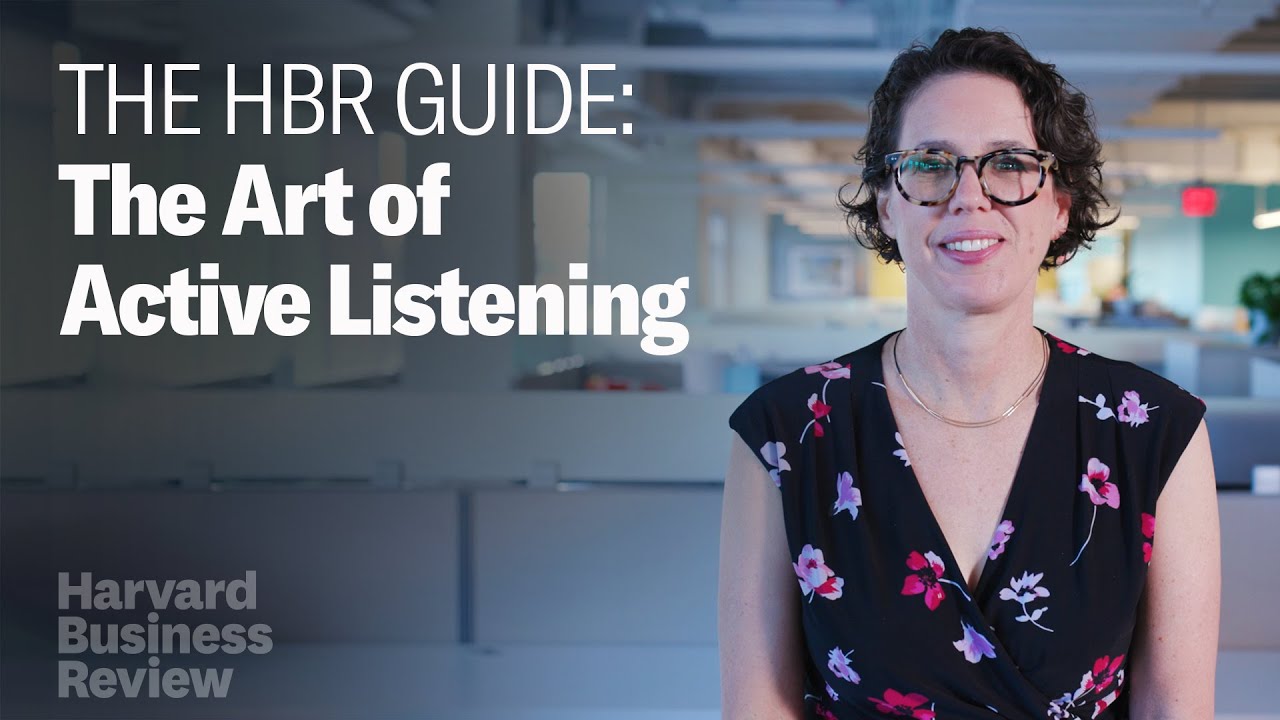
Think about these questions before watching. Share your ideas with a partner.
Describe a time you were talking to someone, but you felt they weren't truly listening. What signals or behaviors gave you that impression?
In what situations do you find it most challenging to be a fully engaged listener? For example, when you're busy, tired, or disagree with the speaker?
Think about someone you consider to be an excellent listener. What specific things do they do that make you feel heard and understood?
2
Watch the video from 0:55 to 4:50. Pay attention to the main ideas, key vocabulary, and examples in this section.
▶ You only need to watch 0:55–4:50. The exercises focus on this part.
Video script167 segments · click a timestamp to jump
AMY GALLO: Are you a good listener?
No, really.
Are you?
You might think you are because you stay silent while they're
talking, nod your head and say mm-hmm,
and repeat back, word for word, what you heard them say.
This has been standard management advice
on good listening for ages.
But what if I told you that following these tips
could leave the listener feeling unheard or even dismissed?
The truth is that mastering the art of listening
involves a whole host of other skills.
You need to do more.
In this video, you'll learn techniques
that will help you in both professional and personal
relationships.
Are you ready to be not just a good listener but a great one?
Let's get started.
The first step after putting away all distractions,
like cell phones and laptops, is to recognize
that listening is an active, noncompetitive, two-way
interaction.
Authors Jack Zenger and Joseph Folkman
write that we shouldn't be passive, like a sponge merely
absorbing information.
Instead, we need to be active listeners,
like a trampoline, giving the speaker's thoughts height,
acceleration, energy, and amplification.
But how do you become a so-called trampoline listener?
First, it's important to ask yourself,
how do I usually listen?
Maybe you're typically task-oriented,
focused on efficiency; or analytical,
aiming to analyze problems from a neutral perspective;
or relational, building connections and responding
emotionally; or critical, perhaps judging both
the content and the speaker.
You may, out of habit, default to one of these styles in most
situations.
But if you then ask yourself, why
do I need to listen right now, you
may realize that a different mode or a combination of modes
is better suited for this moment.
Is a family member in need of emotional support,
or a coworker hoping for an honest critique?
Reflecting on the goals of each conversation, what you want,
and what the speaker needs will help you determine
the best way to listen.
This question can also remind us to listen without an agenda
so we can process what the other person is saying
without formulating a response.
At some point in the conversation,
you'll likely have to share your perspective.
But for now, take in what they have
to say without thinking about what you'll say next.
Another question to ask is, who is the focus of attention
in the conversation?
Sharing your own personal stories
can establish connection and validation.
But you don't want to steer the conversation away
from the speaker in a way that makes
them feel dismissed or unheard.
Also, you can ask, what am I missing?
Remember, good listening is much more
than nodding, saying mm-hmm, and parroting back
what you heard the person say.
In reality, speaking up and asking good questions signals
to the speaker that not only have you heard what they said,
but you understood it enough to want more information.
It can also profoundly changed the conversation.
If you pay attention to verbal and nonverbal cues,
that may reveal that the speaker has more
to say than what appears at face value.
They may be uncertain about sharing vulnerability,
or they may not even realize that they're
expressing unexamined emotions.
Asking questions based on what may have been left unsaid
can show the other person that you were listening deeply.
It can make them feel supported and lead
to insight for both of you.
Here's an example.
An employee tells you, I'm worried about my presentation
for the board meeting.
You might try to naturally reassure and relate
by saying something like, oh, you're going to be great.
It took me years before I could present without being nervous.
Unfortunately, while you're attempting
to make a connection here, that kind of response
can actually dismiss their concerns
without inviting further detail.
It ignores what might be an important issue underlying
their statement and switches the focus to you.
To show that you're listening in a deeper way,
you can say something like, I was nervous
when I started presenting too.
What's worrying you?
Big difference, right?
When trying to be a better listener,
another good question to ask yourself
is, am I getting in my own way?
All too often, we prevent ourselves
from being able to listen deeply because of our own insecurities
or head trips.
We might be emotionally uncomfortable
or worry about how confident and prepared
we seem to the other person.
With practice, quieting that internal monologue
will leave space to actually hear what's
being said by the other person.
So far, we've been talking about how anyone
can be a better listener.
But if you're a senior leader, where much more is at stake,
good listening is an imperative skill.
It's wise to ask, am I in an information bubble?
Many leaders find themselves in those information bubbles
because employees are afraid of questioning, challenging,
second-guessing, or disappointing them.
They may spin information in a positive light
to avoid tough conversations with leadership.
As Kevin Sharer, former CEO and chairman of Amgen, said,
"If you walk around and see a bunch of smiling faces and say,
'Gee, everybody looks happy to me,' you're not listening."
Leaders must develop the discipline
to listen purely for comprehension
without judgment, agenda, or distraction
and actively seek input from all levels and ranks.
Also, creating an atmosphere that
prioritizes trust over hierarchy means
anybody can feel comfortable sharing information,
whether it's good or bad.
OK.
Let's review.
Most conversations would benefit if we
could be active, supportive trampoline listeners instead
of passive information sponges.
To do this, you can ask yourself,
how do I usually listen?
Reflecting on your default listening style
can help you assess how to improve your listening skills.
Why do I need to listen right now?
Thinking about what the other person might
need from your conversation can provide clues
as to how you can best listen at that moment.
Who is the focus of attention in the conversation?
Be careful sharing your own experiences
in an attempt to connect.
You don't want to steer the conversation away from what
the speaker is trying to say.
What am I missing?
Ask good questions not only about what is said
but what may be left unsaid.
Am I getting in my own way?
Be careful not to let your own internal monologue prevent you
from truly being able to listen deeply.
And for our current and future senior leaders
out there, ask, am I in an information bubble?
Practice listening purely for comprehension.
And create an environment where employees have opportunities
to share feedback and feel comfortable doing so.
Thanks for watching.
All of the strategies that I've shared today
are based on HBR articles linked below.
Do you have your own strategies for becoming a better listener?
Or is there a topic you want us to cover in a future HBR video?
Comment below.
We're listening.
Bye.
3
Answer these questions in your own words. Support your answers with evidence from the video.
01According to the video, what is the key difference between a "sponge" listener and a "trampoline" listener?
Sample answerA sponge listener is passive and just absorbs information without interacting much. A trampoline listener is active and helps give the speaker's thoughts more energy and height, amplifying what they are saying.
02Why is it important to think about the purpose of a conversation before deciding on a listening style?
Sample answerIt's important because different situations require different types of listening. For instance, a family member might need emotional support, which requires a relational style, while a coworker might want an honest critique, which requires a more critical approach. You have to adapt to what the speaker needs.
03What does the video suggest that asking good questions shows the speaker?
Sample answerIt shows the speaker that you haven't just heard their words, but you've understood them well enough to want more information. It signals that you are deeply engaged and processing what they've said.
04In the example about the employee's presentation, how does the recommended response ("What's worrying you?") reflect the "trampoline" listening approach?
Sample answerThe bad response dismisses the employee's concern and shifts the focus. The good response, by asking a question, invites the employee to share more details. This is like a trampoline because it takes their initial statement and gives it a platform to be explored more deeply, amplifying their concern instead of shutting it down.
4
Vocabulary
Vocabulary
These expressions will help you communicate more naturally about this topic.
Examples
To read between the lines — to understand the real or hidden meaning behind what someone says or writes, even if it's not stated directly.
Usage note: This is useful in both personal and professional contexts. For example, 'She didn't say she was unhappy, but reading between the lines, I think she's looking for a new job.'
To be on the same wavelength — to think in a similar way and to understand each other well.
Usage note: This is a common, informal expression used to describe a good connection with someone. For example, 'We work so well together because we're always on the same wavelength.'
To get your wires crossed — to have a misunderstanding with someone, often because you thought they were talking about something different.
Usage note: This is a common informal idiom. You might say, 'I think we got our wires crossed. I thought the meeting was at 10 am, not 11 am.'
To chime in — to join a conversation and add your opinion or thoughts, especially one that you were just listening to.
Usage note: This can be used positively, but be careful not to interrupt. It's often followed by 'with'. For example, 'He was telling his story when his colleague chimed in with some extra details.'
Unsolicited advice — advice that is given to someone who did not ask for it.
Usage note: This often has a slightly negative connotation, as it can be unhelpful or annoying. A good listener knows when to offer support instead of unsolicited advice.
5
Read the statements below. Decide if they are true or false based on the video, and correct the false ones.
01The video identifies three main listening styles: task-oriented, emotional, and critical.
02The video suggests that asking insightful questions is a more effective sign of good listening than simply repeating what the speaker said.
03In the example about the nervous employee, the speaker's first response is unhelpful despite being an attempt to build a connection.
04The video advises against sharing personal stories under any circumstances during a conversation.
05Listening without an agenda involves temporarily putting aside your own perspective to fully process what the other person is saying.
6
Complete the sentences with words from the box. One word is extra.
Word bank
01Although my friend meant well, I found his advice on my career choices rather unhelpful.
02From our first meeting, we just clicked; it's great to work with someone who is on the same .
03Feel free to with your ideas at any point during the brainstorming session; we want to hear from everyone.
04I waited at the café for an hour, but he was at the library. We must have gotten our about the meeting place.
05She said she was 'fine,' but if you and paid attention to her tone, you could tell she was upset.
7
Choose the best answer based on what you heard in the video.
01According to the video, what is a potential internal barrier that can prevent someone from listening deeply?
02The video warns that sharing your own personal story can be unhelpful if it...
03Why does the video suggest trying to understand what a speaker might be leaving unsaid?
04Which of the following is NOT a piece of advice given in the video for effective listening?
8
Mastering Active Listening
Improve your understanding of key concepts and collocations related to effective communication.
Match each item on the left with the correct item on the right.
A
B
9
Discuss these questions with a partner. Try to use vocabulary from the lesson.
The video mentions different listening styles, such as relational or task-oriented. In your culture or personal experience, is it common for people to offer unsolicited advice when someone is just looking for emotional support? How can this lead to people getting their wires crossed?
The video suggests great listeners are like 'trampolines', actively adding energy and amplification. Do you agree this is always the best approach? Can you think of situations where being a more passive 'sponge' listener is more appropriate, and it might be better not to chime in?
To truly be on the same wavelength with someone, a listener often needs to read between the lines to understand what the speaker really needs. What practical steps can a person take to develop this skill, and what clues do you look for to understand someone's unspoken needs?
This lesson is for Lessonpills members
Sign in at learn.lessonpills.com to print lessons or save them as PDF.