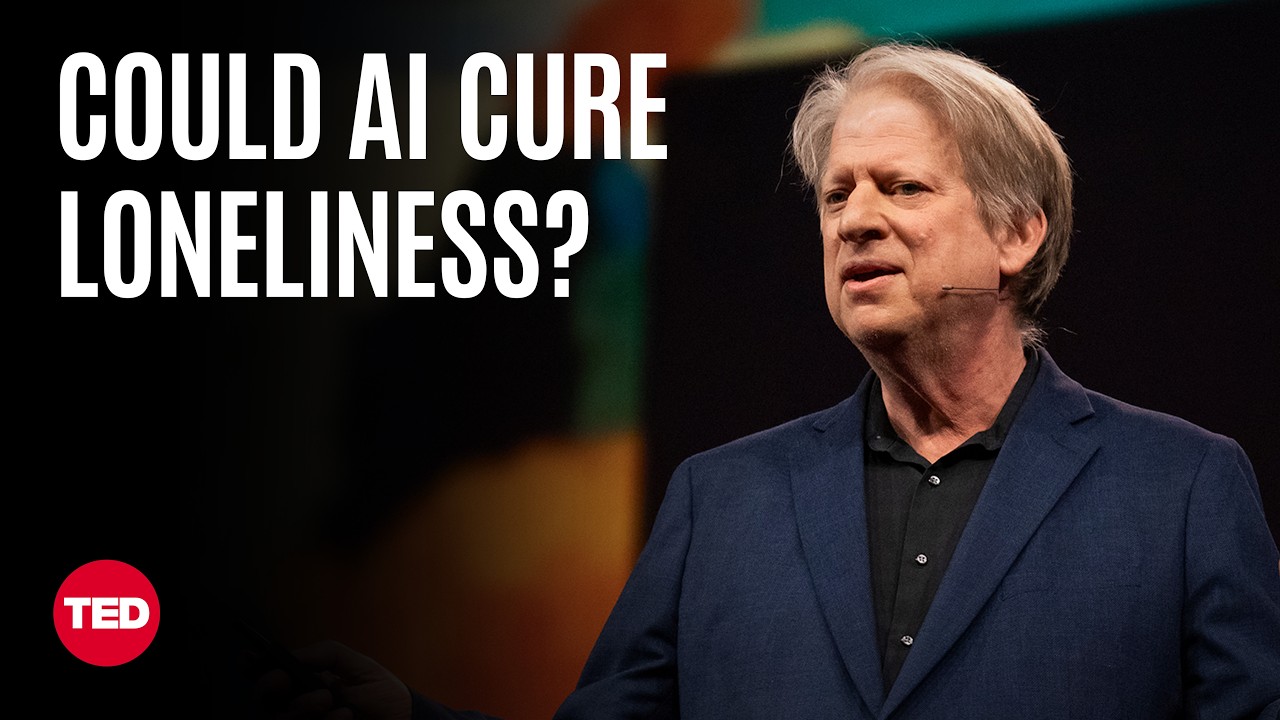
The video's introduction mentions a difference between temporary feelings of loneliness and a deeper, more profound solitude. How would you describe this distinction, and what do you think are the primary causes of each?
Loneliness is often associated with being physically alone, but it's possible to feel lonely even when surrounded by people. What situations or circumstances might lead to this kind of 'loneliness in a crowd'?
The video's title suggests a connection between AI and the end of loneliness. Without knowing the video's content, what are your initial thoughts on how technology, including artificial intelligence, might influence feelings of connection or isolation in the future?
2
You only need to watch the highlighted section below — the exercises focus on this part.
▶ You only need to watch 0:45–3:27. The exercises focus on this part.
Video script236 segments · click a timestamp to jump
I have a couple of questions for you -- but they’re personal.
So I’m not going to ask for a show of hands.
First, right now, at this stage of your life,
are you lonely?
And if not, have you ever been lonely?
My favorite description of loneliness
comes from Zoë Heller's book "Notes on a Scandal."
And in it, the narrator, who is played in the movie by Judi Dench,
distinguishes between passing loneliness and something deeper.
So she observes that people think they know what it's like to be lonely.
You know, they had a bad breakup or a rough time in summer camp.
But then she says this.
"About the drip, drip of long-haul, no-end-in-sight solitude,
they know nothing.
They don't know what it is to construct an entire weekend
around a visit to the launderette,
or to sit in a darkened flat on Halloween night,
because you can't bear to expose your bleak evening
to a crowd of jeering trick-or-treaters."
And she concludes with this:
“I have sat on park benches and trains and school room chairs
feeling the great store of unused, objectless love
sitting in my belly like a stone until I was sure I would cry out and fall,
flailing to the ground."
I like this quote for a few reasons.
It talks about solitude,
and solitude is a big source of loneliness,
but it also talks about love.
You could be with somebody,
but if you're not loved, not needed, not respected,
you might feel lonely.
And then there's understanding.
Suppose you have something in your head that's important to you,
that matters a lot to you, but you feel others don't get it,
or don't care to get it, or aren't trying hard enough to get it.
This too could cause loneliness.
Loneliness ravages the body as well as the soul.
A report by the Surgeon General
associates it with greater risk of cardiovascular disease,
dementia, stroke and the like.
It's the equivalent of smoking 15 cigarettes a day.
Studies in the United States [and] United Kingdom find
that about one in five people
describe themselves as often or always lonely.
And the most at-risk group is young adults.
I'm here to talk about a possible cure for loneliness
and what it might mean.
And I think we could see loneliness as similar to boredom.
I'm old enough to remember when people were bored all the time.
Long train rides, long car rides, long plane rides.
Late at night when the TV stations switched off
and you were all alone, and you had to read.
(Laughter)
But now most of us carry around our phones
and those phones offer podcasts and movies and books
and music and social media and so on.
And so for many of us, boredom is a thing of the past.
Well the cure for loneliness may also be found in our phones and our laptops.
And it is, of course, generative AI.
Last year, some friends and I
wrote an article called "In Praise of Empathic AI."
If that title makes you cringe and makes you kind of angry,
you're not alone.
Our colleagues hated it.
It's the article that I've written that most people hated.
But bear with me.
We started by making a sort of simple point,
which is [to] review a set of studies that have involved --
like, you get a whole lot of people interacting with other people,
sometimes doctors, sometimes therapists, sometimes just regular people.
And you get a whole lot of people interacting with chatbots.
And then you ask them later: “How did it go, what’s your experience?”
And people tend to rate the chatbots as more empathic, more caring,
more understanding.
And it's no surprise.
AIs are built to be attentive, to be present, to be interested.
An AI is never going to impatiently wait for you to finish telling your story,
so it can tell you one of its own.
(Laughter)
An AI is never going to say,
"Dude, I'm busy. Get back to me later. I got things going on."
Suppose some future -- I don't think it's happening now,
but some future AI could serve as a cure for loneliness.
Would this be a good thing?
Well to some extent, yes.
Obviously, yes.
Think about the many millions of elderly people,
many in institutions,
who go for days and nights without talking to anybody,
in perfect agony of isolation.
Many of them have dementia.
Many of them are difficult to interact with for other reasons.
They don't have family and friends to spend time with them.
And there's not enough money in the world
to pay people to come and talk to them for hours on end.
If some future version of Chat or Claude or Gemini
could ease these people's suffering, it would be a godsend.
But for the rest of us, it's more complicated.
And you can view these cures for loneliness
as akin to a powerful painkiller.
Like a powerful painkiller, it can alleviate suffering.
But like a powerful painkiller,
[it] can sometimes come at a terrible cost.
And to make sense of the cost,
you have to think about what loneliness is for.
So the neuroscientist John Cacioppo,
who founded the modern science of loneliness,
argued that it's a biological signal akin to hunger, thirst and pain.
And as such, it does two things for us.
It could sometimes be paralyzing,
but when it works out well,
it has certain evolved functions that improve our lives.
So one, just as hunger motivates us to seek out food,
loneliness and other forms of social suffering
motivate us to seek out and maintain social connection.
Because we get lonely, we accept an invitation to a party,
we invite a friend out to brunch,
we open up the dating apps.
It also helps us regulate relationships.
It helps us try to repair a relationship gone wrong,
to apologize for messing up,
to try to show genuine interest in our relationship with somebody else.
A second thing that loneliness does is it helps us grow as people.
It's a truism in psychology that we learn from failure.
They call it trial-and-error learning,
[or] reinforcement learning.
The idea is nicely summed up in the movie "Batman Begins,"
where young Bruce Wayne’s father asks the future Batman, “Why do we fall?”
And he answers,
"So we can learn to pick ourselves up."
This is literally true for toddlers who learn to walk by falling and stumbling
and doing things wrong.
It's true for a comedian who learns to improve her act by bombing on stage,
by having her jokes fall flat.
It's true for a boxer
who learns to evade a punch by getting repeatedly smacked in the face.
Well failure in a social realm is associated with loneliness.
And can you imagine what it would be like if people never got
[the] signal [of] failure?
Imagine a teenage boy who never learned to cut short his monologues
because his AI companion never got bored.
(Laughter)
Imagine an adult who never learned to apologize
because her AI companion never needed an apology.
Imagine a world where the answer to the question,
"Am I the asshole?"
is always a firm and resounding no.
(Laughter and Applause)
Now you might think this has an easy technological fix.
You could just go into the settings and make it less sycophantic.
And in fact, I don't use AI myself for social purposes,
but I use it a lot for my work.
And after a while I got tired of Chat and Claude just saying,
"Oh, brilliant question, Paul. Oh, oh, such a clever idea.
How do you get to be so intelligent?"
So I went into the settings, and I said, “Stop.
Do not praise me. Be blunt.
Just be honest. Tell it like it is.”
Then a month later, I changed it back.
(Laughter and Applause)
I kind of missed it.
(Laughter)
You can call this Cordelia's Problem.
In Shakespeare's "King Lear,"
the king brings together his three daughters
to try to decide how to divide up the kingdom,
and he has his daughters tell him how much they love him.
And his first two daughters praise him.
They love him infinitely. He's the center of their lives.
Then Cordelia comes up and says,
"I love you like a daughter should love her father,
no more, no less."
The king is enraged and banishes her from the kingdom.
Now "King Lear" is a tragedy.
His two sycophantic daughters didn't love him at all,
and they betray him in the end.
Now some of you are probably thinking, “Well, I’m not like King Lear.
I like pushback.
I don't want that sort of sucking up."
And maybe, maybe.
But I think some of us like the performance of pushback
rather than pushback itself.
So yeah, something that always says, "Yes, you're wonderful"
gets a bit cloying.
But a properly attuned AI won't do that.
It will resist, it will argue against you,
it'll push back.
And then finally, in a very satisfying way, [it’ll] say,
"I guess you win. You've totally persuaded me."
And I worry that this sort of intelligent and titrated sycophancy
is more corrosive to the soul
than a sort of sucking up yes-men AIs we deal with now.
For some of you, the solution will be clear.
Treat these hypersocial AIs like the powerful painkillers they are.
Make them available to the people who need them the most
and forbid their use for the rest of us.
But this is not the solution that I believe in.
I'm not a catastrophist when it comes to AI.
Just like there are people who deal with AI companions in a normal way
and benefit from it,
and it doesn’t harm their life.
In the same way there are people who resist
technological temptations more generally,
people who, when faced with the unholy trinity
of TikTok, Pornhub and Wordle,
nonetheless --
(Laughter)
go to the gym, meet with friends,
touch grass.
The second reason I don't want to ban these things
is more personal.
When I was 11, my mother died of cancer.
I then entered a period of great pain
and then problems with social relationships
and then a period of loneliness that lasted for years.
I would have benefited so much from someone,
or find something, that would listen to me,
that would express interest,
that I could talk to, that I could share my feelings with.
It seems like a betrayal of my past self to say,
"Tough, do without, suffer and learn from your suffering."
I wonder if the best of all possible worlds
is to create imperfect companions,
companions that somehow alleviate the pain of loneliness
without destroying our humanity.
Companions that are difficult enough to deal with
that we learn from interacting with them.
Companions that are sufficiently imperfect
that we ultimately abandon them to deal with people.
Now I'm pretty confident we could build such things.
I'm less confident that there's money to be had by doing so.
I accept that it might be a bad business model
to create AIs that users ultimately outgrow,
but I hope there are people who care enough to do it anyway.
Thank you.
(Applause)
3
Answer these questions in your own words. Support your answers with evidence from the video.
01According to Zoë Heller's quote, how does she describe the feeling of 'long-haul, no-end-in-sight solitude'?
Sample answerShe describes it as a deep, ongoing loneliness, like having to plan your whole weekend around a trip to the launderette, or feeling so isolated on Halloween that you can't face trick-or-treaters. She also mentions a heavy feeling of 'unused love' inside her.
02What are some of the serious health risks associated with loneliness, according to the video?
Sample answerThe video explains that loneliness can seriously harm both the body and mind. It's linked to a higher chance of cardiovascular disease, dementia, and stroke. The speaker even says it's as bad for your health as smoking 15 cigarettes every day.
03The speaker draws a parallel between loneliness and boredom. In what ways does he suggest the 'cure' for loneliness might be similar to how boredom was addressed?
Sample answerHe remembers a time when people were often bored, especially on long journeys or late at night, but phones with apps like podcasts and social media largely solved that. He suggests that just as our phones and laptops cured boredom, generative AI on these devices could offer a similar solution for loneliness.
04How did the speaker's colleagues react to his article 'In Praise of Empathic AI,' and what does this reaction suggest about the general perception of AI as a solution for loneliness?
Sample answerHis colleagues really disliked the article, with the speaker saying it was the most hated piece he'd ever written. This reaction suggests that many people are probably very skeptical or uncomfortable with the idea of AI being 'empathic' or a genuine solution for human emotional issues like loneliness.
4
Vocabulary
Vocabulary
These expressions will help you communicate more naturally about this topic.
Examples
combat loneliness — to actively work to reduce or overcome feelings of being alone and isolated.
This is a formal to semi-formal collocation. You often hear it in discussions about public health, social policy, or personal well-being strategies. For example: "Governments are looking for ways to combat loneliness among the elderly."
foster connections — to encourage the development of relationships or a sense of belonging among people.
This semi-formal phrase is useful when talking about building communities, improving social ties, or creating environments where people can interact. For example: "Social media can sometimes foster connections, but also create distance."
a double-edged sword — something that has both advantages and disadvantages, or that can be beneficial in one way but harmful in another.
This common idiom is perfect for discussing complex topics like AI, where there are both positive and negative aspects. You can say, "AI is a double-edged sword; it offers great potential but also carries risks."
blur the lines (between X and Y) — to make the distinction or difference between two things less clear, often causing confusion or a change in perception.
This idiom is frequently used when new technologies or ideas challenge traditional categories. For instance: "Advanced AI companions might blur the lines between human and artificial relationships."
rely on technology — to depend heavily on technology for support, information, or to perform tasks.
This common phrasal verb is essential for discussing how much we use and need digital tools in our daily lives. It's often followed by "to do something," like "Many people now rely on technology to stay connected with friends and family."
5
AI and human connection
Consider how artificial intelligence might influence our social lives and feelings of loneliness. Complete the sentences by matching the beginning with the correct ending.
Match each item on the left with the correct item on the right.
A
B
6
Complete the sentences with words from the box. One word is extra.
Word bank
01Local community centers often organize events to help residents and build a sense of belonging.
02While some worry about isolation, online communities can actually among individuals with shared interests.
03The increasing use of artificial intelligence in daily life is often seen as , offering both convenience and potential ethical dilemmas.
04As AI companions become more sophisticated, they could potentially between genuine human interaction and simulated companionship.
05In today's fast-paced world, many individuals increasingly for communication, work, and even social engagement.
7
Grammar: Future continuous and future perfect
Grammar
The future continuous tense describes actions that will be in progress at a specific time in the future. The future perfect tense describes actions that will be completed before a specific time in the future. Both are essential for discussing predictions, plans, and developments related to AI and its potential impact on society and human connection.
Examples
By 2035, many people will be relying on AI companions for daily interaction.
This uses the future continuous to show an ongoing action at a future point in time.
Experts predict that by the next decade, AI will have transformed how we understand and address loneliness.
This uses the future perfect to indicate an action that will be completed before a specific future deadline.
While some worry about increased isolation, others believe that by then, AI will have been providing emotional support to millions, and people will be feeling less lonely overall.
Here, both tenses are combined to describe a complex future scenario, highlighting both completion and ongoing states.
Key points
Future continuous: Use 'will be + verb-ing' to describe an action in progress at a future time.
Future perfect: Use 'will have + past participle' to describe an action completed before a future time or event.
Always include a specific time marker (e.g., 'by 2040', 'next year', 'in five years') to clearly establish the future context for these tenses.
8
Rewrite each sentence using the structure indicated.
01Many people will use AI to combat loneliness in the coming years.
Rewrite this sentence, focusing on the ongoing action of using AI at a specific point in the future. (Use the future continuous tense.)
Hint: The action will be in progress.
02AI will help foster connections among people.
Rewrite this sentence to emphasize that this action will be completed by a certain future time. (Use the future perfect tense.)
Hint: Focus on an action that will be finished before a specific future moment.
03Experts are discussing whether AI will be a double-edged sword.
Rewrite, focusing on the ongoing discussion about AI's nature in the future. (Use the future continuous tense.)
Hint: What action will be happening continuously at that future time?
04Technology has started to blur the lines between human and AI interaction.
Rewrite, indicating that this blurring will be completed by a future point. (Use the future perfect tense.)
Hint: The action of 'blurring' will be finished by the specified future time.
05People will increasingly rely on technology for social interaction.
Rewrite, emphasizing the ongoing nature of this reliance in the future. (Use the future continuous tense.)
Hint: The action of 'relying' will be in progress over a period.
06We expect that AI will not completely solve the problem of loneliness.
Rewrite, using the future perfect tense to express what will not have happened by a certain future time.
Hint: Use the negative form of the future perfect (will not have + past participle).
9
AI and human connection: Error correction
Read each sentence about AI's impact on human connection. Find the single error and correct it.
Each sentence contains one error. Find and correct it.
01Many experts believe that AI could play a crucial role in combating to loneliness in the future.
Corrected version
Many experts believe that AI could play a crucial role in combating to loneliness in the future.
02The ability of AI to foster connections are a double-edged sword, as it can also lead to superficial relationships.
Corrected version
The ability of AI to foster connections are is a double-edged sword, as it can also lead to superficial relationships.
03If we too heavily rely in technology for emotional support, we might lose the depth of human relationships.
Corrected version
If we too heavily rely in on technology for emotional support, we might lose the depth of human relationships.
04The development of advanced AI could lead to a significant reduce in the need for human companionship.
Corrected version
The development of advanced AI could lead to a significant reduce reduction in the need for human companionship.
05The ethical implications of AI blurring the lines between genuine empathy and programmed responses is a complex issue.
Corrected version
The ethical implications of AI blurring the lines between genuine empathy and programmed responses is are a complex issue.
06Some argue that AI could offer a solution for loneliness, but others fear it might create even deeper isolation between people.
Corrected version
Some argue that AI could offer a solution for loneliness, but others fear it might create even deeper isolation between among people.
07By the next decade, many individuals will be relied on AI for daily social interactions, changing the nature of human connection.
Corrected version
By the next decade, many individuals will be relied relying on AI for daily social interactions, changing the nature of human connection.
10
Words to take with you
Vocabulary
These expressions are not in the video but will help you discuss this topic more fluently.
Examples
social isolation — a state of complete or near-complete lack of contact between an individual and society.
Use this term to describe a serious condition where someone has very few or no social interactions. It's often discussed in the context of mental health or public policy. Example: "The pandemic highlighted the widespread issue of social isolation, especially among the elderly."
meaningful interaction — a deep and significant exchange or connection between people that goes beyond superficial conversation.
This phrase emphasizes the importance of quality over quantity in relationships. It's often used when discussing what truly helps reduce loneliness. Example: "Many people feel that online interactions, while numerous, often lack meaningful interaction."
sense of belonging — the feeling of being accepted, included, and valued by a group or community.
This is a fundamental human need. You can talk about how technology might help or hinder one's sense of belonging. Example: "Volunteering can help people develop a stronger sense of belonging within their local community."
virtual companionship — the experience of having a non-physical, often AI-driven, entity or program provide a sense of presence or interaction.
Use this term when discussing AI chatbots, digital assistants, or virtual reality characters that offer support or conversation. Example: "Some argue that virtual companionship could offer a solution for those who struggle with human connection."
to crave human interaction — to have a very strong desire or need for social contact and communication with other people.
This verb phrase describes a deep, innate human need. It's often used when someone has been isolated for a long time. Example: "After weeks of working from home, she started to crave human interaction and decided to join a co-working space."
11
Odd one out: AI, connection, and isolation
Consider the broader topic of AI, human connection, and the challenges of loneliness. Which word or phrase in each group doesn't fit with the others?
Which word or phrase does not belong in each group? Think about the common connection.
01with the nounActions to overcome isolation
02with the nounConcepts with dual nature
03with the nounSituations where boundaries are unclear
04with the nounForms of technological dependence
05with the nounFeelings of isolation
06with the nounBuilding relationships
12
Useful phrases: Discussing the impact of technology on social connections and well-being
Vocabulary
These phrases will help you express your opinions and concerns about how technology influences our relationships and overall well-being. They are useful in conversations with friends, colleagues, or in more formal discussions about current social trends.
Examples
It's fascinating how much we've come to rely on technology for social interaction these days. — This phrase introduces the topic by making an observation about our dependence on technology.
Register: Neutral. Use when starting a conversation or making a general statement about the role of technology in modern life.
I think technology can really help foster connections, especially for people who might otherwise feel isolated. — This highlights a positive aspect of technology's role in building relationships.
Register: Neutral. Use when discussing the beneficial ways technology can encourage social bonds and reduce feelings of loneliness.
But it's a bit of a double-edged sword, isn't it? While it connects us, it can also create new forms of isolation. — This phrase introduces a nuanced perspective, acknowledging both the good and bad aspects.
Register: Neutral to slightly informal. Use when presenting a balanced view or a counter-argument, highlighting that something has both advantages and disadvantages.
My main concern is that it might blur the lines between genuine human connection and simulated interaction. — This expresses a specific worry about the distinction between real and artificial relationships.
Register: Neutral. Use when expressing a concern that the differences between two things are becoming less clear, often leading to confusion or a change in perception.
We need to ensure we're using technology to combat loneliness effectively, rather than just distracting ourselves from it. — This emphasizes the goal of using technology purposefully to address social isolation.
Register: Neutral. Use when discussing strategies or the correct approach to actively working against feelings of being alone and isolated.
Ultimately, finding a healthy balance between online and offline interactions seems to be the key. — This offers a concluding thought or a summary of a balanced perspective on the issue.
Register: Neutral. Use when summarizing a discussion or offering a balanced, overarching solution or viewpoint.
13
AI, connection, and the challenge of loneliness
The rise of artificial intelligence brings both opportunities and challenges for human connection. This passage explores how technology might influence our social lives.
Fill in each blank with the correct word from the word bank.
Word bank
In an increasingly interconnected world, technology offers new ways to loneliness. Virtual communities and AI companions can provide a sense of belonging, helping individuals to connections they might otherwise lack. However, this growing tendency to on technology for social interaction is often seen as double-edged sword. While it can offer immediate comfort, there's a risk that over-reliance might actually diminish the quality of real-world relationships. Furthermore, as AI becomes more sophisticated, it could begin to the lines between genuine human empathy and artificial responses, raising complex questions about the nature of true companionship.
14
The future of connection: AI and human relationships
The video you watched explored the concept of loneliness and how AI might impact it. This reading delves deeper into the potential societal shifts.
Read the passage below, then answer the comprehension questions.
The rise of artificial intelligence offers a fascinating, albeit complex, solution to the pervasive issue of loneliness. Many foresee a future where AI companions will actively combat loneliness, providing tailored interaction and emotional support. However, this promising development is undoubtedly a double-edged sword. While these digital entities might offer comfort, they could also blur the lines between genuine human connection and simulated intimacy. By 2035, experts predict that a significant portion of the population will be relying on technology for much of their social interaction, potentially altering the very fabric of community. Will we truly foster connections, or will we merely be engaging with sophisticated algorithms? The long-term impact remains uncertain. We will have seen a complete redefinition of social bonds, and people will be navigating a world where digital relationships hold significant weight.
01What is one potential benefit of AI companions mentioned in the passage?
Sample answerAI companions could actively combat loneliness by offering tailored interaction and emotional support.
02Why is the development of AI companions described as "a double-edged sword"?
Sample answerIt is considered beneficial for providing comfort, but potentially harmful because it might replace genuine human connections with simulated ones.
03According to the passage, what long-term change will have occurred by 2035 regarding social interaction?
Sample answerBy 2035, a significant portion of the population will be relying on technology for much of their social interaction, and social bonds will have been redefined.
04What does the phrase "blur the lines" suggest about the distinction between human and AI relationships?
Sample answerIt suggests that the difference between real human connections and simulated AI intimacy will become less clear, making it harder to distinguish between them.
15
AI, connection, and the challenge of loneliness
The rise of artificial intelligence presents both opportunities and challenges for human connection. This passage explores some of these ideas.
Fill in each blank with the correct word from the word bank.
Word bank
Many believe that artificial intelligence could play a significant role in helping to loneliness, offering companionship through advanced chatbots and virtual assistants. These technologies might even help individuals connections by suggesting shared interests or facilitating online communities. However, this increasing on AI is often seen as sword. While it can provide support, there's a risk that excessive use could the lines between genuine human interaction and simulated relationships, potentially real-world social skills. Therefore, striking a is crucial to ensure technology truly enhances, rather than replaces, human connection.
16
Discuss these questions with a partner. Try to use vocabulary from the lesson.
Can technology truly combat loneliness or is it a double-edged sword?
How do people in your culture foster connections and combat loneliness?
Does relying on technology blur the lines of genuine human connection?
This lesson is for Lessonpills members
Sign in at learn.lessonpills.com to print lessons or save them as PDF.