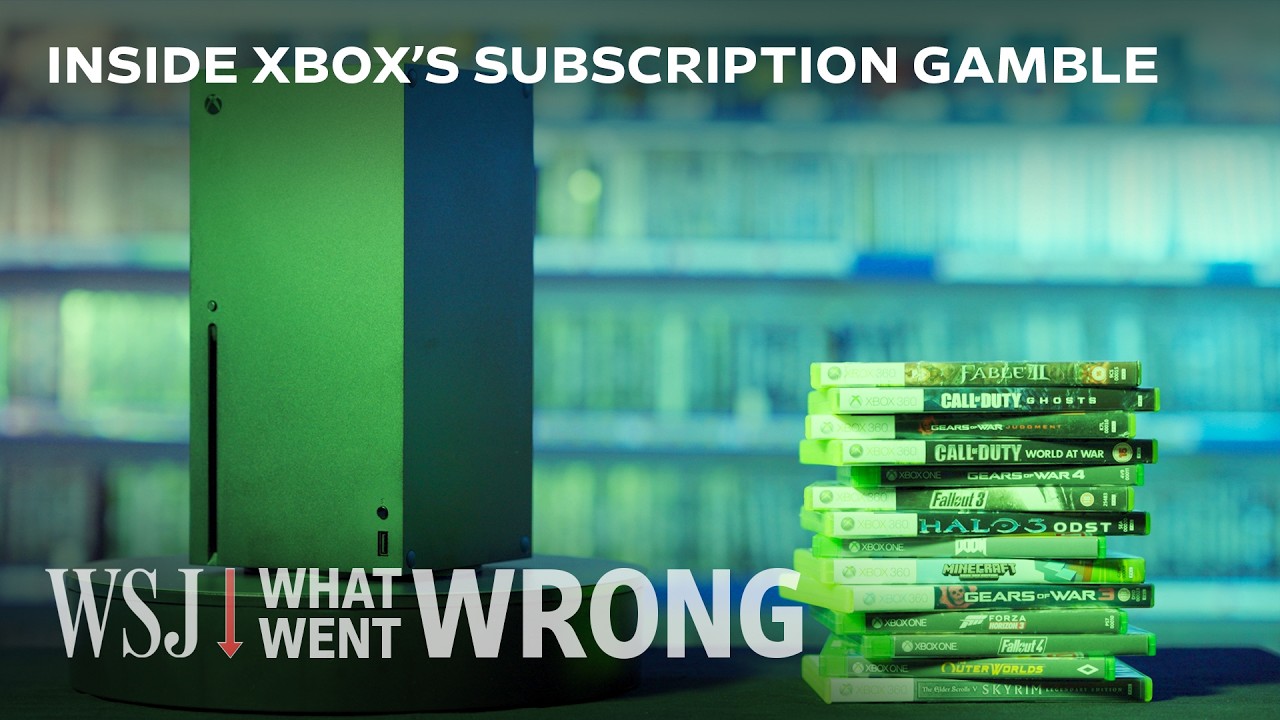
Many people subscribe to services like Netflix, Spotify, or even news apps. What are your thoughts on paying a monthly fee for access to a large library of digital content instead of buying individual items? What are the main advantages and disadvantages from a consumer's perspective?
The video game industry is huge, with new games often costing a significant amount of money. How do you think this affects people's decisions about which games to buy or play? Do you think it encourages people to try new games, or makes them more cautious?
Imagine you're a company trying to compete in a very crowded market, like entertainment or technology. What kind of innovative strategies or business models do you think are most effective to stand out and attract customers? Consider both traditional sales and new approaches.
2
Watch the video carefully. Pay attention to the main ideas and key details.
Video script158 segments · click a timestamp to jump
- For years, Microsoft's Xbox struggled to keep pace
with Sony's PlayStation and Nintendo.
So it bet its future on a different model,
a subscription service called Game Pass.
- We're looking at the massive success of Netflix
in television and they though subscription was the future
and they could do it for video games.
- Microsoft spent more than $80 billion
to acquire game studios
and bring major franchises like "Call of Duty"
and "Fallout" onto Game Pass.
It was one of the biggest bets in gaming history,
but now Microsoft is cutting more
than 3,000 jobs across Xbox,
about a fifth of the division,
and selling or spinning off five game studios.
So what went wrong?
- Microsoft got into the video game business
in the early 2000's with the Xbox console.
They were competing with the already established players,
Sony and Nintendo.
- The Xbox is everything the Rock is,
cutting edge, powerful, exhilarating.
- Consoles typically lost money
and Xbox often lagged its competitors in sales.
So in 2017, Microsoft launched Game Pass.
For $9.99 a month, subscribers could play a library
of games on their console.
With Game Pass, Xbox though it could generate recurring
revenue without having to win the console wars.
- They were ahead of the curve.
There wasn't any other company
that was offering anything comparable.
- The following year, Xbox announced
that its first party games would be available on Game Pass
the same day they were released.
- All the idea at Xbox games you just saw will premiere
on Xbox Game Pass day one.
- Instead of paying up to $70 for a new game,
fans could play it on launch day
with their $10 Game Pass subscription.
- The only concern I ever see is people saying,
"Is it sustainable?"
- Right. - Like can you continue this?
And I'll say, Game Pass right now is doing very well for us.
- They were entirely focused on gaining subscribers
and they thought just like Netflix had done in video
and Spotify had done in audio,
that when they eventually gained enough subscribers,
they'd be able to raise the prices on them,
they'd be the dominant player in the industry,
and then they'd become really profitable.
- How is Xbox not just going
to lose money handover fists on this?
- Yeah, a lot of people say that.
We always kind of laugh.
We just listen, please don't worry about us, like Microsoft.
- And at that time, Xbox was showing promising signs.
With the pandemic supercharging the video game industry,
Game Pass surpassed 15 million subscribers.
Xbox's revenue from content
and services increased 11% from the year before.
- They thought this was the moment
that they could get everybody hooked onto Game Pass.
- Microsoft went on an acquisition spree
to add more games to its portfolio,
buying ZeniMax Media for more than $8 billion,
and Activision Blizzard for 75 billion.
Now Xbox owned franchises like "Fallout," "Doom,"
"Candy Crush," "World of Warcraft," and "Call of Duty."
- People were surprised that Microsoft was spending
so much on games.
It's a pretty small part of Microsoft's overall business.
- But Microsoft wanted to be a major player in gaming
and it was willing to spend to get there.
By 2022, Game Pass was available on a range of devices
and cost up to $14.99 a month.
- I think it will stay in that 10 to 15%
of our overall revenue and it's profitable for us.
- Yet that same year,
Game Pass missed its subscriber growth target
by a wide margin.
After the Activision deal closed, Microsoft wanted
to make a big splash with the next "Call of Duty" release.
The company chose to release it on Game Pass on day one.
- This was a huge deal
because "Call of Duty" sequels
sell tens of millions of copies typically
for as much as $70 per unit.
So to put it on Game Pass
and forgo all that revenue just to gain subscribers
was a pretty risky move.
- "Black Ops 6" set a record
for Game Pass signups on launch day,
but industry analysts questioned the business model.
- The economics of spending several hundred million dollars
to make like a "Call of Duty" sequel
and then put it on a subscription service
that costs somewhere between 20 and 30 bucks a month
were just not panning out for them at all.
- According to regulatory filings, Microsoft acknowledged
that adding titles to Game Pass
would cannibalize retail sales,
but the company still released new games on day one.
- So then in 2025, with the next Call of Duty game,
they decided they would have to raise the price
of Game Pass in order to make these economics work.
- Xbox raised the price
of Game Pass' ultimate tier from $19.99 to $29.99,
a 50% increase.
- We shed millions of subscribers
over the span of a few months.
We corrected that offering, pulling a title out,
bringing the price down.
At the same time, the rising cost
of memory chips is squeezing Xbox's hardware margins.
For three straight quarters,
Microsoft's gaming revenue has declined year over year.
And while Xbox had projected
that Game Pass would reach 77 million subscribers this year,
it currently has less than half of that.
In February, Xbox appointed a new CEO, Asha Sharma,
who had worked as an executive at Instacart
and in Microsoft's core AI division,
but had no background in video games.
- When you bring in somebody like that,
what you're saying is we need somebody
from the outside who's going to think
about it in a whole different way.
- To some industry analysts,
Xbox restructuring was a long time coming.
- Its profit margin is only about 3%,
which is pretty awful for a big company like Microsoft.
They could be making more of a profit margin
by just investing that money into like a bank account.
- Other gaming companies are also dealing
with a post-pandemic slowdown.
- But the other issue Microsoft has from having made this
huge bet on Game Pass is unique.
No other game company kind
of staked its future
on a subscription service the way that Microsoft did.
- Now, Microsoft is changing course.
In recent months, Xbox cut the price of Game Pass Ultimate
to $22.99 and it won't be releasing
the next "Call of Duty" game on Game Pass on day one.
The company says
that after more than eight months of decline,
Game Pass is starting to grow again.
- They've set this very ambitious goal
of having a billion daily players.
Right now they have something
like 500 million monthly players,
so they haven't had a long way to go to get there.
But I think Microsoft wants to get to that level
by investing in its big franchises
and by also becoming a better partner
for independent game developers.
3
Vocabulary
Vocabulary
These expressions will help you communicate more naturally about this topic.
Examples
ahead of the curve — to be among the first to develop or use a new idea or method, giving you an advantage.
This idiomatic phrase is often used in business and technology contexts to praise innovation. You can say a company is ahead of the curve or stays ahead of the curve.
gain market share — to increase the percentage of total sales or customers that a company has in a particular industry or market.
This is a common business collocation. Companies strive to gain market share from their competitors to become a dominant player.
long-term viability — the ability of a business, plan, or system to continue to be successful and exist for a long period.
This semi-formal phrase is often used when discussing the future prospects or sustainability of a project or company. For example, "Is the business model's long-term viability assured?"
disruptive innovation — a new product, service, or business model that significantly changes an existing market or creates a completely new one, often by offering a simpler, more accessible, or more affordable alternative.
This term is frequently used in technology and business to describe groundbreaking changes. A disruptive innovation can shake up an industry.
customer retention — the ability of a company to keep its existing customers over a period of time, rather than losing them to competitors.
This is a crucial metric for subscription-based businesses like Game Pass. High customer retention is key to recurring revenue and profitability.
4
Complete the sentences with words from the box. One word is extra.
Word bank
01Many analysts agreed that Xbox Game Pass was truly when it first launched, as no other company was offering a comparable service at the time.
02To truly in the console war, Xbox needed to attract players who traditionally preferred rival platforms.
03Despite its initial success, some critics questioned the of Game Pass, wondering if it could remain profitable at its current price point.
04The introduction of streaming services was a that fundamentally altered the traditional media landscape, much like Game Pass aimed to do for gaming.
05For any subscription service, strong is crucial; it's often more cost-effective to keep existing users than to constantly acquire new ones.
5
Match each word on the left with its natural partner on the right.
A
B
6
Useful phrases: Discussing business strategies and market trends
Vocabulary
When talking about how companies compete, innovate, and try to keep customers, it's useful to have phrases that help you express your opinions and analyze their approaches. These phrases will help you discuss topics like those in the video, such as subscription models and market disruption, in a professional or casual setting.
Examples
It seems to me that [Company X] was really ahead of the curve with their [strategy/product]. — Introducing an opinion and acknowledging innovation.
Register: Neutral. Use when you want to share your perspective on a company's innovative move or a strategy that was introduced early.
I'd argue that their primary goal was to gain market share, even if it meant short-term losses. — Expressing a strong opinion or analyzing a company's strategic intent.
Register: Neutral to slightly formal. Useful in discussions where you're analyzing a company's strategic priorities and their potential trade-offs.
My main concern is the long-term viability of that business model, especially with increasing competition. — Expressing reservations or skepticism about a plan's sustainability.
Register: Neutral. Use when you want to question the future success or sustainability of a business plan, echoing the 'Is it sustainable?' question from the video.
You could say it was a disruptive innovation, but the challenge is always customer retention. — Acknowledging innovation while highlighting a common business challenge.
Register: Neutral. Good for discussing both the positive and challenging aspects of a new market approach, linking disruptive ideas with the need to keep customers.
Perhaps they underestimated the costs involved, or maybe they just needed to pivot faster. — Offering a possible explanation for a problem or suggesting a different approach.
Register: Neutral. Use when you're analyzing past business decisions and considering what might have gone wrong or what could have been done differently.
Ultimately, it comes down to balancing aggressive growth with sustainable profitability. — Concluding a discussion or summarizing a key challenge in business strategy.
Register: Neutral. Useful for wrapping up an analysis of a business strategy, emphasizing the core dilemma many companies face.
7
Game over? The Xbox Game Pass strategy
The video discusses Microsoft's ambitious venture with Xbox Game Pass, a subscription service designed to disrupt the traditional video game market. This exercise explores the business strategy and challenges faced by such innovative models.
Fill in each blank with the correct word from the word bank.
Word bank
Microsoft's Xbox Game Pass was initially seen as a innovation, aiming to revolutionize how consumers access video games. By offering a vast library for a monthly fee, Xbox was certainly of the curve, hoping to market share from traditional game sales and competitors. Despite early success and significant investment, questions arose about its long-term . Many wondered if the subscription model could truly be profitable, especially when major new titles were released on day one, potentially retail sales. Balancing rapid subscriber growth with customer and sustainable revenue remains a key discussion point in the evolving video game industry.
8
Grammar: Discussing past events and decisions with modal perfects
Grammar
Modal perfects combine a modal verb (e.g., should, must, could, might) with have and the past participle of a main verb. We use them to talk about past events, expressing deductions, regrets, missed opportunities, or hypothetical situations related to the video game industry and business strategies.
Examples
Xbox must have felt very optimistic when Game Pass surpassed 15 million subscribers during the pandemic.
We use must have done to make a strong, logical deduction about a past event or feeling, based on available evidence.
Many critics believe Microsoft should have considered the long-term sustainability of the Game Pass model more carefully.
Should have done expresses regret or criticism about a past action that didn't happen, suggesting a better alternative.
They could have invested more aggressively in acquiring exclusive game studios to strengthen their library.
Could have done refers to a past possibility or ability that was not realized, or an alternative action that was available but not taken.
Microsoft might have underestimated the challenge of raising prices once subscribers were accustomed to the initial low cost.
Might have done (or may have done) expresses a weaker deduction or speculation about something that possibly happened in the past.
Without Game Pass, Xbox would have struggled even more to gain market share against its established competitors.
Would have done describes a hypothetical past outcome if a certain action (launching Game Pass) hadn't occurred. It often implies a conditional situation.
Key points
Use should have done to express regret or to say something was a good idea but wasn't done.
Use must have done for strong deductions about something that almost certainly happened in the past.
Use could have done for past possibilities or abilities that were not taken advantage of.
Avoid using simple past or present perfect when expressing these specific meanings; modal perfects convey nuance about past actions and their implications.
9
Rewrite each sentence using a modal perfect (e.g., should have, could have, might have) to express a past opinion, possibility, or unfulfilled action related to the video game industry.
01Microsoft's initial strategy focused heavily on console sales, which was a risky approach against established competitors.
Express a critical opinion about their strategy using 'should have'.
Hint: Think about what a better past action would have been for Microsoft.
02Xbox launched Game Pass in 2017, becoming a pioneer in subscription gaming.
Speculate about a different outcome if they had waited longer, using 'might have'.
Hint: What was a possible negative consequence of delaying the launch?
03Xbox hoped to gain enough subscribers to eventually raise prices, similar to Netflix's strategy.
Suggest an alternative past action or a missed opportunity regarding their pricing strategy, using 'could have'.
Hint: What was another possible action they had the ability to do regarding pricing?
04Many industry analysts questioned the long-term viability of Game Pass, wondering if its financial model was sustainable.
Express a past possibility that didn't happen, regarding their communication about sustainability, using 'could have'.
Hint: What was a possible action they *could* have taken to alleviate concerns?
05Game Pass was a disruptive innovation that significantly changed how consumers accessed games, but it faced strong competition.
Express a past possibility or a different outcome for competitors, using 'might have'.
Hint: What was a possible reaction from competitors that didn't happen?
06To ensure consistent revenue, the company needed to focus on keeping existing subscribers.
Express a past necessity or a better course of action regarding customer retention, using 'should have'.
Hint: What was the most important action they *ought* to have taken?
10
Game over? The rise and fall of Xbox Game Pass
Read each sentence related to the video and the broader topic. Each sentence contains one error in grammar, vocabulary, or usage. Identify the error and provide the correct sentence.
Each sentence contains one error. Find and correct it.
01Microsoft should thought more carefully about the long-term viability of Game Pass before investing so much.
Corrected version
Microsoft should thought **have thought** more carefully about the long-term viability of Game Pass before investing so much.
02Many consumers now prefer accessing to a library of games rather than owning individual titles.
Corrected version
Many consumers now prefer accessing to a library of games rather than owning individual titles.
03Xbox was ahead from the curve by offering a subscription service, but competitors soon followed suit.
Corrected version
Xbox was ahead from **of** the curve by offering a subscription service, but competitors soon followed suit.
04Industry analysts questioned if the economics of Game Pass was truly sustainable in the long run.
Corrected version
Industry analysts questioned if the economics of Game Pass was **were** truly sustainable in the long run.
05Releasing "Call of Duty" on Game Pass day one must had a significant impact on retail sales.
Corrected version
Releasing "Call of Duty" on Game Pass day one must had **have had** a significant impact on retail sales.
06Microsoft aimed to achieve a disrupt innovation in the gaming market with its Game Pass strategy.
Corrected version
Microsoft aimed to achieve a disrupt **disruptive** innovation in the gaming market with its Game Pass strategy.
07Despite initial success, Game Pass lost its subscriber growth target by a wide margin.
Corrected version
Despite initial success, Game Pass lost **missed** its subscriber growth target by a wide margin.
08If Microsoft would have focused more on exclusive content, they might have retained more subscribers.
Corrected version
If Microsoft would have **had** focused more on exclusive content, they might have retained more subscribers.
11
Words to take with you
Vocabulary
These expressions are not in the video but will help you discuss this topic more fluently.
Examples
Value proposition — the unique benefits or value that a product or service offers to its customers.
Use this when discussing what makes a product or service attractive to consumers. For example: "The initial value proposition of Game Pass was its vast library of games for a low monthly fee."
Competitive landscape — the overall market environment, including all the competitors, their strengths, weaknesses, and strategies.
This phrase is useful when describing the state of competition in an industry. For example: "Understanding the competitive landscape is crucial before launching a new product."
Monetization strategy — the method or plan a company uses to generate revenue from its products or services.
Use this when talking about how businesses earn money. For example: "Xbox's monetization strategy shifted from console sales to recurring subscription revenue."
To cater to (consumer needs/preferences) — to provide what is wanted or needed by a particular group of people.
This verb phrase is used when a business aims to satisfy specific customer demands. For example: "Successful companies constantly adapt their offerings to cater to evolving consumer preferences."
A game-changer — something that completely changes the way a situation or activity is done, often making it much better.
This idiom is used to express an opinion about the significant impact of a new product, idea, or strategy. For example: "Many initially saw Game Pass as a game-changer for the video game industry."
12
Use the word in brackets to form a new word that fits each gap.
01
Game Pass was initially seen as a truly innovation, changing how consumers accessed games.
02
Many analysts questioned the long-term of Game Pass's business model, wondering if it could last.
03
Xbox focused heavily on subscriber growth and customer , hoping to keep players engaged with the service.
04
In the early 2000s, Microsoft faced fierce from established players like Sony and Nintendo in the console market.
05
Despite gaining millions of subscribers, concerns about the ultimate of Game Pass persisted among some investors.
06
Xbox hoped to become the player in the video game subscription industry, much like Netflix in streaming.
13
Discuss these questions with a partner. Try to use vocabulary from the lesson.
Do you think Game Pass has long-term viability as a business model?
What strategies do subscription services in your country use for customer retention?
Can a company be too 'ahead of the curve' with a disruptive innovation?
This lesson is for Lessonpills members
Sign in at learn.lessonpills.com to print lessons or save them as PDF.