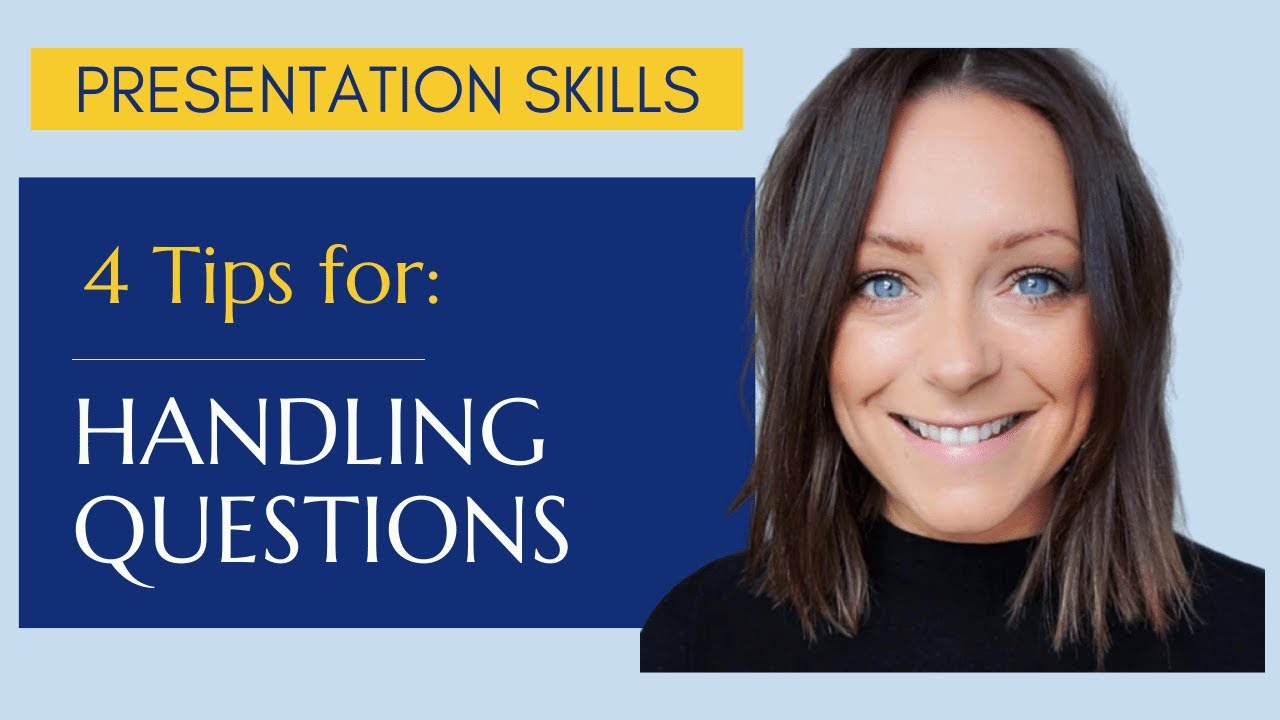
Public speaking: handling difficult questions
1
Think about these questions before watching. Share your ideas with a partner.
- Describe a time you were asked a question during a presentation or meeting that you weren't prepared for. How did you handle it, and what was the outcome?
- Besides not knowing the answer, what else can make a question difficult to handle? Think about the timing, the tone, or the person asking.
- In your opinion, what's the best strategy for managing the Q&A portion of a presentation? Should you take questions throughout, or save them all for the end? Explain your reasoning.
2
Watch the video carefully. Pay attention to the main ideas and key details.
3
Answer these questions in your own words. Support your answers with evidence from the video.
01According to the video, what are the two main advantages of asking someone to email you an unexpected question?
Sample answerFirst, it shows that you've acknowledged their question and are taking it seriously. Second, it puts the responsibility on them to follow up. The speaker suggests that if they don't email, the question probably wasn't that important to begin with.
02Why might a presenter choose a humorous response over a serious one when an audience member asks about a topic that will be covered later?
Sample answerThe speaker says it really depends on the audience. A humorous response, like pretending they've seen your slides already, would work well with a more relaxed group to build rapport. For a more formal or serious audience, a straightforward answer would be more appropriate.
03How does the speaker recommend managing a person who continually asks questions that are not very relevant?
Sample answerShe suggests complimenting them by saying it's a great and unique question, but then asking them to send an email for the answer. The goal is that after doing this a few times, the person will learn to send their questions by email or wait until after the presentation.
04In what type of setting is it most appropriate to ask the audience to help answer a question, and what is the main benefit of this approach?
Sample answerThis technique is best for a large group where people are already familiar with the topic. The main benefit is that it encourages participation from everyone and turns a moment where the presenter doesn't know the answer into a collaborative learning experience for the whole room.
4
Vocabulary
Vocabulary
These expressions will help you communicate more naturally about this topic.
Examples
To think on your feet — to be able to think and react quickly, especially in a difficult or unexpected situation.
Usage note: This is a common idiom used in professional and informal contexts. It's often used to describe a key skill for public speaking.
To field questions — to receive and deal with a series of questions, especially from an audience or journalists.
Usage note: This is a professional-sounding phrase. For example, 'After the presentation, the CEO will field questions from the press.'
To go off on a tangent — to suddenly start talking about a subject that is not directly connected with the main topic.
Usage note: This can describe either a speaker or an audience member. You might say, 'Let's not go off on a tangent; we need to stick to the agenda.'
To buy some time — to do or say something in order to delay having to make a decision or give a direct answer.
Usage note: A useful strategy in a Q&A. Phrases like 'That's an excellent question' can help you buy some time to think of a good answer.
To put someone on the spot — to force someone to answer a difficult question or make a decision when they are not prepared.
Usage note: This phrase describes the pressure of being asked an unexpected question. For example, 'I felt like he was trying to put me on the spot with that question about our budget.'
5
Decide if each statement is true or false. Correct the false ones.
01The strategies discussed in the video are only suitable for in-person presentations.
02One reason to ask an audience member to email their question is that they often won't, which suggests the question wasn't that important.
03When an audience member asks about a topic that will be covered later, the speaker recommends always using a humorous response.
04If you don't know the answer to a question, one effective strategy is to ask the audience for their input.
05The speaker believes that people who ask questions are always genuinely seeking information.
6
Discuss these questions with a partner. Try to use vocabulary from the lesson.
- The video suggests asking the person to email you later. Do you think this is an effective way to handle a tough question, or could it make the presenter seem evasive? Discuss the pros and cons of this technique.
- Think about the professional or academic culture in your country. How is it generally viewed when an audience member asks a question that seems designed to 'stump the presenter'? Is it considered a sign of intelligence or disrespect?
- Imagine you have to field questions from a very critical audience. Besides not knowing an answer, what other situations might force you to think on your feet? How could you buy some time without seeming unprepared?