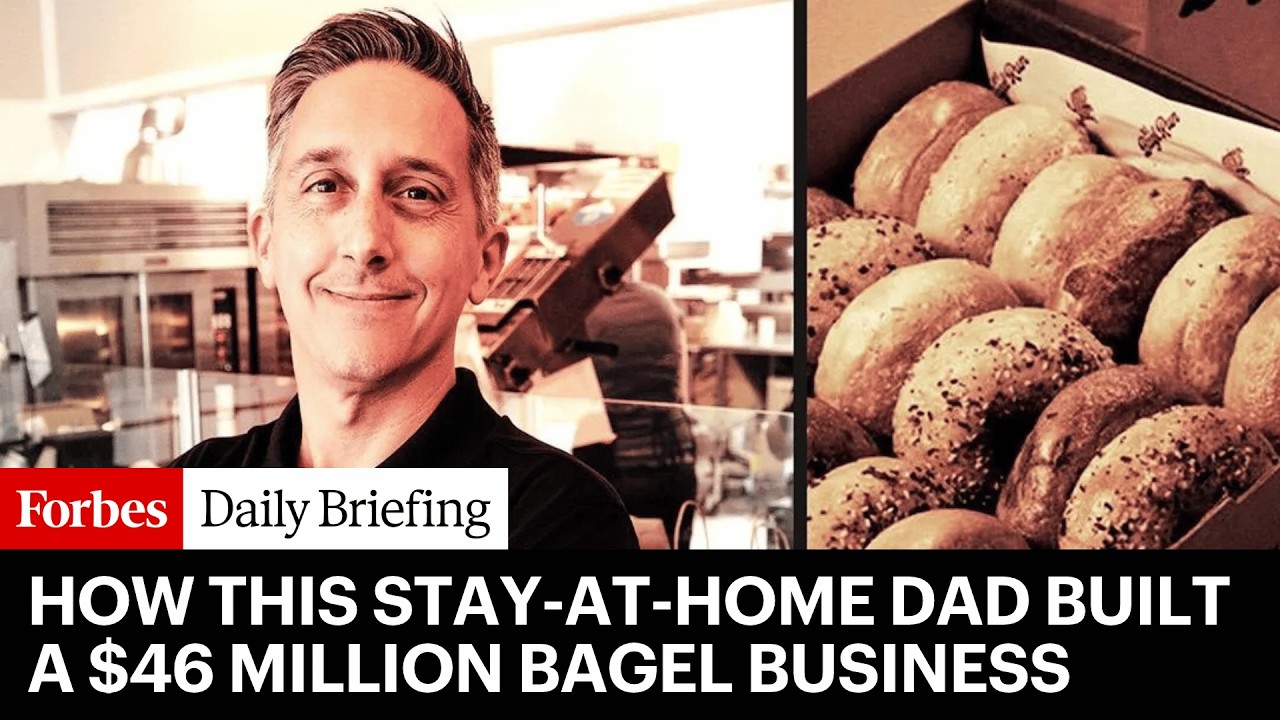
How a stay-at-home dad’s bagel baking hobby turned into a $46 million business
B2
60 min
Premium
1

Think about these questions before watching.

  1. Many people have hobbies or passions they enjoy. Have you ever considered turning a personal hobby into a way to earn money or even a full-time career? What challenges or rewards do you imagine come with that?
  2. In today's world, how common do you think it is for people to make significant career changes, perhaps even leaving a stable job to pursue something completely different? What factors might motivate such a decision, and what risks are involved?
  3. Starting a business often requires a lot of time, effort, and sometimes financial risk. How do you think pursuing an entrepreneurial dream might impact family life and responsibilities, especially if one parent takes on a new role, like becoming a stay-at-home parent?
2

Watch the video carefully. Pay attention to the main ideas and key details.

Video script154 segments · click a timestamp to jump

Today on Forbes, how a stay-at-home

dad's bagel baking hobby turned into a

$46 million dollar business.

[music]

In August 2019, Jeff Pereira lost his

job as a regional vice president for

Atria Senior Living in Central Florida.

As layoffs go, this one was remarkably

well timed.

See, just before that, his wife

Danielle, who was home caring for their

four-year-old daughter and one-year-old

son, was offered a job by her old

employer, Ross Stores, overseeing 16

Florida stores.

She took the position and he became a

stay-at-home dad.

New homebody Jeff started looking for

hobbies.

Danielle suggested a selfish one.

Learn to make me bagels.

Not just any bagels, but the fresh chewy

bagels she had loved growing up in Long

Island, New York and couldn't find in

the Orlando suburb of Windermere where

they live.

The kind where the dough is boiled

before being baked.

Jeff began experimenting.

He says, quote,

YouTube and recipe books helped a ton

and lots and lots of trial and error and

a lot of them were bad. The early ones

were bad.

But soon Jeff's bagel experiments,

including salt bagels, onion, and

everything flavors,

were good enough that neighbors wanted

them and started offering to pay.

Today that hobby has grown into Jeff's

bagel run. A company the Pereiras say is

on track to do $46 million in 2026 store

sales at the seven company-owned stores

in Florida and 37 franchisee locations

in 13 mostly Southern states.

Already signed franchisee contracts

could bring that to 220 locations in 16

states

with 100 of those shops projected to

open by the end of 2027.

Jeff, who is 49 years old, and Danielle,

who is 44,

have gotten this through hard work and

risk taking.

They sold their house to go all in on

the business.

They've also made it this far thanks to

social media marketing,

favorable migration patterns, millions

of bagel loving Northeasterners have

moved south,

a Kickstarter campaign, [music] and

lucky breaks.

One key bit of luck,

in January 2023 a regular customer

introduced the couple to his boss,

Justin Wetherill,

a member of Forbes' 2017 30 under 30

list who used franchising to build

Ubreakifix, a national chain of phone

repair shops.

After selling his operation to Asurion,

a device insurance company for an

undisclosed amount in 2019

he became a private investor.

The now 39 year old Wetherill not only

bought a majority stake in Jeff's Bagel

Run, he also joined it as president and

set it on its franchisor path.

Jeff and Danielle, besides being the

co-founders, are now both vice

presidents.

Wetherill tells Forbes via email that as

quote a founder at heart

he had been looking to invest in a

business that he believed in and could

be a part of building.

He adds quote

I never imagined that would lead me to

bagels.

But his interest was piqued after a

co-worker brought him some Jeff's Bagel

Run bagels.

He says quote

I was blown away by the quality.

I knew I had to meet Jeff and Danielle.

After meeting them he spent time in the

shop and made bagels with them.

Having scaled a franchise business

before, he says, he saw an opportunity

to build a national brand around quote

bagels made from scratch in every shop

every day.

How much has he invested in the

operation?

Wetherill says quote I've made a

significant eight figure capital

commitment to Jeff's Bagel Run to date

and I fully expect to continue investing

as we grow.

My commitment is both financial and

personal.

Jeff describes the working relationship

that he, Danielle, and Wetherall have

this way, quote, we call ourselves a

little three-legged stool.

I'm great for brand, for marketing, for

innovation. Danielle's an operator.

Justin's a little bit more of a

strategic visionary kind of guy. And the

three of us, we run it daily now.

Back in November 2019 when he was

starting out,

he built a crude website for Jeff's

Bagel Run with the help of Shopify.

It featured a short menu with the eight

flavors Jeff had perfected within just a

few months.

A major milestone came when they got

their first catering gig from a local

pastor, 160 bagels.

As they grew, they needed more

refrigerator capacity. At one point,

they had five refrigerators at their

home.

The timing of the COVID pandemic and

lockdowns helped since everyone was

ordering food online.

They even received media attention from

the Orlando Sentinel's food writer.

The pair began selling bagels at outdoor

farmers markets and customers lined up

even one day in the rain.

In their first full year in business,

they sold $90,000 worth of bagels.

The first Jeff's Bagel Run shop had a

soft opening in June 2021

and then a grand opening, complete with

a ribbon cutting a few weeks later in

July.

For full coverage, check out John

Shroyer's piece on forbes.com.

This is Kieran Meadows from Forbes.

Thanks for tuning in.

3

Decide if each statement is true or false. Correct the false ones.

01Jeff Pereira's wife, Danielle, encouraged him to start baking bagels because she missed the specific fresh and chewy kind she enjoyed growing up in Long Island, New York.
02Jeff's Bagel Run is projected to achieve $46 million in sales by the end of 2027, primarily from its Florida locations.
03Justin Wetherill, an experienced entrepreneur who previously built a national chain of phone repair shops, invested a significant eight-figure sum and joined Jeff's Bagel Run as president.
04Jeff, Danielle, and Justin Wetherill describe their leadership as a 'three-legged stool,' with Jeff focusing on operations, Danielle on marketing, and Justin on strategic vision.
05The COVID-19 pandemic and subsequent lockdowns inadvertently boosted Jeff's Bagel Run's growth because more people were ordering food online during that period.
4

Vocabulary

Vocabulary
These expressions will help you communicate more naturally about this topic.
monetize a passion — to make money from an activity or interest that you love doing
This phrase is often used in discussions about entrepreneurship, side hustles, and turning hobbies into profitable ventures. It suggests a deliberate effort to earn income from something you genuinely enjoy.
gain traction — to start to become popular, accepted, or successful, especially after a period of little progress
This is a common business collocation, used to describe a product, idea, or company beginning to attract interest and grow. You might say a new business is gaining traction in the market.
take the plunge — to decide to do something important or difficult, especially after a period of hesitation
This idiom is frequently used when someone makes a significant life change, such as quitting a job to start a business, moving to a new city, or getting married. It implies a bold, decisive action.
carve out a niche — to create a special and successful position for yourself or your business within a larger market or field
This phrase is excellent for describing how a business or individual finds a unique space by offering something specific or catering to a particular group. It implies effort and strategic thinking.
scale up a business — to increase the size, production, or scope of a business to meet growing demand or achieve greater profitability
This is a key business term for companies that are expanding beyond their initial stages. It refers to the process of growing operations, often requiring more resources, staff, and infrastructure.
5

Turning a hobby into a business

Explore key phrases related to entrepreneurship and business growth.

Match each item on the left with the correct item on the right.

A
B
6

Match each word on the left with its natural partner on the right.

A
B
7

Grammar: Third and mixed conditionals

Grammar
Third conditionals describe hypothetical situations in the past and their imagined past results, often expressing regret or relief. Mixed conditionals combine a hypothetical past condition with a hypothetical present result, showing how a different past could lead to a different present.
If he hadn't lost his job, he wouldn't have started baking bagels.
This third conditional shows how a past event (losing his job) was a necessary condition for another past event (starting the business).
If he had known the business would grow so quickly, he would be a multi-millionaire today.
This mixed conditional connects a hypothetical past knowledge to a present financial status. Notice 'would be' for the present result.
The business might not have succeeded if he hadn't been so dedicated to perfecting his recipe.
We can reverse the order of the clauses. 'Might have' suggests a possible past outcome, not a certain one.
If he hadn't embraced the stay-at-home dad role, he wouldn't have the flexible lifestyle he enjoys now.
Another mixed conditional, illustrating how a past choice (embracing the role) affects his current way of life.
  • Use the third conditional (if + past perfect, would have + past participle) to talk about hypothetical past events and their past consequences.
  • Use the mixed conditional (if + past perfect, would + base verb) to talk about a hypothetical past event and its present consequence.
  • Remember that these conditionals describe situations that are contrary to fact in the past.
  • Common mistake: confusing 'would have' (past result) with 'would' (present result) in the main clause.
8

Rewrite each sentence using the structure indicated.

01He didn't take the plunge and invest in the startup early, so he missed out on the chance to monetize his passion.
Rewrite using the third conditional.
Hint: Consider what would have happened if the opposite action had occurred in the past.
02The business didn't gain traction quickly, so they couldn't scale up their operations last year.
Rewrite using the third conditional.
03She didn't research the market thoroughly, which is why her business isn't carving out a niche now.
Rewrite using a mixed conditional (past condition, present result).
Hint: The 'if' clause describes a past action, and the main clause describes a present consequence.
04They didn't have enough capital, so they couldn't monetize their passion for artisan crafts.
Rewrite using the third conditional.
05He didn't take the plunge and quit his job, so he isn't pursuing his dream of entrepreneurship today.
Rewrite using a mixed conditional (past condition, present result).
06The company didn't adapt to new trends, and as a result, it struggled to gain traction in the market.
Rewrite using the third conditional.
9

Sort each item into the correct category.

Past conditions, past results (third conditional)
Past conditions, present results (mixed conditional)
If he hadn't taken the plunge, he wouldn't be a successful entrepreneur now.If he had hesitated longer, someone else might have carved out that niche.If the bagels hadn't gained traction early on, the company wouldn't exist anymore.The company wouldn't have monetized his passion if the bagels hadn't been so popular.If they hadn't decided to scale up, their business wouldn't be so widely recognized today.They wouldn't have scaled up the business if demand hadn't increased so rapidly.If he hadn't lost his job, he wouldn't have started baking.He wouldn't have this thriving business if he hadn't monetized his passion years ago.If he hadn't carved out such a unique niche, he might not be enjoying this level of success.If she had suggested a different hobby, the business might not have gained traction.
10

Words to take with you

Vocabulary
These expressions are not in the video but will help you discuss this topic more fluently.
side hustle — a secondary job or business that someone does in addition to their main job, often to earn extra income or pursue a passion
Use this noun phrase to describe a small business or activity someone does on the side of their primary employment, or before it becomes their main focus. Example: "Many people start a side hustle, like baking or crafting, before deciding to turn it into a full-time business."
bootstrap a business — to start and grow a business using only personal savings, profits, or minimal external funding, rather than seeking large investments
This verb phrase emphasizes self-reliance and resourcefulness in the early stages of a business. Example: "Instead of looking for investors, she decided to bootstrap her online store, reinvesting all her initial profits."
proof of concept — evidence or a demonstration that a business idea or product is feasible and can achieve its intended purpose
This noun phrase is used when you need to show that your idea works in practice, often on a small scale, before investing heavily. Example: "The initial sales of the bagels provided strong proof of concept that there was a market for high-quality, homemade products."
work-life balance — the state of equilibrium between a person's professional life and their personal life, including family, leisure, and self-care
This noun phrase is essential when discussing how people manage their time and priorities, especially when starting a demanding new venture or changing career roles. Example: "Achieving a good work-life balance can be challenging when you're launching a new business, but it's crucial for long-term well-being."
disrupt an industry — to introduce a new product, service, or business model that significantly changes the way an existing industry operates, often by creating new markets or value networks
Use this verb phrase to describe how an innovative company or product challenges established competitors and changes consumer expectations. Example: "The new subscription service for gourmet coffee aims to disrupt the traditional retail coffee market."
11

Use the word in brackets to form a new word that fits each gap.

01
Many aspiring business owners dream of achieving full of their creative skills and hobbies.
02
After launching their unique product, it quickly began to gain significant in the competitive market.
03
Making the to leave a stable job and start a new venture requires immense courage and careful planning.
04
To succeed, a small business often needs to its offerings to a specific group of customers, carving out a unique market position.
05
The company's rapid required substantial investment in new facilities and an expanded workforce.
06
Her strong spirit was evident from the way she transformed a simple craft into a profitable online store.
12

Useful phrases: Discussing career changes and entrepreneurial ventures

Vocabulary
These phrases will help you confidently discuss career transitions, starting your own business, and the challenges and rewards of entrepreneurship in various social and professional settings. They are perfect for conversations about the topics covered in the video.
I've been contemplating a career shift recently. — This phrase opens a conversation about personal career changes or introduces the general topic.
Register: Neutral. Use when you want to open a conversation about your own potential career changes or to introduce the topic generally in a professional or semi-formal setting.
What prompted you to take the plunge and start your own venture? — This asks about someone's motivation for making a significant career or business decision.
Register: Neutral. Use when asking someone about their decision to start a business or make a significant career change. It shows genuine interest in their motivation.
It sounds like your business is really gaining traction now. — This acknowledges and compliments the growing success or popularity of someone's business or project.
Register: Neutral. Use to acknowledge and compliment someone's business or project when it's starting to become successful or popular after a period of development.
How did you manage to carve out a niche in such a competitive market? — This inquires about how someone differentiated their business or product in a crowded field.
Register: Neutral. Use when inquiring about how someone differentiated their business or product in a crowded market, showing an understanding of market dynamics.
It's impressive how quickly you've managed to scale up your operations. — This expresses admiration for a business's rapid growth or expansion.
Register: Neutral. Use to express admiration for a business's rapid growth or expansion, especially when discussing the practicalities of increasing production or services.
It's truly inspiring to see someone monetize their passion so successfully. — This offers a positive reflection on someone's achievement in turning a hobby into a profitable business.
Register: Neutral. Use to express appreciation and inspiration when someone has successfully turned their hobby or interest into a profitable business.
13

Complete the sentences with words from the box. One word is extra.

Word bank
01Many people dream of finding a way to and turn their favorite hobby into a source of income.
02After months of hard work, the startup finally began to in the market, attracting more customers each week.
03Leaving a stable job to start your own company is a huge decision, but sometimes you just have to and follow your entrepreneurial spirit.
04The small bakery managed to by offering unique gluten-free and vegan pastries, appealing to a specific customer base.
05To meet the increasing demand for their products, the owners realized they needed to by investing in new equipment and hiring more staff.
14

From passion to profit: the journey of a home-based business

Many people dream of turning a beloved hobby into a successful venture. Read about Lena's experience.

Read the passage below, then answer the comprehension questions.

For years, Lena brewed her own unique coffee blends, a passion she shared only with close friends. They constantly raved about her artisanal roasts, urging her to sell them. Initially, Lena was hesitant to **monetize a passion**, fearing it would strip the joy from her hobby. However, after receiving a small inheritance, she decided to **take the plunge**, investing in professional equipment and setting up an online store. Her 'Morning Muse' blends quickly began to **gain traction** among local coffee enthusiasts. If she hadn't offered those initial free samples at the farmers' market, her brand might never have become known. Realizing the potential, Lena worked tirelessly to **carve out a niche** in the crowded coffee market, emphasizing ethical sourcing and unique flavor profiles. The demand soon outstripped her home production capacity. She knew if she wanted to truly succeed, she would need to **scale up her business**, moving into a small commercial space. It was a daunting prospect, but the thought of expanding her reach was too exciting to ignore.

01What was Lena's initial concern about selling her coffee?
Sample answerShe was worried that if she tried to monetize her passion, it would make her stop enjoying her hobby.
02What event helped Lena's coffee blends first become popular?
Sample answerOffering free samples at the farmers' market helped her brand gain traction and become known.
03What does the phrase 'carve out a niche' suggest about the coffee market Lena entered?
Sample answerIt suggests that the coffee market was already very competitive, so Lena had to find a unique space or specialty for her product to stand out.
04What was the main challenge Lena faced once her business started growing significantly?
Sample answerHer main challenge was that she couldn't produce enough coffee from home to meet the high demand, so she needed to scale up her business by moving to a commercial space.
15

Turning hobbies into successful businesses

Many entrepreneurs have found success by transforming their personal interests into thriving ventures. This passage explores the journey from a hobby to a profitable business.

Fill in each blank with the correct word from the word bank.

Word bank
Many people dream of being able to a passion, transforming a beloved hobby into a source of income. It often starts small, perhaps by selling handmade goods online, and if the product resonates with customers, it can quickly traction. At some point, the decision to the plunge and commit fully to the venture becomes necessary, often requiring significant personal investment. Success then depends on the ability to out a niche in a competitive market, offering something unique that stands out. Finally, for true growth, entrepreneurs must learn how to up a business effectively, expanding operations without compromising quality.
16

Discuss these questions with a partner. Try to use vocabulary from the lesson.

  1. How risky is it to "take the plunge" and "monetize a passion"?
  2. What local hobbies could "gain traction" and "scale up" into businesses?
  3. Is it always necessary to "carve out a niche" to succeed in business?