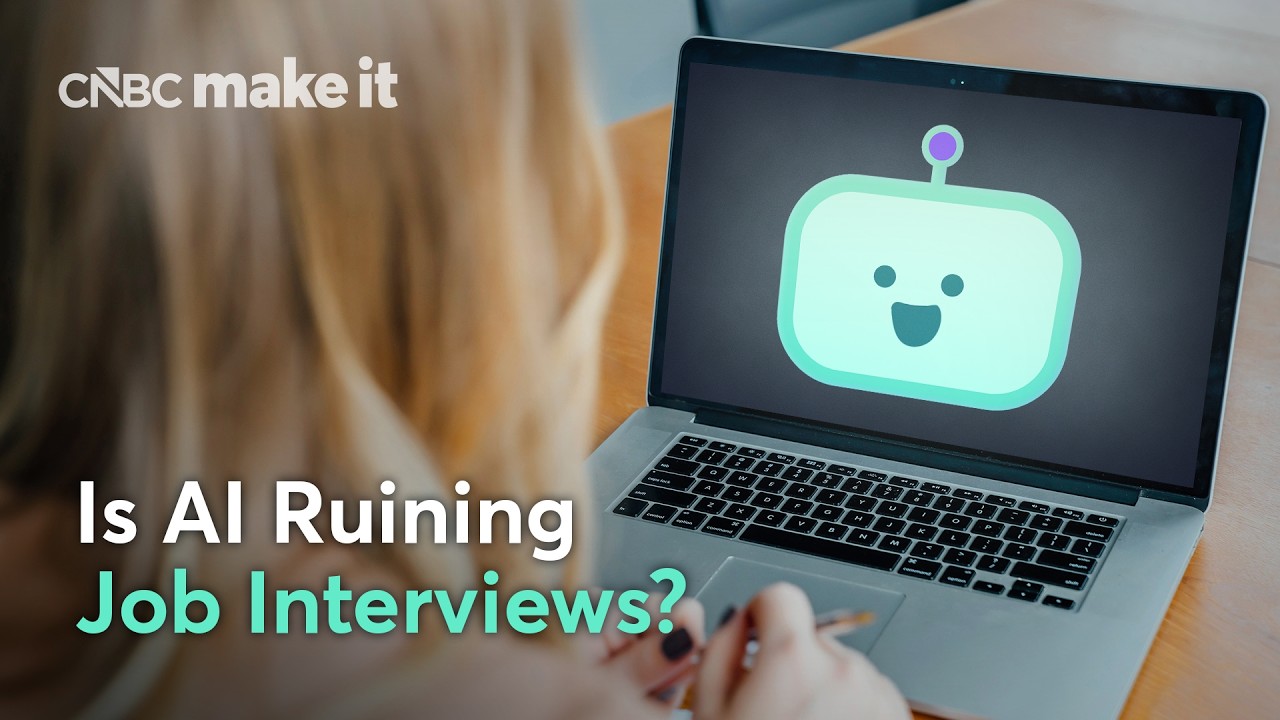
Have you ever encountered artificial intelligence in a professional setting, perhaps during a job application process or customer service interaction? Describe your experience and how it made you feel.
The video you're about to watch discusses AI in job interviews. Before we watch, what are some advantages and disadvantages you can imagine for both job applicants and employers when AI is used in the hiring process?
Considering that a job interview is often a crucial human interaction, what potential ethical concerns or challenges might arise if AI becomes the primary interviewer? How might this impact the 'human element' of recruitment?
2
Watch the video carefully. Pay attention to the main ideas and key details.
Video script154 segments · click a timestamp to jump
If you've applied for a job recently,
there's a growing chance the first person interviewing
you isn't a person at all.
They just said, okay, well,
we would like to do a phone interview and we will be
calling you at this time.
And so, at first, I'm like talking like I
would to a person and then it clicks in that this is
not a person.
Nearly two-thirds of job seekers surveyed in 2026
said they've already been interviewed by AI,
a 12% increase from six months prior.
There are several reasons why employers are leaning
into AI to conduct more interviews.
I think some companies probably are using it as a
cost-saving measure if they do not have
an in-house recruiter.
Employers are also facing a historic surge in job
applications, with the number of U.S.
applicants for each open role doubling since the
spring of 2022, according to LinkedIn.
I think the biggest reason would be time saved.
One thing it's important to remember is that throughout
the ups and downs of the economic and just sort of
hiring climate over the last six or so years,
what used to be really robust recruiting teams have
been cut down quite a bit to be sometimes even just 1 or
2 people, depending on the size of the company.
And with the influx of applications,
there are a lot of great folks out there,
and for some companies, I imagine it is nearly
impossible to screen all of their qualified applicants.
So what does an AI interview actually look like?
The process varies depending on the software the employer
uses, but the system usually starts with a brief
introduction, then asks a series of questions based on
the job description, recording your answers along
the way. Afterward, the software sends the
hiring manager the information they might need,
which could include a short summary of the conversation,
a score showing how closely a candidate matched the job
requirements, an assessment of their performance,
and a final overall score or ranking.
The hiring manager then ultimately decides who moves
to the next round, which usually involves a
human-to-human conversation.
While it all sounds very convenient for the
employers, AI interviews still have some obvious
limitations.
AI interview tools really stink at asking follow-up
questions because LLMs are coded on what they expect
the next word to be.
And so what I've seen in those systems recently is
that people will use gibberish with the tool,
and then the tool will ask a follow-up question,
but they ask it with the gibberish embedded because
it doesn't have the intelligence to ask a good
next question.
What I found is if you're pausing to think and you're
letting a moment really sink in, or you're processing the
question and you're letting it go,
it will interrupt or move you straight onto the next
question without giving you the opportunity to think on
it, noodle a little bit, and then give an answer,
or take 30 seconds and restate what you were trying
to say. It really does a bad job of the human element of
the interviewing process.
In response, some job seekers are deciding the
trade-off simply isn't worth it.
They're giving me an opportunity to speak and
record my answers.
But if I hesitated in any sort of way,
the recording would end and then they would move on to
the next question. So I never really ever got to
formulate any sort of answer.
But sometimes the concerns go beyond a frustrating
candidate experience.
Researchers have also warned that AI hiring tools can
reinforce bias, and complaints against some
software providers allege discrimination based on
factors like age, race, and disability.
I couldn't even record the video because I have a
condition called nystagmus, and that causes involuntary
movement of my eyeballs.
When I'm talking, my eyeballs are continuously
moving. Every time it would stop the video and say,
please look straight ahead and speak.
I couldn't finish the video.
I had to stop it, you know?
And I thought that that was,
that was probably like the lowest point in my search
because it was just demoralizing that,
you know, I couldn't be treated like a human being
to have a conversation with.
According to a recent survey,
nearly 4 in 10 U.S.
candidates say they've already withdrawn from a
hiring process because it included an AI interview.
12% of those surveyed said they would withdraw their
application if one were required.
That's notable in a tight labor market that currently
gives employers much of the leverage.
I have spoken with people who have varying degrees of
positive to negative interactions,
but I think the one through line that it really is
lacking in that human experience.
I think having an interview in a digital environment is
one of those things that we human beings think we're
really good at, but I actually don't think
we are, because there are these social and emotional
components that come up when a human is talking to a
machine, right? There's no one there to say,
it's okay, don't be nervous.
And broadly, we also have some of that performance
anxiety of how do I show up my best when I don't have a
person on the other side to nod or confirm that I'm
giving them the answer that I need.
And you know, the endurance of giving your
best answer over and over again without a human
interacting is something that we as a society
aren't really good at.
For job seekers who do decide to go through with an
AI interview, here are a few tips.
So I recommend you always start by being very,
very clear and saying yes or no.
Yes, I did this.
No, I have not done that.
And you need to answer that explicitly,
all right? No need for nuance here.
Remember, it's a bot on the other side.
Really enunciate.
Remember that you're talking to a language model and you
can ask for restating more clear answers,
an example of what it's saying.
A lot of them have these conversational elements
built into it.
Candidates are really struggling with AI
interviewing because they think it's an all-new skill,
or that they should be applying a different
methodology to be successful in that environment than
they typically would in a traditional interview
environment. The truth is, and I find myself telling
people this a lot, is that the same rules
apply. You just need to communicate about your
experience in a slightly different way in an AI
environment than you do with a person,
because there's not a person to fill in all of the gaps
that you don't mention explicitly.
Employers are hoping AI can deliver on speed and scale
in hiring, but as applicants push back against an
increasingly automated process,
companies may have to find a balance between efficiency
and maintaining the connection that
candidates still value.
3
Answer these questions in your own words. Support your answers with evidence from the video.
01Why are employers increasingly using AI to conduct job interviews, according to the video?
Sample answerThe video explains that companies are using AI for several reasons. It can be a cost-saving measure, especially if they don't have a large in-house recruiting team. Also, with a huge increase in job applications, AI helps save time because it's nearly impossible for human recruiters to screen all qualified candidates efficiently.
02In what ways do AI interview tools struggle to replicate the "human element" of an interview?
Sample answerAI tools struggle with the human element because they're not good at asking follow-up questions, unlike a person. Also, if you pause to think or process a question, the AI might interrupt you or move on, not giving you time to formulate a thoughtful answer or rephrase what you want to say. It lacks the empathy and flexibility of a human interviewer.
03How can AI interviewing tools lead to unfair or discriminatory outcomes for job seekers, based on the examples provided in the video?
Sample answerThe video warns that AI hiring tools can reinforce bias. For example, one job seeker with nystagmus, a condition causing involuntary eye movement, couldn't complete a video interview because the AI kept stopping, telling them to look straight ahead. This shows how AI can unintentionally discriminate against candidates based on factors like disability, race, or age if not designed properly.
04What is the main difference in communication strategy a job seeker should adopt when facing an AI interview compared to a human one, according to the tips given?
Sample answerThe main difference is that you need to be very explicit and clear. The video advises starting with a direct 'yes' or 'no' and avoiding nuance, because you're talking to a bot. You also need to enunciate clearly. Unlike a human, an AI can't fill in the gaps or interpret subtle cues, so you have to state everything directly and precisely.
4
Vocabulary
Vocabulary
These expressions will help you communicate more naturally about this topic.
Examples
automated screening process — a system that uses technology, often artificial intelligence, to review job applications and filter candidates without direct human involvement.
Usage note: This is a formal collocation often used in discussions about recruitment technology. You might hear it in sentences like, 'Many large companies now rely on an automated screening process to manage high volumes of applications.'
the human element — the personal, emotional, and subjective aspects of an interaction or situation that are unique to human beings.
Usage note: This phrase is commonly used to contrast human interaction with technology or automation. For example, 'Critics argue that AI interviews often lack the human element, making it difficult to assess soft skills.'
unconscious bias — prejudices or stereotypes that are not intentionally held but can influence decisions and judgments, often without the person being aware of them.
Usage note: This is an important concept in discussions about fairness and equality, especially when evaluating AI systems. It's often paired with verbs like 'address,' 'mitigate,' or 'perpetuate,' as in 'AI tools must be carefully designed to avoid perpetuating unconscious bias.'
level the playing field — to make a situation fair for everyone, so that no one has an advantage over others.
Usage note: This is an idiomatic expression used when discussing equality or fairness in competition. For instance, 'Some hope AI can level the playing field by removing human biases, while others fear it might introduce new ones.'
a double-edged sword — something that has both advantages and disadvantages, or that can have both positive and negative consequences.
Usage note: This common idiom is useful for describing situations or tools that are beneficial in some ways but harmful in others. For example, 'Using AI in job interviews can be a double-edged sword; it saves time but might miss out on great candidates.'
5
Complete the sentences with words from the box. One word is extra.
Word bank
01Many companies now rely on an to handle the initial stages of recruitment, filtering out candidates before human review.
02Despite technological advancements, many argue that removing from job interviews leads to a less nuanced assessment of candidates.
03While AI aims for objectivity, there's concern that algorithms can still perpetuate if the data they are trained on reflects existing societal prejudices.
04Proponents of AI in hiring claim it can help by evaluating all applicants based solely on qualifications, without personal favoritism.
05Using AI for recruitment is often seen as ; it offers efficiency but also raises ethical questions about fairness and transparency.
6
Match each word on the left with its natural partner on the right.
A
B
7
Grammar: Third and mixed conditionals
Grammar
Third conditionals discuss hypothetical situations in the past that did not happen and their imagined past consequences. Mixed conditionals combine a past condition (from a third conditional) with a present or future result (from a second conditional) to show how past actions affect the present or future.
Examples
If companies hadn't started using AI for interviews, many job seekers wouldn't have felt so frustrated.
This is a third conditional, showing a hypothetical past action (companies did start using AI) and its imagined past consequence.
If the AI had been programmed to detect empathy, it might not be causing so much dissatisfaction among candidates now.
This is a mixed conditional. A hypothetical past condition (AI programmed differently) leads to a hypothetical present result.
Candidates who had prepared for AI-driven questions would have performed better, even if they found the process impersonal.
This third conditional illustrates a past hypothetical action (preparing) leading to a past hypothetical result (performing better).
Key points
Third conditionals use 'if + past perfect' in the condition clause and 'would have + past participle' in the result clause.
Mixed conditionals often combine 'if + past perfect' (past condition) with 'would + base verb' (present result).
Remember to use the correct past perfect form (had + past participle) and modal perfect form (would have + past participle).
8
Correcting errors in AI interview discussions
Read each sentence carefully. Identify the single error in grammar, vocabulary, or usage, then write the correct sentence.
Each sentence contains one error. Find and correct it.
01Many companies now use an automatic screening process to filter job applications.
Corrected version
Many companies now use an automatic automated screening process to filter job applications.
02If the AI wouldn't have flagged my resume, I might have gotten an interview.
Corrected version
If the AI wouldn't have hadn't flagged my resume, I might have gotten an interview.
03AI in hiring aims to level the playing field, but it can also introduce new forms of unconscious biased.
Corrected version
AI in hiring aims to level the playing field, but it can also introduce new forms of unconscious biased. bias.
04Many candidates rely in their communication skills to make a good impression during interviews.
Corrected version
Many candidates rely in on their communication skills to make a good impression during interviews.
05If they would have implemented better AI algorithms, the system would be more fair today.
Corrected version
If they would have had implemented better AI algorithms, the system would be more fair today.
06Using AI for interviews is a double-edged knife; it offers efficiency but lacks the human touch.
Corrected version
Using AI for interviews is a double-edged knife; sword; it offers efficiency but lacks the human touch.
07The increasing use of AI in recruitment processes are raising concerns among job applicants.
Corrected version
The increasing use of AI in recruitment processes are is raising concerns among job applicants.
08The main affect of AI on hiring is that it can process many applications quickly.
Corrected version
The main affect effect of AI on hiring is that it can process many applications quickly.
9
Rewrite each sentence using the third or mixed conditional structure, as indicated.
01Because they didn't implement an automated screening process earlier, the HR department spent countless hours reviewing applications manually.
Rewrite using the third conditional.
Hint: Think about what didn't happen in the past and its past result.
02Companies didn't prioritize the human element in their AI recruitment, which is why they are currently facing significant backlash from candidates.
Rewrite using a mixed conditional (past condition, present result).
Hint: Connect a past hypothetical action to a present hypothetical outcome.
03The AI system showed significant unconscious bias because its developers failed to train it on diverse datasets.
Rewrite using the third conditional.
Hint: Consider the cause and effect in the past.
04AI recruitment hasn't truly leveled the playing field, so we don't see a significant increase in diverse hires today.
Rewrite using a mixed conditional (past condition, present result).
Hint: Imagine a different past and its impact on the present.
05They rushed the implementation of the AI interviewing system, which led to numerous technical glitches and candidate complaints.
Rewrite using the third conditional.
Hint: What was the past mistake and its past consequence?
06We didn't fully understand that AI in recruitment is a double-edged sword, so we are still struggling with its negative impacts today.
Rewrite using a mixed conditional (past condition, present result).
Hint: Think about how a past realization could change the present situation.
10
Words to take with you
Vocabulary
These expressions are not in the video but will help you discuss this topic more fluently.
Examples
streamline processes — to make a process more efficient and simpler by removing unnecessary steps or complexities.
This phrase is often used when talking about how technology, like AI, can improve efficiency in business operations. For example: 'Companies use AI to streamline their recruitment processes and handle a large volume of applications.'
algorithmic bias — systematic and repeatable errors in a computer system that create unfair outcomes, such as favoring or disfavoring certain groups.
This term is crucial when discussing the ethical challenges of AI, especially in hiring. It's different from 'unconscious bias' because it refers specifically to bias embedded in the AI's code or data. For example: 'One major concern with AI in hiring is the risk of algorithmic bias leading to discrimination.'
candidate experience — the overall perception and feelings a job applicant has about an employer's hiring process, from application to onboarding.
This phrase highlights the applicant's perspective. It's important for companies to ensure a positive candidate experience, even with automated systems. For example: 'A poor candidate experience due to impersonal AI interviews can damage a company's reputation.'
lack of nuance — the absence of subtle distinctions or variations; an inability to understand or express subtle differences.
This expression is often used to describe a limitation of AI, especially when it comes to evaluating complex human interactions like interviews. For example: 'AI interview tools often struggle with the lack of nuance in human communication, missing important non-verbal cues.'
human oversight — the act of a person or group monitoring and guiding a system or process, especially one that is largely automated, to ensure it functions correctly and ethically.
This term emphasizes the need for human involvement even when AI is used. It's about ensuring accountability and ethical decision-making. For example: 'Even with advanced AI, human oversight is essential to prevent errors and ensure fairness in hiring decisions.'
11
Matching: AI in job interviews
Explore key concepts related to artificial intelligence and its impact on the hiring process.
Match each item on the left with the correct item on the right.
A
B
12
AI in hiring: A complex reality
Read the passage below, then answer the comprehension questions.
The rise of artificial intelligence in recruitment has been presented as a solution to many hiring woes. Proponents argue that an automated screening process can efficiently sift through thousands of applications, saving time and resources. Furthermore, it's often claimed that AI can help level the playing field by removing unconscious bias, which might inadvertently influence human recruiters. If this technology were truly impartial, it would indeed be a game-changer for diversity.
However, the reality is more complex. Many job seekers report feeling alienated by interactions with AI, sensing a critical loss of the human element in what should be a personal process. The promise of eliminating bias is also proving to be a double-edged sword; if AI systems are trained on biased historical data, they can perpetuate or even amplify existing prejudices. If companies had thoroughly addressed these ethical considerations from the outset, perhaps the current backlash wouldn't be so pronounced. The challenge lies in harnessing AI's efficiency without sacrificing fairness or genuine connection.
01According to the passage, what are two main advantages that proponents claim for using AI in recruitment?
Sample answerProponents claim AI can efficiently sift through applications and help level the playing field by removing unconscious bias.
02What is a common negative experience reported by job seekers who interact with AI during the hiring process?
Sample answerJob seekers often report feeling alienated and sensing a loss of the human element.
03The passage describes AI's promise to eliminate bias as 'a double-edged sword.' What does this phrase mean in this context?
Sample answerIt means that while AI aims to remove bias, it can also unintentionally perpetuate or amplify existing prejudices if it's trained on biased data.
04Based on the passage, what action could companies have taken to potentially reduce the negative reactions to AI in hiring?
Sample answerCompanies could have thoroughly addressed the ethical considerations of AI from the outset.
13
Discuss these questions with a partner. Try to use vocabulary from the lesson.
How might AI interviews be a "double-edged sword" for job seekers?
Have you experienced an "automated screening process" in your country? What was it like?
Can AI truly "level the playing field" or does it introduce new biases?
This lesson is for Lessonpills members
Sign in at learn.lessonpills.com to print lessons or save them as PDF.