How Nate's Honey uses AI to protect its 6 billion bees | AI in action
B2
60 min
Premium
Scan to watch
1
Think about these questions before watching.
What natural processes or elements do you think are most essential for producing the food we eat every day? Have you ever considered the role of creatures like insects in this process?
Have you noticed any changes in the natural world around you recently, such as fewer insects, different plant life, or shifts in local wildlife? What do you think might be causing these observations?
How do you feel about using advanced technology, such as artificial intelligence, to solve environmental problems or protect wildlife? Can you think of any examples where technology has successfully helped (or perhaps unintentionally harmed) natural ecosystems?
2
You only need to watch the highlighted section below — the exercises focus on this part.
▶ You only need to watch 0:53–3:20. The exercises focus on this part.
Video script501 segments · click a timestamp to jump
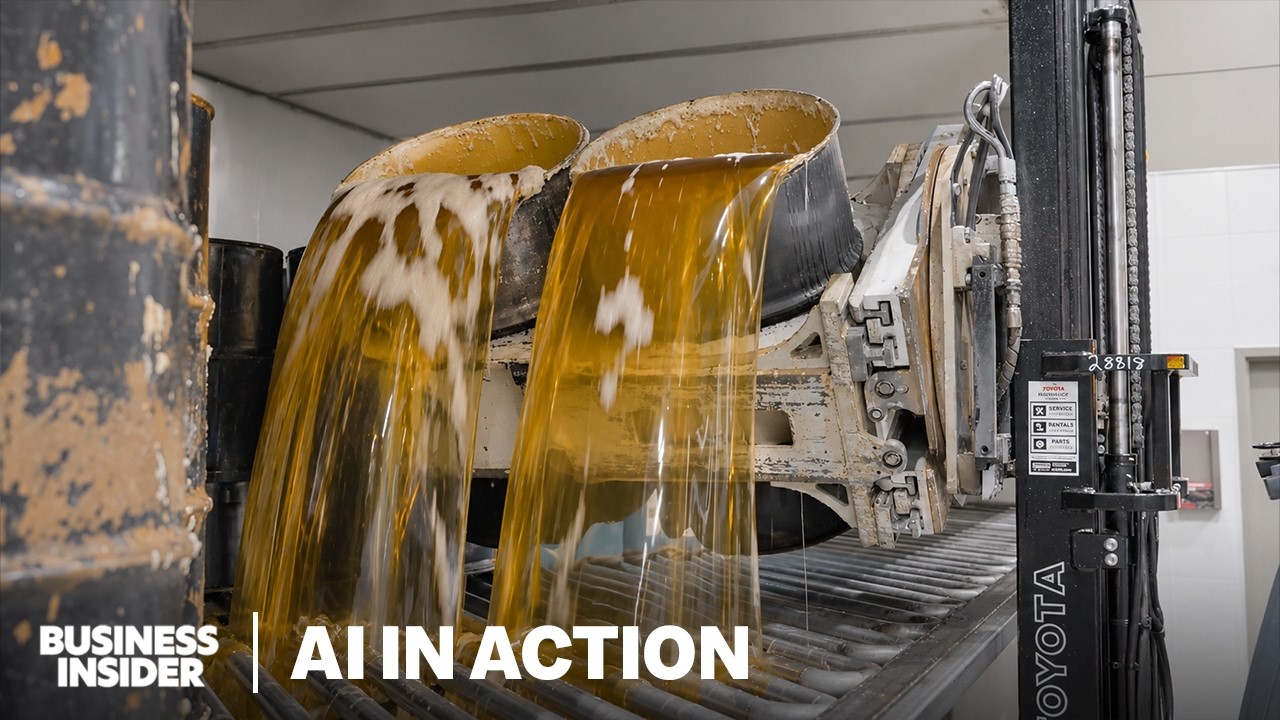
This bottling plant can hold up to 30
million pounds of honey at a time. But
keeping it supplied starts with keeping
bees alive.
And today [music] that's harder than
ever.
>> Oh wow.
>> Bees face a growing number of threats
[music] to their survival. About 50% of
bee colonies die each year in the US.
That affects a lot more than just honey
farmers. One in every three bites of
food we eat directly benefits from bee
pollination. [music]
Can you give me a picture of what the
inside of a grocery store would look
like if we don't keep these bees
healthy?
>> Yeah. So, there'd be no color. It would
be a pretty bleak place [music] to be
going. Yeah.
>> Which is why Sweet Harvest Foods is
betting on artificial intelligence to
help keep its honeybees healthy, like
these robot hives. So, can AI [music]
actually help beekeepers spot trouble
earlier, keep colonies [music] healthy,
and ultimately get bees to produce more
honey?
So, [music] we are deep in rural Montana
right now, and we've been driving for
about 100 miles, [music] and as you can
see, there are practically no buildings
in [music] sight, if any. But what we do
keep seeing are these clusters of
beehives kind of spaced all around these
hills [music] and fields. So we're going
to go see a couple of them today.
>> That's where we met Matt Halgaw whose
family has worked with bees since the
1400s.
>> We [music] made it.
>> Yeah, this is great. Beautiful morning.
Bees for some reason they like like
[music] lighter colors and you know
smooth materials. So right now I am
their biggest nightmare. I
>> You're a little bit of their enemy for
now.
>> How many times would you say you've been
[music] stung?
>> Thousands. Thou probably tens of
thousands of times.
>> Today, Matt leads Nate's Hives, the
nation's largest beekeeper, managing 6
billion bees in hives like these across
the country. I think we're ready.
At first glance, [music] it's hard to
picture a role for AI here until you see
what Matt is up against.
>> So, here we'll just warn the bees that
were coming. Give them a little bit of
We'll just kind of tell them, "Hey,
>> how many how many bees are in there?"
>> Oh, at least 60,000
>> in one
>> in one. Look at all that honey.
>> That's just a [music] single colony.
This yard has 64, each in [music] its
own stack of wooden boxes.
>> Keep in mind that a bee in its lifetime
can produce about 1 12th of a tablespoon
of honey. So, it takes a lot of bees to
put honey on the table.
>> Bees only start collecting nectar to
produce honey midway through their
lives. [music] And a lot can go wrong
before a bee ever gets there. things
like drought, weather stress, um
exposure to [music] pesticides in the
landscape. Bees are very complex. You
know, they're very [music]
tightly linked to the environments that
they are in. Kelly Cohanic studies bee
health.
>> If the hut [laughter]
>> she got,
>> she got me.
>> A typical checkup looks something like
this. Kelly and Matt go frame by frame,
looking at how evenly the queen bee has
laid her eggs. One clue to the colony's
health.
>> The queen is so important. She's
integral. She's the hub of the wheel.
So, as we look at this frame, [music]
the queen was very organized.
>> Taps. Oops.
>> Wow. So, each of these frames about
1,000 bees. Yeah. I never thought I'd be
holding a thousand bees.
>> But these days, even a busy hive can
hide something deadly. A tiny might
called feroa.
>> It's very similar to a tick in humans.
It feeds on the bees, but it also
vectors viruses [music] to the bees that
can be very harmful and detrimental to
their health.
>> The might first appeared in the US in
the 1980s after bees were imported from
overseas.
Then it spread quickly states side
because these colonies are constantly on
the move. Farmers all over America rent
the bees to pollinate their crops. A
business that accounts for about 50% of
a beekeeper's revenue. In January, they
get moved to California to pollinate
almonds. We send bees to Texas and
Florida, and then they come to the
Midwest, you know, kind of late spring,
early summer. It can be a little
stressful for the hives to be loaded
onto the truck and to be moved like
that. They can get hot. You know, it can
decrease their population a little bit.
Nate says it does its best to keep the
bees comfortable. If a veroamite gets
in, it can wipe out an entire bee colony
in a matter of weeks. But when hives are
scattered across huge distances, a lot
can happen between checkups. By the time
a beekeeper returns and sees an obvious
problem, [music]
it may already be too late. That's where
AI could help. And the simplest tool to
detect these mites sits on something
beekeepers already carry, a smartphone.
When you put your phone in there and it
starts listening, [music]
>> what is it hearing that allows it to
make the determination?
>> It's hearing much of what we're hearing
when we open the hive. We're hearing,
you know, the buzzing of the bees.
>> The AI recording tool Nates is testing
[music] can detect very subtle changes
that a human ear might miss. A healthy
queen keeps the hive organized, creating
a steadier buzz like this.
If she is sick or gone, the bees can
become more sporadic.
They're a little more confused [music]
because they're a little bit lacking
direction without a queen. So, there is
a unique sound to a queenless hive. The
goal with AI is to identify problems
earlier on so they can allow us to be a
little bit more predictive and proactive
than we've been able to be historically.
Where do you see the limits of AI being?
There's always going to have to be
people involved in order to turn that
data into a management practice. So,
beekeepers have to make lots of
different choices every day, all the
time. Another tool they're testing is
this robotic hive here. Four bee
colonies live inside a single system.
About once a week, the machine removes
every frame and photographs both sides.
[music] AI then searches those images
for mites on individual bees.
>> You know, historically what we've done
is you actually have to take a sample of
about 300 bees from the hive and you
have to physically shake the sample of
bees to dislodge the mites from the bees
and that's how you kind of count how
many mites are in the colony.
>> And that was a slow process too. And so
the idea is that the robot can kind of
act as a sentry to let us know earlier
if the might load is starting to
increase so that we can come out to the
yard and take care of it.
>> We weren't allowed to disclose the
technology powering these hives.
>> I don't think we'll ever get to a place
where all the hives look like this. The
idea behind this specifically is to have
one of these in each yard to sort of act
as a representative for the rest of the
[music] hives in the yard. Right now,
beekeepers use bees QR codes to log each
hive's health over time. Nate's plans to
use that data to help breeders raise
queens from colonies that are the most
resilient and produce the most honey.
>> Right now, the USD averages are about 50
lbs per colony in the United States. 30
years ago, it used to be 85 lbs or so.
Can Can we get that back there?
Harvesting starts with beekeepers
removing the surplus honey that bees
have stored at the top of the hives.
From the bey yard, those boxes are
trucked into what they call a tempering
room. You feel the heat just putting
your arm in. It is hot in here.
>> We want to keep it warm because, as you
know, honey is very viscous and so we
need the honey to flow out of the comb
and into the tank. So, how much honey
would do you say?
>> You're going to have to stop and let me
count.
>> We [laughter] can do that. Okay.
>> No, that's totally fine.
>> Okay. 1 2 3 1 2 3 4 5 6.
>> After some calculating, we landed on
this being about 100 pallets, each
carrying [music] roughly 1,500 lb of
honey. So, think about how many bees
were involved in making
all of the honey in here.
>> Hundreds of thousands. Millions.
>> Millions of bees.
>> Millions of bees.
>> I cannot believe that I'm literally just
eating it straight from the hive. And
this is how good it tastes.
>> Next, these boxes go into the extraction
room. Bees seal each cell of honey with
a thin wax cap.
That's what this machine gets rid of
first. This facility can run through
roughly a thousand boxes a day. Across
its whole network, Nate's hives can
process over 200,000 boxes over a
season.
>> We want to work like a beehive. So, if
everybody has a job and everybody can do
every job, that gives you a lot of
respect for your co-workers.
Then the frames go into this spinner
which uses centrifugal force to pull out
the honey. So they're just going
non-stop essentially all day.
Machines strain out the wax and other
debris, but nothing here goes to waste.
>> That is a lot less sticky than I
expected.
That's the beeswax. So, don't stick your
finger in there, but I'm going to. So,
that's hot wax.
>> What are you going to make with this?
>> Most of it will be go to candle making.
Some of it will go to cosmetics.
>> Ow, that is wild. That's crazy.
>> The cleaned honey is collected into
these 3,300 lb vats.
>> It's almost hard to comprehend how
little the honey is manipulated. It's
such a fresh product.
If your ancestors in the 1400s
were to see something like this,
what do you think they'd say?
And the answer, standing in front of a
vat like this wasn't what I expected.
>> What would be the most intriguing is how
little beekeeping has changed since they
were doing it. And I think in a way that
gives us a connection almost to our
past, right? and maybe even to our
future that some things never change.
>> Even here, the old rhythm holds. Once
all the honey is spun out, these wooden
frames head back to the hives to be
filled again.
For the honey, the journey is just
beginning. It's pumped into bulk
containers that are trucked hundreds of
miles to this bottling plant in
Minnesota.
>> The bees are doing the work, right? It
is our jobs to protect what the bees
have already done.
>> The 360 square foot facility is operated
by Sweet Harvest Foods, which owns
Nate's Honey and Hives. It's about the
size of six football fields. Robert
Denahi has worked for the company for 11
years.
>> Everything you see down the aisles here
are honey products. [music]
>> Everything.
>> Everything you see everything that is
here. And this only represents about
three weeks worth of inventory for us
here at Sweet Harvest.
>> No way.
>> It's mindboggling.
>> Honey consumption in the US has doubled,
almost doubled in the last 10 years, and
consumers just can't seem to get enough
of it.
>> Today, only about 20% of [music] the
honey consumed in the US is produced
domestically.
>> What we're going to do now is travel
down our international highway of honey
transport. That's what I call this lane.
[music]
Is there like a reason for the different
colors like the red, blue, black?
>> I love that you asked that question.
Often it is a different country of
origin coming through. [music] So it
takes the world, right? So we have a
relationship to the globe and and we
work in harmony with all the different
countries that are extracting honey.
[music] One thing that a lot of
individuals may not understand about
honey is it's in everything. It's not
just in food. It's in makeup. It's in
medications. But before any of this
honey reaches [music] consumers, the
company needs to know exactly what's
inside it. Samples are tested for
pesticides, antibiotics, pollen, and any
ingredient that would compromise the
honey's purity.
>> Every single load gets tested without
fail. This isn't a trust us, we're doing
the right thing. If anyone were ever to
come in here and pull a sample of honey
and say, "Hey, I think something's going
on here." we can open up an independent
third party labs test and say this is
what's going on or or or this is how it
tested.
>> Once it passes the checks, the honey can
move into processing. [music]
>> So, we walked in and it's real like you
feel how [music] the temperature went
up. It is really hot in here.
>> Yes, honey is naturally crystallizing as
it ages. [music]
So, it becomes incredibly difficult to
to handle
>> to keep it runny. [music] It's 90° in
here.
We're going to be kneading these.
>> Yeah,
>> we're coming.
>> Yeah, it's a little warmer in here, is
it not?
>> It is a a recipe for success. [music]
>> Then batches get blended together inside
an oven that's bigger than a New York
studio apartment.
>> Yeah, you can probably fit a couple of
them in there, to be honest. Yes.
>> No two batches taste or look exactly the
same. Once the honey is poured in here,
a special software system checks its
flavor and color, then recommends which
of these giant tanks it should go into
to keep the [music] blend consistent.
>> We don't want all of this hard work up
till now to be jeopardized because of
human error.
>> So machines are less likely to make
mistakes in this context than people.
>> Absolutely. For advanced
>> tech tech allows us to be consistent.
Just one of these tanks holds about
70,000 lbs of honey. That'll make 70,000
[music]
16oz bottles.
>> Wild.
>> And this [music] entire tank is going to
get bottled today.
>> We can ultimately select the filling
line that we're transferring to. And
what's really neat about this system is
it'll tell us [music] which travel path
our honey is taking.
>> It's like a little honey GPS system.
>> Exactly. Do you ever like just nerd out
over this?
>> I geek out all day. I mean, I this is my
my pride and joy.
>> Many producers heat their honey a lot to
help it flow through these pipes and
into bottles, but Nates keeps its honey
raw, limiting the heat to preserve the
natural enzymes. And at the bottling
line, that comes with a tradeoff.
>> So, in terms of how fast the bottles get
filled, right, for raw honey, is that
slower? I I love that you asked that
question. Yes. So, for raw honey, it is
naturally cooler product, which then
becomes more viscous, right? It's
thicker. So, it does take longer for us
to produce that. Let me grab a bottle
here.
>> Every 30 minutes, workers pull bottles
from the line to check temperature and
make sure the honey isn't being
overheated.
>> And it takes about 10 seconds before you
know where you're at for a total
temperature. The product is very
precious to us. We hold it just like we
would our own children, right? It's
precious. You want to ensure that this
product gets into the bottle and gets
into the bottle correctly the first
time.
>> This line is bottling organic. To
qualify as that, the hives supplying
this honey need miles of wild or organic
farmland around them to limit pesticide
[music] exposure. But that's so hard to
find in the continental US that Nates
and all other American honey processors
need to source it from overseas. Then
label where it comes from.
>> India, Brazil, Mexico. So this will
never say United States.
>> USA does not create organic product.
>> That is so crazy to me. Still, I think
that's probably been the most shocking
part of this entire experience. From
there, the finished bottles are packed
up and moved into the warehouse.
>> It looks like it just disappears.
>> And if you want to look through this
window, you'll actually see the robot
hard at work.
>> That gives Terminator vibes.
>> Terminator vibes. Absolutely. It's not
as scary as the Terminator. It's here to
help us.
There's one more way AI could [music]
help beekeepers in the future, and it
takes us back to the very beginning of
the process. Sweet Harvest and Nates are
exploring how AI could help decide where
to put honeybees in the first place.
Right now, beekeepers [music]
consider weather, historical
performance, and what they can see
around a potential beyard.
>> And so, [music] this board attempts to
do those things and works as sort of a
scratch pad, if you will, or a
whiteboard [music] for us. But in the
future, satellite imagery analyzed by AI
[music] could identify major nectar
sources like clover, alalfa, and canola,
then determine whether those plants are
actually blooming. It could even help
identify areas that may be more
vulnerable to pests.
>> And so we want to track all of that. And
we'll be able to plug technology in with
[music] near real-time satellite data.
It's not going to be a perfect solution,
but if you can do it in advance and
identify the yards you think are going
to be most productive, it saves you
cost. It gives you better yields.
>> For now, the final decision still rests
with the beekeepers. If bees could talk
to us, what do you think they would tell
us about their experience today versus
their experience maybe like 10 10 years
ago? H
I hope
that they would ask us why have you not
solved the problem of honeybee
mortality? If a cattle rancher walks out
into the field and sees half of his
cattle dead in the field, it's shocking.
It's sad. It's devastating. [music]
>> Bee lovers like Matt and Kelly hope AI
may be part of the solution. And the
stakes go far beyond [music] honey.
>> No bees, no life. Because you feel the
bees disappear, it's hard to live the
life.
>> They have a very, very fragrant smell.
You can imagine that if you smelled
that, a bee would just want to eat it
up.
3
Answer these questions in your own words. Support your answers with evidence from the video.
01What did the video's narrator observe about the landscape and beehives while driving in rural Montana?
Sample answerThe narrator mentioned driving about 100 miles in rural Montana and seeing almost no buildings. Instead, they kept seeing clusters of beehives spread out across the hills and fields.
02Who is Matt Halgaw, and what is notable about his family's history with beekeeping?
Sample answerMatt Halgaw leads Nate's Hives, which is the largest beekeeper in the nation, managing billions of bees. What's really notable is that his family has been involved with beekeeping for a very long time, since the 1400s.
03Based on the information provided, why is it challenging for beekeepers like Matt Halgaw to produce a significant amount of honey?
Sample answerIt's challenging because a single bee only produces about 1/12th of a tablespoon of honey in its entire life. Even though a single colony can have 60,000 bees and a 'yard' can have 64 colonies, it still takes an enormous number of bees and a lot of effort to get enough honey to put on the table.
04In what ways do environmental factors pose a threat to bee health and their ability to collect nectar, according to the video?
Sample answerThe video explains that bees are very sensitive and closely connected to their environment. Environmental factors like drought, extreme weather, and exposure to pesticides in the landscape can all go wrong and prevent bees from even getting to the point where they can start collecting nectar to make honey.
4
Vocabulary
Vocabulary
These expressions will help you communicate more naturally about this topic.
Examples
Colony collapse disorder — the sudden, unexplained disappearance of worker bees from a beehive, leading to the death of the colony.
Usage note: This is a specific, formal term used when discussing the decline of bee populations and the threats they face.
Dwindling numbers — a gradual reduction in the quantity or amount of something, often referring to populations of animals or resources.
Usage note: This semi-formal collocation is commonly used to describe decreasing populations. For example, 'The dwindling numbers of pollinators are a concern.'
Play a crucial role — to be extremely important or essential in a particular situation or process.
Usage note: This phrase is very common in academic and formal contexts. It's often followed by 'in' + a noun or gerund, e.g., 'Bees play a crucial role in crop pollination.'
Mitigate risks — to make a problem, threat, or bad situation less severe, serious, or painful.
Usage note: This is a formal collocation often used in discussions about problem-solving, environmental protection, or business strategy. For example, 'Technology can help mitigate risks to bee health.'
Food security — the state of having reliable access to a sufficient quantity of affordable, nutritious food.
Usage note: This is a formal or academic term. It's often discussed in the context of global challenges, agriculture, and economic stability. For example, 'Bee health is vital for global food security.'
5
Protecting our pollinators
Bees are vital for our planet's health and our food supply. Match the terms and phrases related to bee conservation and modern solutions.
Match each item on the left with the correct item on the right.
A
B
6
Match each word on the left with its natural partner on the right.
A
B
7
Grammar: The causative (have/get something done)
Grammar
The causative structure 'have/get something done' is used when we arrange for someone else or something else (like AI) to perform an action for us, or when something happens to us that we didn't directly do ourselves. It emphasizes that we are the recipients or initiators of an action, but not the doers.
Examples
Many beekeepers now have their beehives monitored by AI-powered sensors.
This means the beekeepers arrange for the AI sensors to do the monitoring for them.
They often get their data analyzed by specialists to understand bee health trends.
'Get something done' is similar to 'have something done' but can sometimes imply more effort in arranging it, or a less formal context.
Before AI, farmers simply had their fields pollinated by natural bee populations.
This shows a past action where the bees performed the pollination for the farmers.
If a disease is detected, beekeepers can have their colonies treated by veterinarians.
Here, the beekeepers arrange for the veterinarians to perform the treatment.
Key points
Use 'have/get + object + past participle' to show someone else does the action for you.
'Have' is generally more formal; 'get' is common in spoken English and can imply overcoming a difficulty to arrange something.
Always use the past participle form of the main verb (e.g., monitored, analyzed, treated).
8
Correcting errors in sentences about bee protection
Each sentence contains one error. Find and correct it.
01Artificial intelligence is playing a crucial role for mitigating the risks associated with colony collapse disorder.
Corrected version
Artificial intelligence is playing a crucial role for in mitigating the risks associated with colony collapse disorder.
02The dwindling numbers of bee colonies across the globe seriously threatens our food security.
Corrected version
The dwindling numbers of bee colonies across the globe seriously threatens threaten our food security.
03Many beekeepers are starting to get their beehives monitoring by advanced sensor technology.
Corrected version
Many beekeepers are starting to get their beehives monitoring monitored by advanced sensor technology.
04If we didn't have healthy bee populations, a significant portion of our crops wouldn't have been pollinated.
Corrected version
If we didn't have healthy bee populations, a significant portion of our crops wouldn't have been be pollinated.
05Innovative solutions are being developed to mitigation the risks posed by pesticides to bee health.
Corrected version
Innovative solutions are being developed to mitigation mitigate the risks posed by pesticides to bee health.
06The colony collapse disorder is a complex phenomenon that scientists are still struggling to fully understand.
Corrected version
The Colony collapse disorder is a complex phenomenon that scientists are still struggling to fully understand.
07With AI, beekeepers can have their hives data analyzed for early detection of problems.
Corrected version
With AI, beekeepers can have their hives hives' data analyzed for early detection of problems.
9
Rewrite each sentence using the causative structure ('have something done' or 'get something done') as indicated in the prompt.
01Experts are monitoring the bee colonies' health regularly.
Rewrite using the causative 'have something done'.
Hint: Think about who arranges for the monitoring, not who does it.
02The scientists asked technicians to install new AI sensors in the hives.
Rewrite using the causative 'get something done'.
Hint: Focus on the 'thing' that was acted upon (the sensors) and the action (installed).
03The community wants the local council to clean up the polluted area near the apiaries to mitigate risks.
Rewrite using the causative 'get something done'.
Hint: Identify the 'thing' that needs to be acted upon (the polluted area).
04The organization arranged for the public to be educated about how dwindling numbers of bees affect food security.
Rewrite using the causative 'have something done'.
Hint: Consider who received the education and who arranged for it to happen.
05Because of colony collapse disorder, farmers often hire specialists to pollinate their crops.
Rewrite using the causative 'have something done'.
Hint: What service do the farmers arrange for their crops?
06It's essential that we ask experts to assess the impact of climate change on bee health, as bees play a crucial role.
Rewrite using the causative 'get something done'.
Hint: What specific 'thing' needs an assessment?
10
Words to take with you
Vocabulary
These expressions are not in the video but will help you discuss this topic more fluently.
Examples
biodiversity loss — the reduction or disappearance of different kinds of living organisms (plants, animals, microorganisms) in a given area or on Earth.
Use when discussing environmental problems, extinction, or the importance of varied life forms. Example: "The decline in bee populations contributes significantly to biodiversity loss, impacting entire ecosystems."
sustainable agriculture — farming methods that are environmentally friendly, economically viable, and socially responsible, ensuring long-term productivity without harming natural resources.
Use when talking about farming practices that protect the environment, conserve resources, and ensure food supply for future generations. Example: "Many farmers are adopting sustainable agriculture practices to protect pollinators and soil health."
ecological balance — the state of equilibrium in an ecosystem where all living organisms and their environment are in harmony, maintaining stable populations and interactions.
Use when discussing how different parts of nature depend on each other, and what happens when one part is disturbed. Example: "The disappearance of key species like bees could severely disrupt the ecological balance of many regions."
harness technology — to make use of or exploit technology, often for a specific purpose or benefit.
Use when talking about applying scientific knowledge or tools to solve problems or achieve goals. Example: "Scientists are working to harness technology, like AI, to monitor bee health and predict threats."
pressing issue — an urgent or critical problem that requires immediate attention and action.
Use to emphasize the importance and urgency of a problem. It's often followed by 'for' or 'facing.' Example: "The decline of pollinator populations is a pressing issue for global food security and environmental stability."
11
Complete the sentences with words from the box. One word is extra.
Word bank
01Researchers are investigating the complex environmental factors contributing to the widespread phenomenon known as .
02Conservationists are alarmed by the of many insect species, highlighting the urgent need for habitat protection.
03Beyond pollination, healthy soil microbes in nutrient cycling and plant growth.
04Implementing sustainable farming practices is essential to the environmental hazards posed by traditional agriculture.
05The long-term availability of nutritious provisions for all people is known as and is a major global challenge.
12
Useful phrases: Discussing environmental challenges and solutions
Vocabulary
When talking about environmental issues, it's important to express concern, propose solutions, and engage in thoughtful discussion. These phrases will help you articulate your ideas clearly and naturally in English.
Examples
''It's really concerning to see the impact of [environmental issue] on [area/species].'' — To introduce an environmental topic and express initial worry.
Register: Neutral. Use when starting a conversation about an environmental problem you're worried about, e.g., 'It's really concerning to see the impact of climate change on coastal communities.'
''I think it's crucial that we address [issue] before it's too late, especially since [factor] plays such a vital role.'' — To stress the importance and urgency of an issue, often linking it to a broader impact.
Register: Neutral to slightly formal. Use when you want to highlight the significance of a problem or action, e.g., 'I think it's crucial that we address plastic pollution before it's too late, especially since oceans play such a vital role in our ecosystem.'
''We need to explore more effective ways to mitigate the risks associated with [problem], perhaps by [suggested action].'' — To suggest that solutions are needed and to hint at a possible approach.
Register: Neutral. Use when discussing how to reduce the negative effects of an environmental challenge, e.g., 'We need to explore more effective ways to mitigate the risks associated with deforestation, perhaps by promoting sustainable agriculture.'
''I completely agree; the dwindling numbers of [species/resource] really highlight the urgency of the situation for our food security.'' — To express strong agreement while connecting a specific problem to a larger consequence.
Register: Neutral. Use when agreeing with someone's concern and reinforcing the severity of the issue, e.g., 'I completely agree; the dwindling numbers of pollinators really highlight the urgency of the situation for our food security.'
''While that's a valid point, we also have to consider the long-term implications for [aspect] if we don't act comprehensively.'' — To politely express a slightly different perspective or add a layer of complexity to the discussion.
Register: Neutral. Use when you want to acknowledge another person's idea but also introduce another important factor or consequence, e.g., 'While that's a valid point, we also have to consider the long-term implications for biodiversity if we don't act comprehensively.'
''Ultimately, ensuring [positive outcome, e.g., a healthy ecosystem] depends heavily on a collaborative approach to these challenges.'' — To summarize the main takeaway or emphasize the necessity of a particular strategy.
Register: Neutral to slightly formal. Use at the end of a discussion to draw a conclusion or stress the importance of cooperation, e.g., 'Ultimately, ensuring a healthy planet depends heavily on a collaborative approach to these challenges.'
13
Protecting our pollinators
Bees are vital for our planet's ecosystems and food production. This exercise explores the challenges they face and how technology can help.
Fill in each blank with the correct word from the word bank.
Word bank
The health of bee populations worldwide is a growing concern, with scientists observing a significant increase in colony in many regions. This , often linked to pesticide use, habitat loss, and climate change, poses a serious not only to ecosystems but also to human food supply. Bees' crucial in pollinating a vast array of crops makes their survival essential for agricultural productivity and overall . Artificial intelligence is now being employed to help monitor bee health and behavior, offering innovative ways for risk associated with their in numbers. By analyzing data from smart hives, AI systems can identify early warning signs, contributing to efforts to reverse this trend and ensure a stable future for our planet's biodiversity.
14
The silent guardians of our food
Bees are more than just honey producers; they are essential for our planet's health and our own sustenance. This reading explores the challenges they face and the importance of protecting them.
Read the passage below, then answer the comprehension questions.
Beyond the sweet taste of honey, bees play a crucial role in our ecosystem, silently supporting much of the plant life and agriculture we depend on. However, these vital pollinators are facing unprecedented challenges. Scientists are particularly concerned about colony collapse disorder, a mysterious phenomenon where worker bees vanish, leaving hives empty. This, coupled with habitat loss and pesticide use, has led to a worrying trend of dwindling numbers among bee populations worldwide. The implications for global food security are immense; without bees, many crops would fail, drastically altering our diets and economies. To mitigate risks, researchers are exploring various solutions. Many communities are now working to get bee-friendly gardens planted, and farmers often have their fields professionally assessed for pollinator health. It's becoming clear that we need to have our collective efforts focused on protecting these tiny creatures, ensuring a sustainable future for both bees and humanity.
01What is the primary role of bees in the ecosystem, as described in the passage?
Sample answerBees play a crucial role by silently supporting much of the plant life and agriculture that humans depend on.
02According to the passage, what is 'colony collapse disorder'?
Sample answerColony collapse disorder is a mysterious phenomenon where worker bees vanish from their hives, leaving them empty.
03Why does the passage suggest that declining bee populations pose a significant threat to global food security?
Sample answerIt suggests this because without bees, many crops would fail, which would drastically change our diets and economies, making it harder to access sufficient food.
04What are some of the actions mentioned that communities and farmers are taking to help protect bees?
Sample answerCommunities are working to get bee-friendly gardens planted, and farmers often have their fields professionally assessed for pollinator health.
15
Protecting our pollinators: The role of AI
Bees are essential for our planet's health and our food supply. Read the passage below about the challenges bees face and how technology is helping.
Fill in each blank with the correct word or phrase from the word bank.
Word bank
The global decline in bee populations, often attributed to factors like pesticide use and habitat loss, poses a significant threat to our planet's ecosystem and ultimately, to human . This alarming describes the sudden disappearance of worker bees, leaving hives empty. Bees have a in pollinating a vast array of crops, meaning their could lead to severe agricultural challenges. Fortunately, technology, particularly artificial intelligence, is emerging as a powerful tool for the of these environmental threats. AI-powered monitoring systems can analyze hive data, helping beekeepers identify issues early and the of effective strategies to protect these vital insects, thereby safeguarding our future.
16
Discuss these questions with a partner. Try to use vocabulary from the lesson.
What are the biggest risks of dwindling bee populations globally?
How might dwindling bee numbers impact food security in your country?
Is using AI the best way to mitigate risks to bee colonies?
This lesson is for Lessonpills members
Sign in at learn.lessonpills.com to print lessons or save them as PDF.