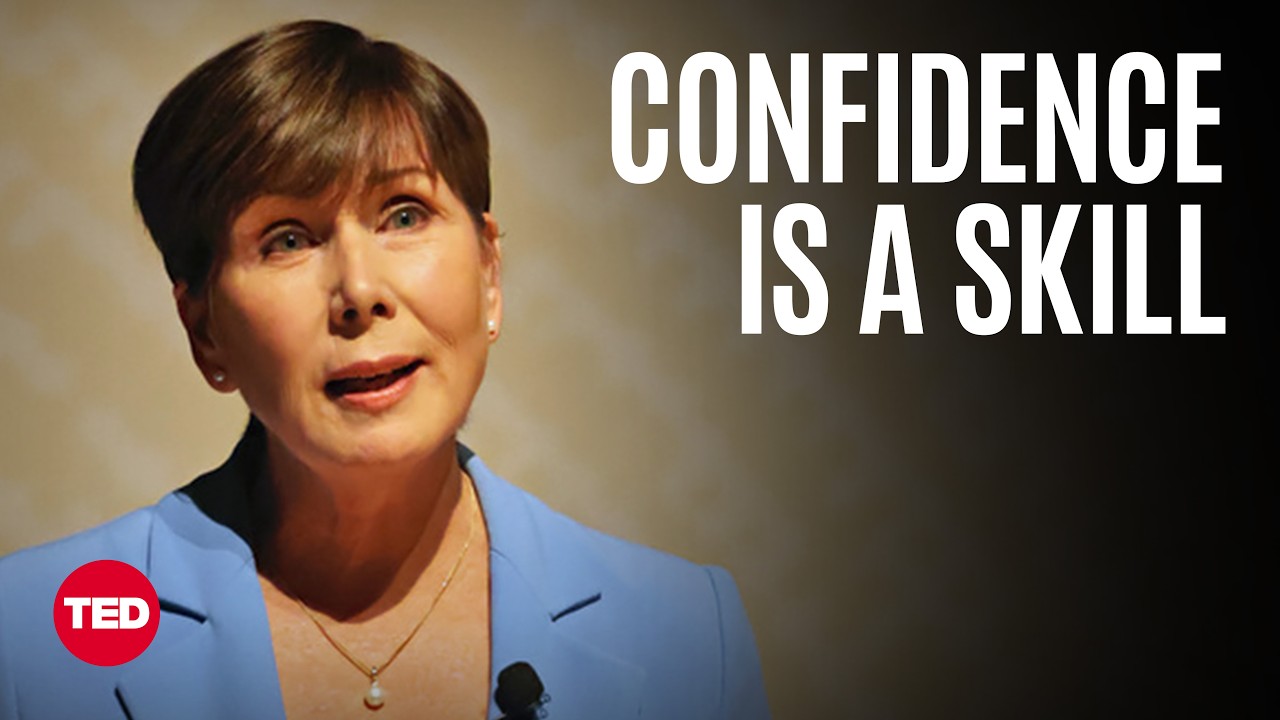
How to look and sound confident | Cara Hale Alter | TED
B2
60 min
Premium
Scan to watch
1
Think about these questions before watching.
Have you ever experienced a situation where you felt completely misunderstood by someone, or where their perception of you was very different from how you see yourself? What happened?
When you meet someone new, what nonverbal cues (like body language, facial expressions, or eye contact) do you pay attention to the most? How do these cues influence your first impression of them?
Imagine you're in a new, important situation (e.g., a job interview, a presentation, meeting new colleagues). What strategies do you use, or would you try to use, to project confidence and competence, even if you're feeling a bit nervous inside?
2
You only need to watch the highlighted section below — the exercises focus on this part.
▶ You only need to watch 0:00–5:00. The exercises focus on this part.
Video script312 segments · click a timestamp to jump
We all have a fundamental desire to be seen and understood.
And to have other people see us the way we see ourselves:
capable, competent,
intelligent, playful, charismatic --
you get to choose the adjectives that fit you.
But that's why when there's a disconnect, when we feel misjudged,
it can be very disconcerting,
even painful.
Several years ago, when I was teaching at Stanford,
one of my students, Lauren,
came to me for help unraveling some confusing feedback
she'd received at her new job.
Lauren said of herself that she was painfully shy and timid,
especially around new people,
so she was taken aback
when her manager told her
that her new coworkers were finding her aggressive and judgmental.
She could not wrap her head around how that could possibly be true.
In observing Lauren, I did notice
that when she was feeling particularly nervous or intimidated,
she took on a pretty extreme poker face
and her posture became rigid and locked down.
So what felt to Lauren from the inside like deer-in-the-headlights panic,
looked from the outside like a cold, hard stare.
So I encouraged her to try to loosen up her facial features
and try to literally reach out rather than close up
when she was feeling uncomfortable.
How we feel on the inside can be very different
from how we come across on the outside.
There's a common misconception that how we come across to others
is very subjective in the eye of the beholder.
But I've spent 25 years studying nonverbal communication,
researching the predominant cues that we as human beings use
to assess credibility, confidence, leadership presence.
And the bottom line is that there are ground rules, metrics.
Certain behaviors lead to very predictable assessments
on the part of the listener.
So if you can better understand
what behaviors lead to what types of assessments,
you can just be more in charge of the image that you project.
And today, I'd like to address two very specific behaviors
that have an outsized impact on what I call visible credibility.
And that's your ability to project confidence and competence
so that other people just immediately recognize your true potential.
These two keystone behaviors are strong posture and strong voice.
And I know that seems cliché --
sit up straight and speak up --
but it is precisely because these behaviors
seem so much like common knowledge
that we don't feel the need to actively cultivate these good habits.
So let me be explicit.
Strong posture means that if you are standing up,
your weight is balanced equally over both feet.
And whether you're standing or you're seated,
your spine and your shoulders form a T.
This area has literal core strength.
There's no wishy-washiness in my spine.
Notice what happens to my appearance of leadership presence
as soon as I allow more flexibility in my spine.
So this has literal core strength,
even if I take a couple of steps.
Then your head moves independently on your shoulders,
like a camera on a tripod,
and your nose and eyes should align and track in the same direction.
Which means that if I look at you,
both my nose and eyes point directly toward you.
And if I look at you, eyes and nose directly toward you.
Notice what happens right now
when my eyes and nose move a little bit more independently.
I'm very likely to look uncomfortable.
But I could also look sneaky.
Or mischievous.
Or judgmental.
Or skeptical.
So here's the takeaway for posture.
If you’d like someone to describe you as having a strong spine and a level head,
I encourage you to have a strong spine and a level head.
If you'd like someone to describe you as being straightforward and direct,
try to be straight on.
And if you'd like to create a closer connection to whoever you're speaking to,
try to literally open up and reach out.
So it's not accidental that we describe someone
who has great influence
as having a powerful voice.
I like to demonstrate the power of the speaking voice
on a scale from one to five.
For volume, one on the scale would mean you can't hear a word I'm saying.
So I'm actually not going to do that.
Two is a bit like this.
It's below average.
Now you can hear me --
it's just that you're doing all the work.
Level three is about like this.
Level three is average, and most people, by the way, speak at average volume.
It's fine.
It's adequate.
But it's just adequate.
I'm missing a lot of opportunities to make a connection and to have influence.
Level four is hopefully where I've been speaking all along.
Now at this volume, I’m trying to come all the way to you,
but it's a sliding scale.
It depends on the size of the room
and the acoustics and the situation itself.
But four means optimal for that situation.
(Very loudly) Level five is that one step too far.
(Laughter)
Where if, at level four,
I was really making a connection with you,
at level five, you begin to put up some boundaries.
So it's a really big drop from four,
getting you a perfect connection,
to that one step too far,
getting you the opposite of what you want.
People will put up barriers.
And most people intuitively know this.
So most people gravitate to the safety of the average zone.
And that is the most common mistake I see with any group that I work with --
people who are willing to be average.
But this is a situation where good is the enemy of great.
Because if your average with any one of your skills,
you won't get any feedback because you're fine.
But you might miss the opportunity to be exceptional.
It sometimes happens that someone will have what I call a meter issue,
and that's that their internal meter or measure
of how loud they are
is out of sync with the external measure,
so they just think they're talking far louder than they are.
And this is a very common problem,
but I experienced a pretty extreme case of this
in one of my seminars.
Eugene was frustrated that his ideas were not being acknowledged in meetings.
He'd bring up a point that he thought was pretty important,
but receive no reaction.
In giving him feedback,
I asked him if he was aware that his volume was significantly soft,
a level two or below on my scale,
and that I was missing about 50 percent of everything he was saying.
He looked up at the other participants and he said,
"Is that true?"
And every person in the room nodded yes.
They had all noticed, but had been too polite to mention it.
In that moment, Eugene had a realization.
He'd been carrying around this burden,
that the problem was his character,
that his ideas were weak,
or that he wasn't worth listening to.
But it finally clicked.
They couldn't technically hear him.
It's important to note that when we receive feedback,
it often comes to us on the character-trait level.
Even well-meaning mentors will offer advice like,
“You need to show more confidence” or “Try to be more assertive”
or "try to be more approachable."
And then you're just left wondering what exact behavior you need to adjust.
What I know as a coach
is that what is often described as a character flaw
is really just a straightforward skills gap.
And if you could identify the specific behavior that needed to be addressed,
it might be relatively easy to fix.
So, for example, so far in this conversation,
I have been trying to follow the guideline
of keeping my head and shoulders level.
But if I were to change that behavior
and have a lot of extraneous movement,
it's possible that the feedback I'd get,
that in order to show more leadership presence,
I should tamp down my enthusiasm or my passion.
(Laughter)
And you can imagine what that would do to my psyche
if my takeaway for how to show more leadership presence
was be less enthusiastic.
When the actual straightforward behavior
that needed to be adjusted just then was”
Can I speak with my head and shoulders level?
That's a relatively easy thing to do.
These skills -- strong posture, strong voice --
they're not that complicated.
And I'm not in any way suggesting that this is the only way
to project credibility and confidence.
If you cannot follow one of these guidelines
for whatever reason, no worries.
There are many ways to demonstrate visible credibility.
It's just that most people find these behaviors relatively easy to adopt,
and they can be game-changing.
I had a young woman in one of my programs, Jamie,
and she thought of herself as a real go-getter,
highly capable, leadership material.
But she wasn't advancing as fast as she thought she should.
The higher-ups just didn't seem to believe in her.
When I sent her to the front of the room for some interactive, on-camera coaching,
I noticed she was sending some pretty mixed signals.
So let me demonstrate.
She started in a very small, asymmetrical posture,
eyes cast down,
and she had a tendency to speak with a thin voice,
using upward inflections.
So I started by asking her to stand with her weight balanced over both feet
and her shoulders level.
And she did.
Then I asked her to pick up her gaze so that her head was level.
And she did.
Then I suggested she open up her gestures
so they'd be a little more interactive.
And she did.
Then I encouraged her to use a full voice
with downward inflections.
And she did.
And then finally,
I suggested she really focus on eye contact
and try to see the people in front of her.
And she did.
And in that moment, she looked like the self-assured,
aspiring leader she thought herself to be.
And I said, "Jamie, that looks great.
How does it feel?"
And she said,
"Phony.
This isn't me."
When we step outside of our usual habits,
it can feel so unnatural.
But there is nothing more natural about being in this position
or being in this position.
They're just habits.
And also, I have to ask, what is you?
Are you how you feel about yourself from the inside?
Or are you what others perceive about you from the outside?
Even though I guide people to use these nonverbal signals intentionally,
I am a fierce advocate for authenticity.
But I don't believe being authentic means you in your raw state,
or you not trying very hard or not caring what other people think.
My definition of authenticity
is when the adjectives you would use to describe yourself
are the very same adjectives someone else would use
to describe you.
There's alignment.
But if you see yourself one way,
and let's just say that's brimming with potential
and ready to take on more responsibility,
but other people are not seeing that about you,
changing your behaviors
so that they would see that about you,
that's not inauthentic.
That's alignment.
That’s you representing yourself accurately.
And there is no tool more helpful for getting this alignment
than the video camera.
When Jamie had a chance to see herself from the outside,
both the before and after versions,
she was very surprised,
but she became immediately motivated
to cultivate those new behaviors until they felt [like] second nature.
It is fairly universal
that people do not like to watch themselves on video,
but the reason people show so much improvement
with just a small amount of on-camera feedback
is that it's not really about ability.
It's about awareness.
Nearly all of us are fully capable of changing a behavior.
We just may not know that we need to.
If we are not coming across at our best,
it is usually because of a blind spot.
And though it is a bitter pill to swallow,
no one, including me,
is immune to a blind spot.
One day, many years ago,
I played with my children in the morning
and then I took them off to preschool.
And that day, as I went around running all of my errands,
everyone I came upon greeted me with these big beaming smiles.
It’s like magic dust had been sprinkled over the Earth
and everybody was in a fantastic mood.
But they seemed especially happy to see me.
When I got home,
I caught a glimpse of myself in the mirror,
and I had forgotten that when I was playing with the children in the morning,
I [had] drawn a kitty nose and whiskers on my face.
(Laughter)
So I had been going around all day long
with a kitty nose and whiskers on my face,
and no one had mentioned it.
Not a single person.
And why do you think?
Because they assumed I knew.
I mean, so obvious a signal on my face
could not have been accidental on my part.
So it taught me a couple of lessons
that apply very well to our conversation here today.
First, you cannot trust that you will get outside feedback
because more often than not, people assume you know.
But second, people react to the signals that we send out,
whether we are aware of them or not.
And it can create a reciprocal reaction.
By the time I got home that day,
I was kind of bubbling over with positive energy,
and my rationalization was that the world had changed.
Not that I had anything to do with it.
So this brings me to my call to action.
Be courageous.
Seek out outside feedback.
Intentionally get an outside view of yourself.
Even if it's on your cell phone, in your living room.
And now that you know some of the key signals
for projecting visible credibility --
grounded stance, strong spine,
level shoulders, level head, full voice --
you have some tools to guide you.
Because the good news is that qualities like leadership presence,
credibility, confidence,
these are not special talents that some people have and some don't.
These are skills.
Skills that any one of you can develop.
(Applause)
3
Answer these questions in your own words. Support your answers with evidence from the video.
01What was the main problem Lauren, the speaker's student, faced at her new job, and how did her internal feelings contrast with her external appearance?
Sample answerLauren was a shy person, but her coworkers thought she was aggressive and judgmental. She felt really nervous and panicked inside, like a 'deer-in-the-headlights,' but on the outside, her rigid posture and 'poker face' made her look cold and unapproachable.
02According to the speaker, what is a common misconception about how we come across to others, and what has her 25 years of research revealed instead?
Sample answerThe speaker says a common misconception is that how we appear to others is very subjective, or 'in the eye of the beholder.' However, her research in nonverbal communication shows there are 'ground rules' and 'metrics' that lead to predictable assessments of things like credibility and confidence.
03Why does the speaker emphasize 'strong posture' and 'strong voice' as 'keystone behaviors' for visible credibility, even though they might seem like common knowledge?
Sample answerShe calls them 'keystone behaviors' because they have a significant impact on how confident and competent we appear to others, helping them recognize our potential. She explains that precisely because these behaviors seem like common sense ('sit up straight and speak up'), people often don't actively work on cultivating them.
04In what specific ways can a lack of 'strong posture,' particularly with head and eye movement, negatively affect how someone is perceived?
Sample answerIf your head and eyes move too independently instead of aligning and tracking together, the video suggests you might look uncomfortable. It can also make you appear sneaky, mischievous, judgmental, or skeptical, which can definitely undermine your visible credibility.
4
Vocabulary
Vocabulary
These expressions will help you communicate more naturally about this topic.
Examples
come across as — to give a particular impression; to be perceived in a certain way by others.
Usage note: This phrasal verb is often used when discussing first impressions or how one's actions are interpreted. It can be followed by an adjective (e.g., 'confident', 'aggressive', 'friendly').
exude confidence — to show a quality or feeling very clearly and strongly; to radiate confidence.
Usage note: The verb 'exude' suggests a natural, effortless display of a quality. It's often used for positive traits like confidence, charm, or warmth.
articulate your thoughts — to express your ideas, opinions, or feelings clearly and effectively in words.
Usage note: This phrase emphasizes clarity and precision in verbal communication. It's crucial for sounding intelligent and competent, especially in formal settings.
hold your own — to maintain your position, opinion, or strength in a challenging situation or against opposition.
Usage note: This idiom implies resilience and self-assurance, especially in discussions, debates, or competitive environments. It means not being easily intimidated.
make a lasting impression — to create a strong and memorable effect on someone, often for a long time.
Usage note: This common collocation is used when discussing initial encounters, job interviews, or public speaking, highlighting the importance of how you present yourself.
5
Projecting confidence in communication
Match each item on the left with the correct item on the right.
A
B
6
Match each word on the left with its natural partner on the right.
A
B
7
Grammar: Modal perfects for past actions and deductions
Grammar
Modal perfects combine a modal verb (like should, must, might) with have and a past participle. We use them to talk about past actions we regret, advice about what would have been better, or to make deductions about what happened in the past. They are essential for discussing past events and their implications, especially when reflecting on confidence and communication.
Examples
I should have made more eye contact during the interview; I probably seemed less confident than I felt.
Use 'should have done' to express regret or to say that something would have been a better idea in the past.
She must have felt incredibly nervous before her presentation, even though she appeared calm.
Use 'must have done' for a strong deduction or certainty about a past event or feeling.
If only I could have expressed my ideas more clearly, the team might have understood my vision better.
'Could have done' expresses a past ability or possibility that wasn't realized. 'Might have done' expresses a possibility about the past.
He couldn't have foreseen how his quiet demeanor would be misinterpreted as disinterest.
'Couldn't have done' indicates that something was impossible in the past.
Key points
Use `should have + past participle` to express regret or unfulfilled obligation in the past.
Use `must have + past participle` to indicate a strong deduction about a past event.
Use `might/may/could have + past participle` to express possibility or unrealized ability in the past.
Common mistake: Forgetting 'have' or using the base form of the verb instead of the past participle (e.g., 'I should done' instead of 'I should have done').
8
Rewrite each sentence using the structure indicated.
01He came across as quite hesitant, which made me think he wasn't fully convinced by his own arguments.
Rewrite using a modal perfect to express a past deduction about his conviction.
Hint: Use 'might not have been' to express a past possibility.
02Her clear and concise explanation suggests that she practiced articulating her thoughts many times.
Rewrite using a modal perfect to express a strong past deduction.
Hint: Use 'must have' for a strong certainty about a past action.
03The manager was very impressed by her performance, so she definitely created a memorable effect.
Rewrite using a modal perfect to express a strong past deduction about the impression.
Hint: Use 'must have' to show strong certainty about a past outcome.
04He didn't speak up during the debate, and he missed the chance to defend his point effectively.
Rewrite using a modal perfect to express an unfulfilled past action or regret related to holding his own.
Hint: Use 'should have' to express that something would have been a good idea in the past but didn't happen.
05She didn't seem confident at all during the interview; I'm certain she wasn't trying to project self-assurance.
Rewrite using a modal perfect to express a strong past deduction about her confidence.
Hint: Use 'couldn't have been' to express strong certainty that something was not true in the past.
06His presentation was unclear because he didn't organize his thoughts beforehand.
Rewrite using a modal perfect to express a past regret about his preparation and its impact on articulating his thoughts.
Hint: Use 'should have' for regret about a past action, and 'could have' for a past possibility that didn't happen.
9
Correcting errors for confidence
This exercise focuses on common mistakes related to discussing confidence and communication. Each sentence contains one error. Find and correct it.
Each sentence contains one error. Find and correct it.
01She always tries to exude confident, even when she feels nervous inside.
Corrected version
She always tries to exude confident, confidence, even when she feels nervous inside.
02He must have been practiced his presentation many times to speak so fluently.
Corrected version
He must have been practiced his presentation many times to speak so fluently.
03It's important to articulate your thoughts clearly on a meeting.
Corrected version
It's important to articulate your thoughts clearly on in a meeting.
04Her powerful speech made a lasting impressive on everyone in the audience.
Corrected version
Her powerful speech made a lasting impressive impression on everyone in the audience.
05Developing self-assurance take time and consistent effort.
Corrected version
Developing self-assurance take takes time and consistent effort.
06If you want to come across like confident, maintain eye contact.
Corrected version
If you want to come across like as confident, maintain eye contact.
07If she would have spoken up earlier, she might have held her own in the debate.
Corrected version
If she would have had spoken up earlier, she might have held her own in the debate.
08Despite the strong opposition, he managed to hold his own up during the discussion.
Corrected version
Despite the strong opposition, he managed to hold his own up during the discussion.
10
Words to take with you
Vocabulary
These expressions are not in the video but will help you discuss this topic more fluently.
Examples
Project an image/aura — to intentionally present a particular impression or feeling to others.
Use this when someone deliberately tries to show a certain quality, like professionalism or friendliness, through their actions and appearance. You can project confidence, professionalism, or even an aura of mystery.
Self-assured — feeling confident in one's own abilities or character; not easily intimidated.
This adjective describes someone who has a strong sense of self-belief. It's similar to 'confident' but often implies a deeper, more stable inner certainty. For example, 'a self-assured speaker' or 'she seemed very self-assured during the interview'.
Command attention — to attract and hold the focus of others, often due to one's presence, voice, or actions.
This phrase is used when someone naturally draws people's focus and respect. It's not just about being loud, but about having a presence that makes people listen. For example, 'The speaker's powerful voice commanded attention from the start.'
Gravitas — seriousness, dignity, and authority in a person's manner or appearance.
This noun describes a deep, impressive quality that makes someone seem important and worthy of respect. It's often associated with leaders or people in positions of influence. For example, 'His calm demeanor and thoughtful responses added gravitas to his argument.'
Maintain composure — to stay calm and in control of your emotions, especially in a difficult or stressful situation.
This phrase is about keeping a calm and steady manner when things are challenging. It shows strength and self-control. For example, 'Despite the unexpected questions, she managed to maintain her composure throughout the press conference.'
11
Use the word in brackets to form a new word that fits each gap.
01
She spoke about her ideas, making a strong impact on the audience.
02
Clear of ideas is crucial for effective communication in a team.
03
His presentation was very , leaving everyone convinced of his expertise.
04
Our of others is often influenced by their body language and tone of voice.
05
Developing a healthy level of can help you stand up for yourself without being aggressive.
06
To make a truly impact, you need to be authentic and consistent in your message.
12
Useful phrases: Participating confidently in a professional meeting or discussion
Vocabulary
In professional meetings, it's not just about having good ideas, but also about how you present them. These phrases will help you articulate your thoughts clearly, engage effectively with others, and make a strong impression, ensuring you come across as confident and capable.
Examples
I'd like to offer a different perspective on this. — Introducing an alternative viewpoint or a new angle to the discussion.
Register: Neutral/Formal. Use when you want to present an idea that might contrast with what's been said, but in a polite, constructive way. It shows you've listened but have your own thoughts.
That's an excellent point, and I'd add that... — Acknowledging someone else's valid contribution and then expanding on it with your own insights.
Register: Neutral. Use to show active listening and build rapport while still contributing your own ideas. It demonstrates collaborative confidence and helps you build on existing discussions.
I see your point, but I'm not entirely convinced that... — Expressing disagreement respectfully without being confrontational.
Register: Neutral. Use when you need to challenge an idea or assumption, but want to maintain a professional and collaborative tone. It allows you to 'hold your own' gracefully.
It's crucial to remember that... — Highlighting the importance of a particular fact, principle, or consideration.
Register: Neutral/Formal. Use when you want to ensure a key piece of information or a core principle isn't overlooked, helping you 'articulate your thoughts' with impact and conviction.
Could you elaborate a bit more on what you mean by...? — Requesting further explanation to ensure full comprehension or to prompt someone to clarify their stance.
Register: Neutral. Use when you need more detail, want to encourage deeper discussion, or if you're unsure about a specific point. It shows engagement and critical thinking.
So, to summarise, we're looking at... — Briefly restating key points or decisions made, often to confirm understanding or transition to the next agenda item.
Register: Neutral. Use at the end of a discussion point or before moving on. It demonstrates leadership, helps 'make a lasting impression' as someone who can synthesise information, and ensures everyone is on the same page.
13
Projecting confidence
The video discusses the importance of how we present ourselves. This exercise explores key phrases related to appearing confident and making a strong impact in various situations.
Fill in each blank with the correct word or phrase from the word bank.
Word bank
Projecting confidence is crucial in many professional and social situations. Your body language and tone of voice determine how you a certain way to others. Truly confident individuals often , even in challenging environments. They are able to clearly, ensuring their message is understood. This clarity allows you to in discussions, maintaining your position respectfully. Ultimately, developing these skills helps you and be perceived as capable and competent.
14
Projecting confidence in the workplace
Understanding how we are perceived by others is crucial, especially in professional environments.
Read the passage below, then answer the comprehension questions.
Maya had always been a diligent worker, meticulous in her tasks, yet she often felt overlooked in team meetings. Despite her insightful contributions, she found it difficult to articulate her thoughts clearly when put on the spot. Her colleagues must have perceived her quiet demeanor as a lack of conviction, as she rarely spoke up to hold her own in debates. She often wondered if she should have spoken more assertively, even when unsure. One day, her manager suggested she work on her presentation skills. Maya realized that simply being competent wasn't enough; she needed to exude confidence to truly make a lasting impression. She began practicing, focusing on her posture and voice. Slowly, she started to come across as more authoritative, even when discussing complex issues. This shift wasn't about changing who she was, but about ensuring her capabilities were accurately reflected in how she presented herself.
01What was Maya's main difficulty during team meetings initially?
Sample answerShe found it difficult to articulate her thoughts clearly when asked to speak spontaneously.
02What specific advice did Maya receive from her manager?
Sample answerHer manager advised her to work on her presentation skills.
03Based on the passage, why might Maya's colleagues have initially underestimated her capabilities?
Sample answerHer quiet demeanor and reluctance to speak up or hold her own in debates might have led them to perceive her as lacking conviction or confidence.
04What did Maya realize was necessary, beyond just being competent, to succeed professionally?
Sample answerShe realized she needed to actively exude confidence and ensure her capabilities were clearly communicated to make a lasting impression.
15
Complete the sentences with words from the box. One word is extra.
Word bank
01To be effective in an interview, it's crucial to professional and prepared.
02Despite her nervousness, she managed to during her presentation, which impressed the board.
03Before you speak, take a moment to organize your ideas so you can clearly.
04In a debate with experienced speakers, it can be challenging to and defend your viewpoint effectively.
05Networking events are excellent opportunities to on potential employers or collaborators.
16
Discuss these questions with a partner. Try to use vocabulary from the lesson.
How can someone genuinely exude confidence when feeling nervous inside?
Describe a time you felt misjudged. How did you try to articulate your thoughts?
Is it always important to make a lasting impression or hold your own in new situations?
This lesson is for Lessonpills members
Sign in at learn.lessonpills.com to print lessons or save them as PDF.