Humanoid robots: discussing AI ethics and future technology
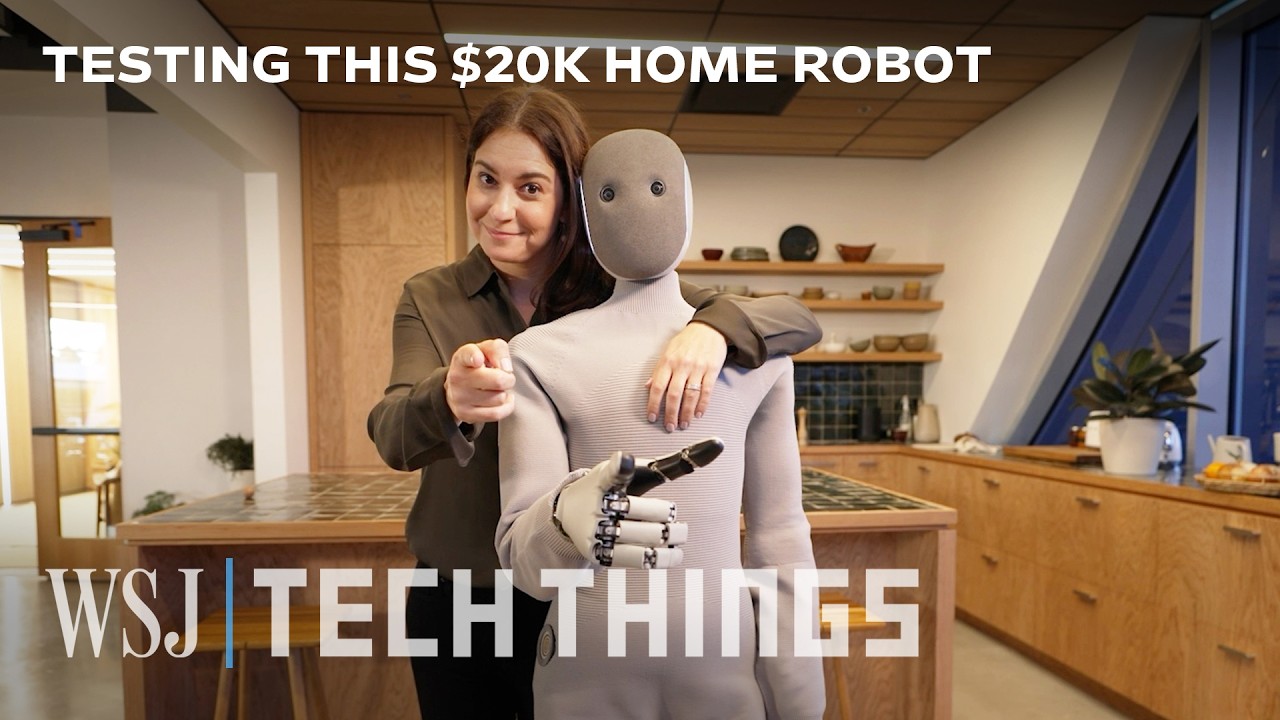
1
Think about these questions before watching. Share your ideas with a partner.
- If you were to integrate a humanoid robot into your daily life, what specific tasks would you delegate to it, and what boundaries would you need to establish to feel comfortable with its presence?
- How do you weigh the convenience offered by advanced home automation against the potential erosion of personal privacy that comes with internet-connected cameras and microphones?
- Looking beyond domestic help, what potential societal shifts, both beneficial and detrimental, do you anticipate with the widespread adoption of humanoid robots in roles traditionally held by humans, such as caregiving or customer service?
2
Watch the video from 2:25 to 5:25. Pay attention to the main ideas, key vocabulary, and examples in this section.
3
Answer these questions in your own words. Support your answers with evidence from the video.
01In what ways does the prototype of Neo shown in the video differ from the version planned for release in 2026?
Sample answerThe prototype demonstrated is slower and less refined than the final version is expected to be. The video mentions it needed breaks to charge and cool down, whereas the 2026 model will be safer and have superior hand dexterity.
02What is the primary challenge in Neo's development, and how is it currently being addressed?
Sample answerThe primary challenge involves developing both its physical body and its AI brain. Currently, the 'brain' aspect is addressed through tele-operation, where a skilled human pilot named Turing controls the robot remotely to perform tasks.
03Why is the use of tele-operation a crucial step in making Neo's AI model smarter?
Sample answerTele-operation is crucial because the videos of the robot performing tasks under human control serve as training data. This data is fed into the AI neural network, allowing it to learn from real-world examples and eventually perform tasks autonomously.
04What does the company representative mean by the 'big sister principle' and the associated 'social contract' for early adopters?
Sample answerThe 'big sister principle' is an analogy for the company's approach to data. Unlike a 'big brother' who just monitors, a 'big sister' is meant to be helpful. The 'social contract' is the understanding that for Neo to become more useful, users must agree to share their data, which is used to improve the AI. The user can decide how much data they are willing to trade for increased utility.
4
Key vocabulary for discussing new technology
Vocabulary
These expressions will help you discuss the development, impact, and challenges of technologies like AI and robotics with more precision.
Examples
To iron out the kinks — to solve the small problems or details in a new plan or system.
Usage note: This is a common, slightly informal idiom used when discussing product development. It implies that the main system is in place, but minor adjustments are still needed.
A double-edged sword — something that has both positive and negative consequences.
Usage note: Use this idiom to introduce a balanced argument or to highlight the complexity of an issue, such as the trade-off between AI convenience and data privacy mentioned in the video.
To be in its infancy — to be in the very early stages of development.
Usage note: This metaphor is often used to describe new technologies or industries, suggesting they have significant potential for future growth and change.
To bridge the gap (between A and B) — to connect two different things or reduce the difference between them.
Usage note: This is a useful collocation for discussing how technology can connect different concepts, like human intuition and artificial processing, or the digital and physical worlds.
The crux of the matter — the most important or central point of a complex issue.
Usage note: This is a semi-formal phrase used to focus a discussion on the core problem. For example, 'The crux of the matter is not if robots can perform tasks, but if they can do so autonomously and safely.'
5
Decide if each statement is true or false. Correct the false ones.
01The version of Neo demonstrated in the video required periodic breaks to recharge and cool down.
02The company representative likens their data collection model to a 'big brother' who monitors the user.
03The actions performed by Neo under human guidance are recorded and used as training material to enhance its own AI capabilities.
04The tasks Neo performed, such as getting a drink and loading a dishwasher, were executed autonomously by its advanced AI.
05The company suggests that the degree of Neo's usefulness is directly proportional to the amount of data a user is willing to share.
6
Complete the sentences with words from the box. One word is extra.
Word bank
01The increasing autonomy of AI is a sword; it offers incredible efficiency but also raises significant ethical concerns about control and job displacement.
02The of the matter in AI ethics isn't whether robots can perform human tasks, but whether they should, and what moral framework we should apply to them.
03Before the humanoid robot can be released to the public, the engineers need to iron out a few remaining in its operating system.
04Although the technology behind domestic androids is progressing rapidly, the field is still very much in its , with widespread adoption likely decades away.
05The development of more intuitive human-robot interfaces is essential to the gap between complex AI capabilities and everyday user accessibility.
7
Choose the best answer based on what you heard in the video.
01How is the human operator, Turing, controlling the Neo robot?
02What was the journalist's immediate physical reaction to operating Neo via tele-operation?
03According to the company representative, what is the primary justification for collecting user data through Neo?
04Which of the following aspects of Neo's future is NOT discussed in the video excerpt?
8
Humanoid Robots: Capabilities & Concerns
Explore the world of advanced robotics and the implications of integrating them into daily life.
Match each item on the left with the correct item on the right.
A
B
9
Discuss these questions with a partner. Try to use vocabulary from the lesson.
- The video reveals that a human may need to remotely control Neo to complete certain tasks. Do you see this as a reasonable step to help iron out the kinks while the technology is in its infancy, or is the crux of the matter that we are still too far from true AI autonomy for such products to be genuinely useful?
- The designers gave Neo a sweater to make it less 'creepy' and more approachable. Considering your own cultural context, what design elements do you think would be essential to bridge the gap between humanoid robots and the public in your country? What aesthetic choices might be seen as welcoming versus unsettling?
- Neo's design prioritizes safety, making it lightweight and not superhumanly strong. This is a double-edged sword, as it makes the robot safer but potentially less capable. For a domestic robot, do you believe the company has struck the right balance, or does this limitation make the product impractical?