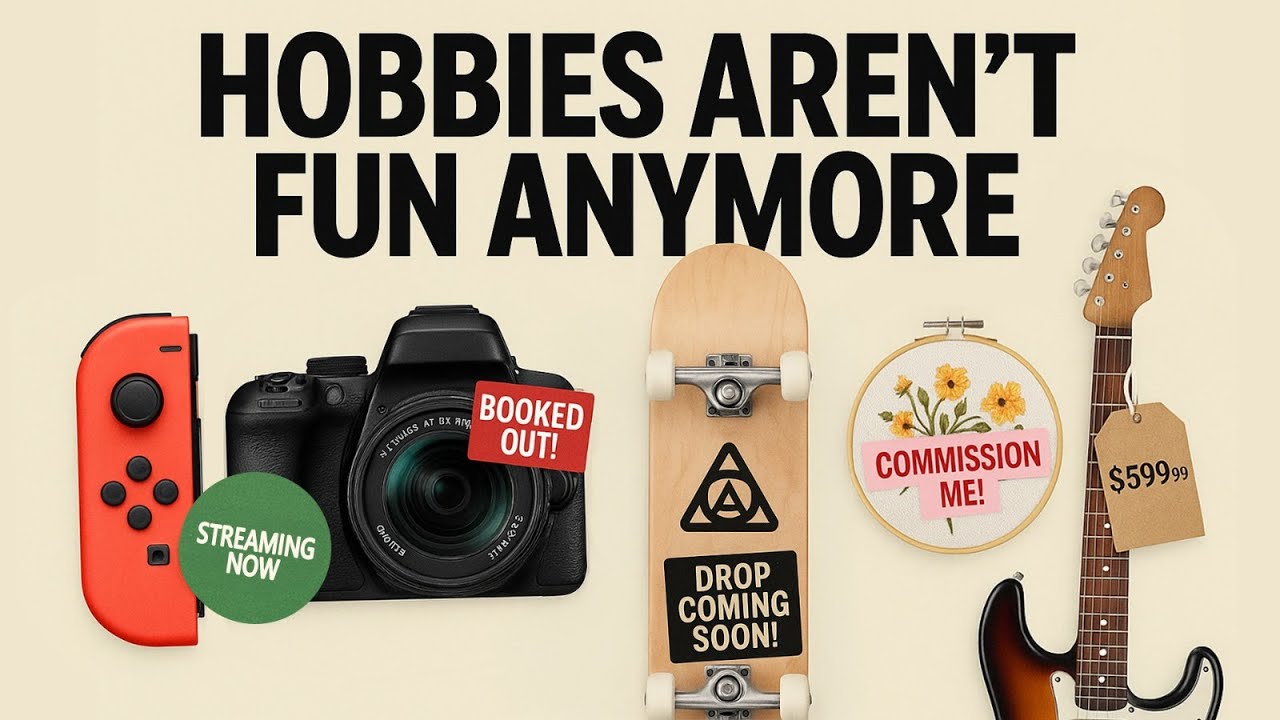
Hobbies and hustle culture: discussing purpose and enjoyment
1
Think about these questions before watching. Share your ideas with a partner.
- What, in your opinion, is the main purpose of having a hobby? Is it for relaxation, skill development, or something else entirely?
- In what ways has social media changed how people approach their hobbies and free time?
- At what point does a hobby stop being a hobby and start feeling more like a job? Describe the potential advantages and disadvantages of turning a passion into a profession.
2
Watch the video carefully. Pay attention to the main ideas and key details.
3
Answer these questions in your own words. Support your answers with evidence from the video.
01According to the speaker, how has our culture's view of hobbies changed?
Sample answerThe video says that hobbies aren't just for fun anymore. Now, there's a feeling that you have to be productive with them, like you're building a career or a brand, instead of just enjoying the activity itself.
02What does the speaker identify as the key element that made hobbies special in the past?
Sample answerThe speaker says they were special because it was the one part of your life where it was okay to be bad at something. You could experiment and make mistakes without any pressure or negative consequences because it was just for you.
03In what ways does the video suggest social media contributes to the pressure we feel about our hobbies?
Sample answerIt suggests that social media makes us feel like we have to turn everything into 'content'. So instead of just skateboarding for fun, you feel you should be filming it for TikTok. The act of documenting the hobby becomes more important than doing it.
04Why does the speaker describe simply enjoying a hobby as a 'radical' act?
Sample answerI think it's because our culture is so focused on productivity and 'hustling.' Doing something just for enjoyment, with no goal of making money or improving yourself, goes completely against that mindset. So, in this context, just having fun is a form of rebellion.
4
Key vocabulary
Vocabulary
These expressions will help you discuss the topic of hobbies and pressure more effectively.
Examples
Side hustle — a job or business that you do in addition to your main job to earn extra money.
Usage note: This is a very common, informal term. It often refers to turning a hobby or skill into a source of income, which is a key idea in the video.
To dabble in something — to take a slight and not very serious interest in a subject or activity.
Usage note: This is the opposite of the 'hustle' mindset. Use it to describe trying a hobby casually, without pressure to become an expert. For example: 'I'm not a serious painter, I just dabble in watercolours.'
To get caught up in something — to become so involved in an activity or situation that you don't notice other things.
Usage note: This phrasal verb often has a slightly negative meaning, suggesting a loss of perspective. For example: 'It's easy to get caught up in comparing your progress to others online.'
For its own sake — for the value or enjoyment of the activity itself, not for any other reason or reward.
Usage note: This is a great phrase for expressing the idea of intrinsic motivation. It directly contrasts with doing something to build a brand or make money. For example: 'I play the piano purely for its own sake.'
To monetize a hobby — to start earning an income from an activity you previously did for fun.
Usage note: This is a key collocation for this topic. It describes the process of turning a personal interest into a commercial one. For example: 'There's a lot of pressure on creators to monetize their hobbies.'
5
Decide if each statement is true or false based on the video. Correct the false ones.
01The video claims that people new to music production typically focus first on mastering complex musical theory.
02According to the speaker, the pressure to be productive often causes people to skip the initial experimentation phase of a new hobby.
03The speaker suggests that, for many, the act of documenting a hobby for social media has become more important than the enjoyment of the activity itself.
04The video's main argument is that the true value of a hobby is in the experience of doing it, not in the final result.
05The speaker's primary concern about turning hobbies into side hustles is the high risk of financial failure.
6
Complete the sentences with words from the box. One word is extra.
Word bank
01Many people feel pressure to their creative hobbies, turning their passion for painting or music into a source of income.
02She started baking cakes for friends, and it eventually grew into a successful that she runs on weekends.
03It's easy to get in the cycle of constant improvement and forget to simply have fun with your interests.
04I play the piano purely , not to perform for others or to build a career.
05Instead of trying to become an expert, I just want to in a few different activities like pottery and coding to see what I enjoy.
7
Choose the best answer based on what you heard in the video.
01According to the video, what is 'productivity guilt'?
02What example does the speaker use to illustrate how newcomers to a creative hobby often bypass the enjoyment phase?
03What does the speaker suggest is the true, beneficial function of a hobby?
04Which of the following consequences of 'hustle culture' is NOT directly mentioned in the video?
8
Hobbies or Hustle?
The speaker discusses how hobbies have changed. Match the phrases to complete the ideas.
Match each item on the left with the correct item on the right.
A
B
9
Discuss these questions with a partner. Try to use vocabulary from the lesson.
- The video suggests that the pressure to monetize a hobby can ruin the enjoyment. To what extent do you agree? Is it possible to have a successful 'side hustle' based on a passion without getting caught up in the pressure to perform?
- Thinking about your own culture, is there a strong emphasis on productivity in leisure time? Do people feel pressure to turn their passions into a 'side hustle', or is it more common for people to 'dabble in' activities just 'for their own sake'?
- Imagine a friend wants to start a new creative activity but is worried about the pressure to be good at it immediately. What practical advice would you give them to help them enjoy the process and do it 'for its own sake'?