Hybrid work models: debating policy and fairness
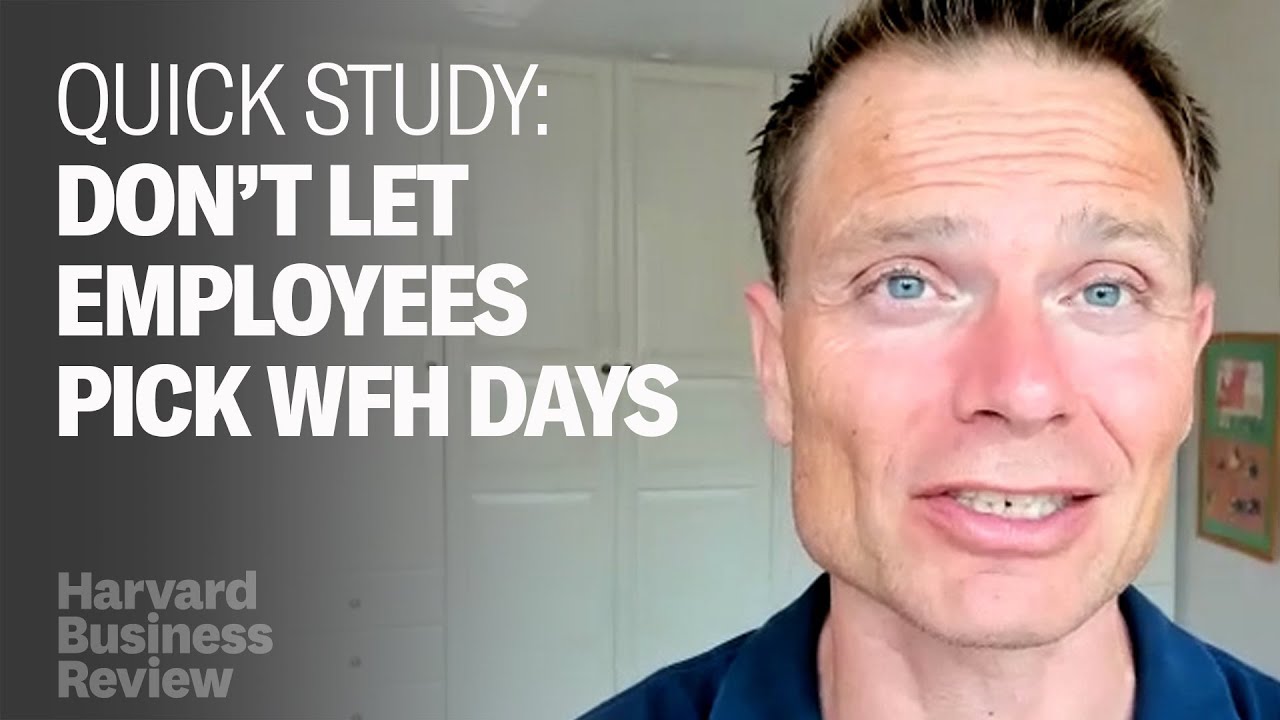
1
Think about these questions before watching. Share your ideas with a partner.
- If you were to design the perfect work week for yourself, what would be the ideal split between remote and in-office days, and what factors would influence your decision?
- To what extent should companies accommodate individual employee preferences for remote work versus mandating a uniform policy for everyone?
- Beyond the obvious benefits of flexibility, what potential social or professional drawbacks might arise in a workplace where employees have complete autonomy over their work location?
2
Watch the video carefully. Pay attention to the main ideas and key details.
3
Answer these questions in your own words. Support your answers with evidence from the video.
01According to the speaker, what are the primary drawbacks of 'mixed mode' meetings, and how do they contribute to the formation of in-groups and out-groups?
Sample answerThe main issue is that it creates an uneven playing field. People in the office can communicate non-verbally, which excludes remote attendees. The speaker also points out that the conversation often continues informally after the call ends, solidifying an 'in-group' of office-based staff who are more in the loop.
02In what way could granting employees full autonomy over their work-from-home schedules potentially lead to a 'diversity crisis'?
Sample answerThe speaker argues that specific demographics, such as working mothers or people with disabilities, are more inclined to choose remote work. If they're consistently absent from the office while others are present, they risk being overlooked for promotions, as one study showed their promotion rate was half that of their in-office colleagues. This could create a huge setback for diversity.
03The video outlines two significant problems with a team-by-team approach to scheduling. What are these challenges, and what underlying human behaviors do they expose?
Sample answerThe first is logistical: most teams would choose to work from home on Mondays and Fridays, leading to inefficient office use with mid-week overcrowding. The second is cultural, what he calls the 'great unraveling,' where senior staff coming in on remote days creates pressure for others to do the same, undermining the policy. It reveals a collective preference for long weekends and a tendency to follow leadership cues.
04Why does the speaker advocate for a less flexible, 'boring vanilla' hybrid model, and what potential long-term disaster does he believe this more rigid approach helps to avert?
Sample answerHe believes a 'free for all' approach is destined to fail due to the many problems it creates. He fears this failure would cause companies to abandon the hybrid model entirely and recall everyone to the office five days a week. Therefore, he sees a more structured approach as a way to 'bank the gains' and ensure the survival of hybrid work in the long run.
4
Vocabulary
Vocabulary
These expressions will help you communicate more naturally about this topic.
Examples
A one-size-fits-all approach — a standard solution or policy that is applied to everyone without considering individual needs or circumstances.
Usage note: This phrase is often used critically to argue for more tailored or flexible policies. For example: 'A one-size-fits-all approach to hybrid work rarely succeeds.'
Proximity bias — the unconscious tendency to give preferential treatment to employees who are physically present in the office over those who work remotely.
Usage note: Use this term to discuss the potential for unfairness in hybrid models, especially regarding promotions and opportunities. It's a key challenge for managers to overcome.
To be left out of the loop — to not be included in group communication or kept informed about important decisions and activities.
Usage note: This common idiom perfectly describes the risk for remote workers in a 'mixed mode' setting, as mentioned in the video. For example: 'If decisions are made informally after the meeting, remote team members are often left out of the loop.'
To strike a balance — to find a satisfactory compromise between two opposing forces or ideas.
Usage note: A very versatile phrase. In this context, companies must 'strike a balance between' employee autonomy and organizational needs.
To foster a sense of belonging — to actively create an environment where all individuals feel accepted, valued, and included as part of a group.
Usage note: This phrase is common in discussions about company culture and diversity. It addresses the 'in-group/out-group' problem by focusing on a positive, inclusive goal.
5
Decide if each statement is true or false. Correct the false ones.
01The speaker's perspective on employee autonomy in hybrid work shifted significantly after consulting with a large number of organizations.
02According to the speaker, the most popular days for employees to work from the office are Monday and Friday.
03A study cited in the video suggests that remote workers experience promotion rates that are 50% lower than their in-office counterparts.
04The speaker concludes by advising companies to adopt a cautious, data-driven approach to hybrid work, in direct opposition to the 'go fast and break things' philosophy.
05To prevent 'backsliding', the speaker argues that companies should merely permit, but not mandate, that employees work from home on designated days.
6
Complete the sentences with words from the box. One word is extra.
Word bank
01To ensure fairness in promotions, managers must actively combat by evaluating performance based on results, not physical presence.
02Remote employees often worry they will be on crucial decisions made during informal chats in the office.
03The new hybrid policy aims to between offering employees flexibility and maintaining a cohesive company culture.
04Companies are implementing new virtual team-building activities to among remote and in-office staff alike.
05Given the diverse needs of our global team, a to our work-from-home policy is simply not feasible.
7
Choose the best answer based on what you heard in the video.
01According to the speaker, why is it 'critically important' to mandate specific work-from-home days rather than simply allowing them?
02The speaker cites survey data indicating that several groups are more likely to choose to work from home. Which of the following groups does he specifically mention?
03The speaker warns that a 'free for all' hybrid model could be a disaster. Which of the following is NOT mentioned as a potential negative consequence?
04What is the speaker's core recommendation for companies navigating the implementation of hybrid work?
8
Hybrid Work Challenges
Understand key concepts and challenges related to hybrid work models.
Match each item on the left with the correct item on the right.
A
B
9
Discuss these questions with a partner. Try to use vocabulary from the lesson.
- The video argues that full employee choice can lead to some people being left out of the loop. To what extent should a company mandate specific in-office days to prevent this, and how can it strike a balance between flexibility and equitable team dynamics?
- Considering the cultural and societal norms in your country, which groups of people do you think would most advocate for remote work? How might this trend exacerbate proximity bias in career advancement, and what steps could be taken to mitigate it?
- Instead of a one-size-fits-all approach, some companies let individual teams set their own hybrid work rules. Do you think this is a viable solution, or could it create inequality and undermine efforts to foster a sense of belonging across the entire organization?