Professional networking: discussing social media at work
B1
90 min
Premium
1

Think about these questions before watching. Share your ideas with a partner.

  1. How do you think social media has changed the way people find jobs and build their careers?
  2. What are some good and bad things about sharing your professional life online?
  3. If you were hiring someone for a job, would you look at their social media profiles? Why or why not?
2

Watch the video carefully. Pay attention to the main ideas and key details.

Video script121 segments · click a timestamp to jump

In some ways, the point of Lincoln is obvious.

It's not like Instagram where you're supposed to look cool.

It's not like Twitter where you're supposed to be funny

and it's not like Facebook, where you're supposed to discover

that Harry Styles is a government psyop to turn our kids gay.

LinkedIn, however, is where you go to network.

It should be pretty straightforward.

So why the hell is it so weird?

I'm outside

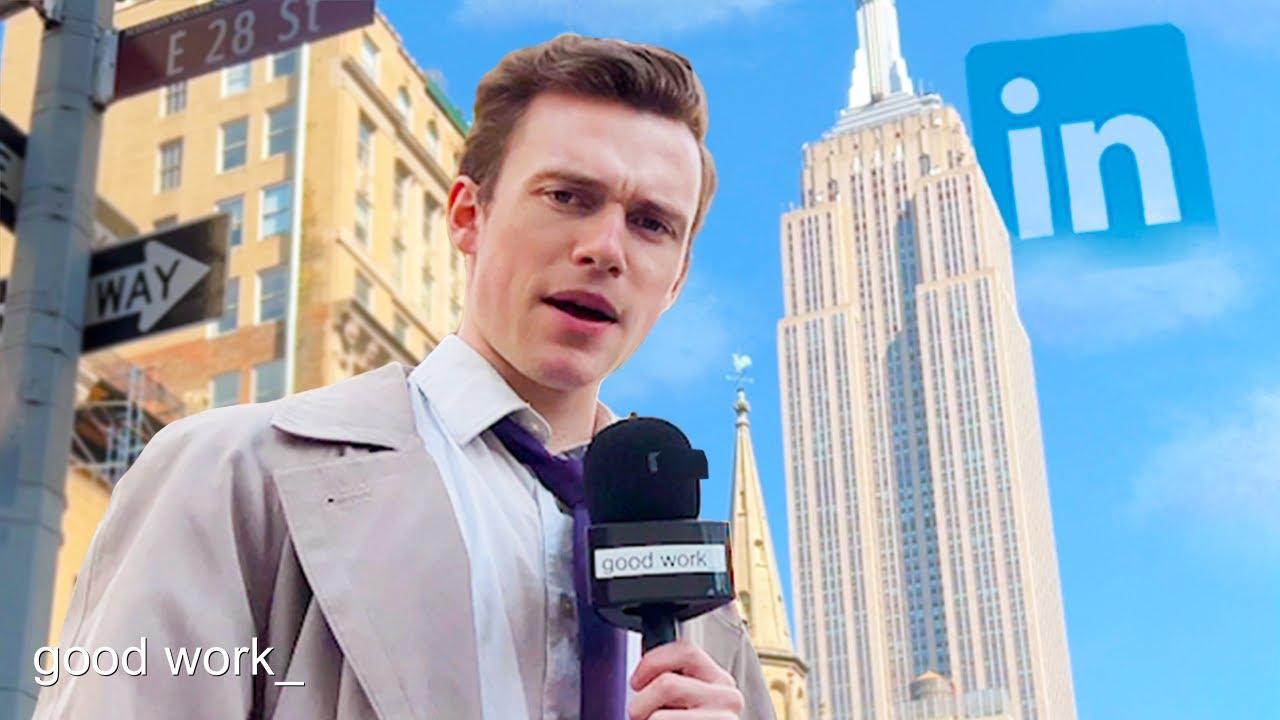
the New York offices of LinkedIn, the preeminent career platform

where people go for job listings, resume building and toxic thought leadership.

How Microdosing helps me relate to the women in our off

what Andrew Tate can teach us about team.

At what age did your child start? Dropshipping.

It's earlier than you think.

Let me explain.

LinkedIn is far and away the most well-known site for hiring.

Meanwhile, as a social network gets most successful, users employ a very

specific tone.

LinkedIn is megatrend. Cringe.

Cringe. Cringe.

Cringe.

I feel like there's like two sides to LinkedIn.

On one side, there is the like digital resumé.

It's a place where you go to maybe find your next job.

And then there's the other side of it, which is more of a social network.

Rachel Carden is a social media consultant and author of the link

in bio newsletter.

And she had a pretty simple explanation

as to why every viral LinkedIn post sounds like Tony Robbins Notes app.

The LinkedIn algorithm is a lot to blame for that sort of personality.

You know, celebrating the wins or highlighting a really engaging,

you know, post that you did on social media

and talking about it and bragging about it.

The algorithm likes that content, and so it feeds more of it.

Which is how you end up with posts like this CEO crying after laying people off,

or this guy asking for a special place on the train for networking, or this guy

talking about how he wants to work even after he's won the lottery,

or this guy saying there's not a cost of living crisis

but a not knowing how to make money crisis.

So why in the hell would anyone want to go viral in this sea of cringe?

You know, it's so important today for

C-level executives to have a presence on LinkedIn, right?

It's the world's biggest networking platform.

Julie Livingston is a public relations

strategist, host of the PR Patter podcast and LinkedIn ghostwriter.

I think LinkedIn is very different than Facebook or Instagram or Twitter

because somehow we take it more seriously.

And again, I think that's because it was initiated.

It was started as a business networking platform.

Julia has built a career off of helping people grow their LinkedIn profiles,

and she described to us the most effective way to communicate on the platform.

It sounds like the person is speaking to you.

It sounds like their voice, like they're just having a conversation

like you and I are having right now.

Sure.

But some would disagree.

LinkedIn is where good content goes to die.

It's the antisocial network where everybody has to be there.

Nobody wants to be there and everybody has to post stuff

that they don't really want to post there.

And then a few people post stuff that they know will get engagement there.

Jack Raines is a writer, business school student and author

of numerous viral LinkedIn posts that parody its cringe voice.

I'm a curator of vibes.

I live and die by my ability to post on the Internet.

And yeah, so I guess I'm a professional and non influencer.

And what kind of quality content does a LinkedIn non influencer put out?

It was like a personal finance hack on how to save money living in New York City.

So I said that every day I go to a different hotel in Manhattan

and I go eat their continental breakfast and then I sign off

on some random room number.

I don't actually do this, but I wrote on LinkedIn like, I post it.

Go to sleep.

Wake up the next day.

Over a million views. It went viral.

Jack's parody posts point out an underlying truth about LinkedIn

thought leadership.

Authenticity matters a lot less than being good at writing

the specific type of posts that the algorithm is horny for.

I feel like it exists in such an odd place because of

the very obvious acting that happens on their.

LinkedIn is a platform that's maybe even meant to be

your most authentic self, and it feels like

people are putting on a performance more than any other platform.

So if this is the state of LinkedIn now, where is it headed?

I mean, I think it's going to continue

to grow in importance as we become a global economy, right?

I mean, so I think it's going to continue to grow.

I don't think the algorithm will ever favor

just like normal sort of storytelling.

So I think we'll see more people

emulate the Adam Grant's of the world and talk like they're experts.

And that's usually how it all starts. It's

like if you talk like you are a thought leader, then you are a thought leader.

I think LinkedIn has the like it has the best longevity

out of all of them because it literally won't die.

Everybody on Instagram could eventually go to TikTok

or to another like photo video sharing app.

Twitter could die because there could be another better version of Twitter.

But with LinkedIn,

because it's so entrenched with like the professional Job Network side of it,

I do think that you're starting

to see more and more people post regular content on LinkedIn.

So while LinkedIn is the worst social media site now,

it has the most potential to be the biggest one

for both the social platform and professional.

But it's not there yet.

So get ready.

Working world, much like GE call it, and chlamydia.

LinkedIn isn't going away any time soon.

And if the future of social media doesn't look like Tik Tok reels, tweets

or YouTube shorts, at least it's something I'm familiar with.

Cringe

from this conversation.

Do you think I have what it takes to be a thought leader?

You know, Dan, I have to say, I've been so incredibly impressed by by

you and the way you address this, this this whole topic.

I think you do have what it takes.

Julie, thank you. Thank you for saying that.

I'll pay you the $15. I promise you for saying that later.

3

Answer these questions in your own words. Support your answers with evidence from the video.

01According to the video, what is the main purpose of LinkedIn compared to other social media sites?
Sample answerThe video says LinkedIn is for professional networking. It's not for looking cool like Instagram or being funny like Twitter.
02What reason does the video give for why so many LinkedIn posts have a similar 'cringe' style?
Sample answerAn expert says the LinkedIn algorithm is the reason. It promotes posts where people celebrate their successes, so more people create that kind of content to get attention.
03What does Jack Raines's viral story about free hotel breakfasts suggest about being successful on LinkedIn?
Sample answerIt suggests that being truthful isn't the most important thing. It's more important to write in the specific style that the algorithm likes, even if the story isn't real.
04Why do the experts in the video believe LinkedIn will likely exist for a long time?
Sample answerThey think it will last because it is so connected to the professional world and finding jobs. While users might move to a new photo app, there isn't another big platform for careers.
4

Key vocabulary for professional networking

Vocabulary
These expressions will help you communicate more naturally about careers and professional social media.
reach out to (someone) — to contact someone, often for the first time, to ask for help or make a connection
Usage note: This is a common and polite phrasal verb used in professional emails and messages. For example: 'I decided to reach out to the hiring manager on LinkedIn.'
personal branding — the way you present yourself to the public to build a particular reputation for your career
Usage note: This is about creating a professional image. You could say: 'He uses Twitter for his personal branding as an expert in marketing.'
get a foot in the door — to get your first opportunity to work in a particular company or industry
Usage note: This is a common idiom. An internship or a junior role is often a good way to get a foot in the door.
build a professional network — to create and grow a group of contacts who can help you in your career
Usage note: This is a key reason people use sites like LinkedIn. For example: 'Attending industry conferences is a great way to build your professional network.'
skill set — the range of skills and abilities a person has for a particular type of work
Usage note: You often see this on resumes and job descriptions. For example: 'The job requires a strong skill set in communication and data analysis.'
5

Decide if each statement is true or false. Correct the false ones.

01According to the video, people use Twitter to be funny and Instagram to look cool.
02The writer Jack Raines became famous on LinkedIn by sharing true stories about saving money in New York.
03One expert, Julie Livingston, says that good posts on LinkedIn should sound like a natural conversation.
04The video explains that the LinkedIn algorithm promotes posts where people celebrate their successes.
05Rachel Carden believes that LinkedIn will probably be replaced by a new professional network in the future.
6

Complete the sentences with words from the box. One word is extra.

Word bank
01It's important to with people in your industry to hear about new job openings.
02Creating a professional profile on sites like LinkedIn is a key part of personal .
03Don't be afraid to out to experienced professionals for advice.
04This job requires a very specific set, including excellent communication and problem-solving abilities.
05An internship can be a great to get a foot in the door at a big company.
7

Choose the best answer based on what you heard in the video.

01What is one of the jobs that public relations strategist Julie Livingston does?
02According to the video, what does writer Jack Raines call himself?
03What future trend does one expert predict for LinkedIn content?
04The video gives several examples of 'cringe' posts on LinkedIn. Which topic is NOT mentioned as one of them?
8

Key vocabulary for professional networking

Learn these useful words and phrases for talking about your career online.

Match each item on the left with the correct item on the right.

Drag or click to match
Definitions
9

Discuss these questions with a partner. Try to use vocabulary from the lesson.

  1. In your country, what is the most common way for people to build a professional network? Is it more important to use sites like LinkedIn or to meet people in person to get a foot in the door?
  2. The video shows examples of people sharing personal stories online. Do you think this kind of personal branding is a good way to show your personality, or is it better to only post about your professional skill set?
  3. Imagine you want to change careers. Who is one person (real or imaginary) you would reach out to for advice? What would you say to them to start building your network in a new field?