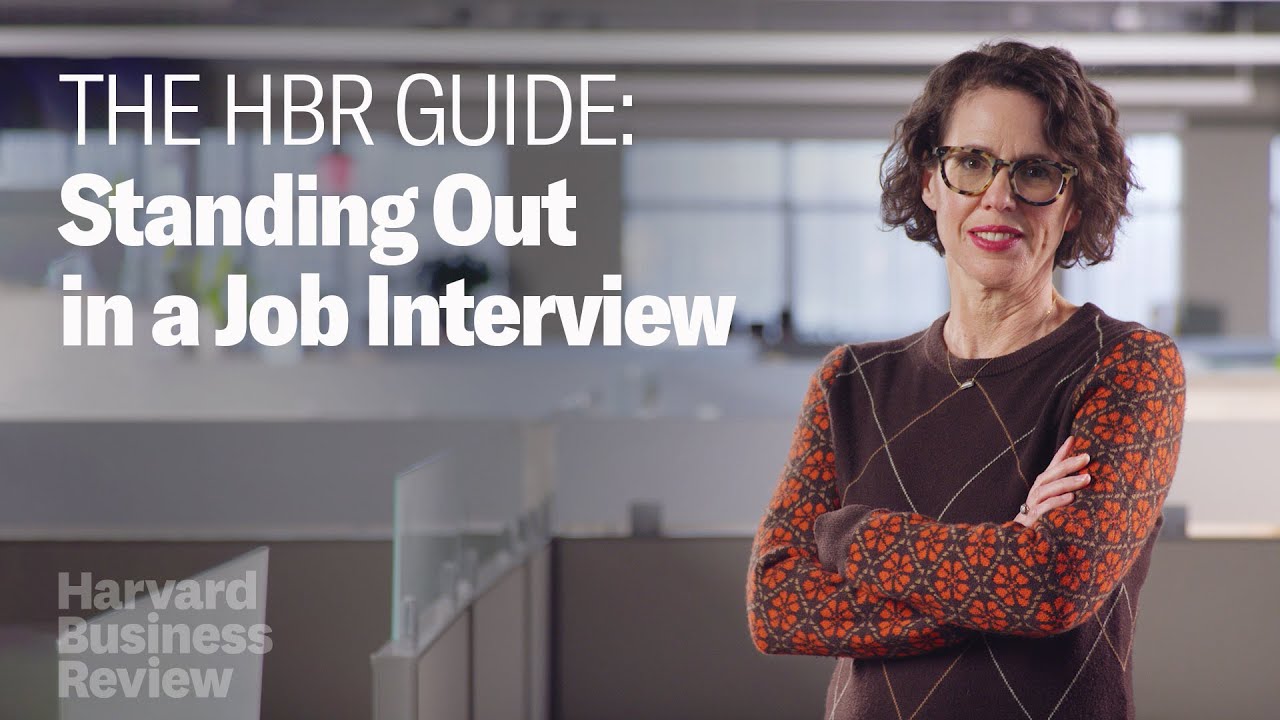
Job interviews: crafting compelling professional narratives
Expert strategies from Harvard Business Review to prepare, perform, and impress
B2
90 min
Premium
Scan to watch
1
Think about these questions before watching. Share your ideas with a partner.
Think about the common advice given for job interviews, such as 'be yourself'. What's the most contradictory or potentially unhelpful piece of advice you've ever received, and why do you think it's problematic?
Beyond simply listing skills from a CV, how can a candidate effectively narrate their professional journey to create a memorable and compelling impression during an interview?
In an age where company information is readily available, what constitutes 'going the extra mile' when researching a potential employer, and how can this preparation tangibly impact interview performance?
2
Watch the video from 1:05 to 5:15. Pay attention to the main ideas, key vocabulary, and examples in this section.
▶ You only need to watch 1:05–5:15. The exercises focus on this part.
Video script231 segments · click a timestamp to jump
AMY GALLO: Let's say you've landed a job interview
for a position you really want.
Well done.
Congratulations.
But when it's time for the interview,
you might get a lot of conflicting advice.
Be yourself.
Whatever you do, don't be yourself.
Take charge of the interview.
Let the interviewer be in charge.
Confusing, right?
Well, I'm here to help.
In this video, I've culled advice
from top experts in the field and want
to share strategic tips on how best to prepare, what to do,
and what to say so that you can make a great impression
in your next interview.
[MUSIC PLAYING]
First, do your homework.
Let's be honest.
Your primary job in the interview
is to dazzle them with the fact that you're perfectly
suited for the role.
But before you can do that, you need
to invest time in learning about the organization and the job.
So find out as much as you can about
how the organization is structured,
its culture, and relevant industry trends.
If possible, see what you can find out
about the people conducting the interview.
There may be valuable professional or personal points
of connection that could help make your interview more
relatable and memorable.
Lastly, research the requirements and challenges
of the particular position you're applying for
and the qualities of a successful candidate based
on that information.
Ask yourself questions like, what technical skills are
essential to perform this job?
What kinds of people skills would I need to succeed?
What do I need to prove I already know how to do
or that I'm willing to learn in order to be successful?
Being well-prepared will boost your confidence
and give you a better chance of acing the interview.
And all of this information is key to your success
in the next tip, crafting your stories.
That's right.
It's story time.
And these stories are all about why you are
the perfect person for the job.
As author Claudio Fernández-Aráoz reminds us,
"people buy into stories far more than they do evidence
or data."
A good story can also stir up empathy
and boost your likability.
If you give them a chance to relate to you as a real person,
you might just set yourself apart from the competition.
Remember how you just researched the skills required for the job
and what's important to the organization?
Well, now you get to tell powerful personal stories that
connect each of those to your own experiences,
values, and achievements in both your work and personal life.
Pick three or four main messages you want to convey and craft
your narratives accordingly.
The goal is to have these in your back pocket
so you can smoothly trot them out
as answers to relevant interview questions.
Author Vicky Oliver writes that a compelling story
has a great beginning, riveting middle,
and an end that makes the interviewer root for you
to win the job.
Have a good opening line, such as,
let me tell you about a time I rescued the organization,
then tell them about any obstacles or issues that arose
and how you overcame them.
Keep the story short but interesting and impactful.
An important note-- not all stories
have to show total perfection.
You will make a real impression and seem more relatable
if you can share stories of challenges and even mistakes,
as long as you remember to show what you learned from them.
Practice, practice, practice--
Once you select your stories, you need to rehearse.
Just like an actor prepares for the stage or screen,
you are preparing a character, a confident, competent, likable,
flexible version of yourself to perform in the interview.
I'm not saying you should be inauthentic or overexaggerate
your experiences or skills.
But author and coach Cathy Salit writes,
"You are literally auditioning for a new role."
You are presenting the best possible version of yourself.
And since you've done your homework,
you know what parts of your personality and experience
to emphasize for each position.
So what exactly should you practice?
Well, for one, practice your opening.
First impressions really matter here.
In fact, research shows that people
form opinions about your personality and intelligence
in the first 30 seconds of the interview, 30 seconds.
So in front of a mirror, pretend you are introducing yourself
and assess things like your posture, tone,
and body language.
You want to communicate a balance of ease, clarity,
and confidence.
The most important thing is to practice telling your stories
with energy and enthusiasm.
You want to be ready to share them as confident, clear,
and straightforward responses to relevant interview questions.
You can even practice in front of a friend
or record yourself on video.
You can then use the feedback to make any necessary adjustments
to your appearance or your delivery
before the actual interview.
Have a great conversation.
Once you're comfortable telling your stories,
Cathy Salit has another unique piece of advice.
Instead of performing as someone who
is trying really hard to get the job,
perform as someone who wants to have
a great conversation with the person across from you.
First, be curious or at least perform curiosity
if you need to.
Ask open-ended questions connected to what you've heard.
This will allow the conversation to unfold more naturally.
Side note, if you need some ideas,
check out the links for another HBR video on 38 smart questions
to ask in an interview.
Be ready to improvise.
I know I've just told you to prepare and rehearse
your stories, but they aren't just talking points
to be rattled off.
You also need to listen attentively and be ready
to accept every conversational opening with the classic improv
phrase, "yes, and" as a way to build upon the conversation.
Also, as author John Lees reminds us,
be flexible, read the room, and adjust accordingly.
If your radar is telling you that your stories aren't
working, you may need to supply different answers,
adjust your tone, or stop speaking altogether
because, well, some interviewers just love
to hear themselves talk.
Pay attention and change course as needed.
When things go wrong--
despite your best efforts to prepare,
interviews don't always go as planned.
Here are some potential pitfalls and what you can do about them.
Lack of direct experience--
If there are areas where your past achievements don't directly
correlate to the job, redirect the focus
away from where your experience might
fall short and towards an emphasis on your potential
and overall competence.
If you can demonstrate your ability to learn a skill
or adapt to a situation, this could convince an interviewer
to ignore any potential holes in your CV.
One side note-- taking charge of the interview in this way
can help steer interviewers away from unconscious biases
that favor experience over competence.
Tough questions about your resume--
If there are some less-than-perfect situations
on your CV, like a long pause in your work history
or a short stay at a recent job, John Lees
recommends preparing multiple ways
to reply so that you aren't left struggling for an answer.
First, prepare a simple, straightforward response
that doesn't go into too much detail.
Then have an additional reply ready
if the interviewer follows up.
For example, if you didn't finish
a degree that would have been helpful to the job,
be ready to answer an initial question with something like,
I felt it was better to go straight into the workforce.
If the interviewer pushes further,
be ready with another level of detail, such as I
thought about it carefully.
I knew it would carry negative connotations,
but I was confident that I would learn a lot more
with direct work experience.
Mistakes happen.
If you notice your interviewer losing interest
or you've stumbled over some answers,
don't dwell on the mistakes.
Just keep going and stay focused.
Answer the current question as if it's the first one.
Even acknowledging the situation with a corrective statement
like, am I giving you what you need,
is there other information I could give you,
and then following their cues can help dig you out
of the current hole and get the conversation back on track.
A note on preparing virtual interviews--
Many interviews these days take place virtually.
If that's the case for you, here are some specific things
you should do to prepare.
First, prepare your space.
You want your background to be clean and uncluttered.
Clean up the area around you, too,
even if it's not visible on camera.
Research shows that when our space is messy,
so is our thinking.
A clean environment will boost your mood
and make you feel less stressed.
These are things your interviewer can see,
and it will make a big difference in your performance.
Your face should be well lit and visible.
Make sure your internet speed is in good shape.
Pro tip, Google internet speed test
and check to make sure the Wi-Fi you are using
can handle the call.
Next, prepare yourself.
Even though it's virtual, you should dress for the interview.
Unless the organization is an all-suit situation,
experts recommend a business casual outfit in neutral colors
to appear more authentic, trustworthy, creative,
and knowledgeable.
Wear something comfortable.
You don't want to be fidgeting with your clothes
while on camera.
Use your computer's camera to check yourself
and your space ahead of time so you
can see what your interviewers will see and make
any necessary tweaks.
OK, let's review.
Here's a quick wrap-up of the do's and don'ts so you can stand
out in your next interview.
All of these strategies are based on articles
linked in the description.
Do you have any advice on how to stand out in an interview?
Or do you have other big topics you'd like me to cover?
Comment below.
Bye for now.
3
Answer these questions in your own words. Support your answers with evidence from the video.
01According to the video, why is telling stories more effective than simply presenting evidence or data in an interview?
Sample answerThe video suggests that stories are more powerful because people connect with them on an emotional level. It mentions that stories can stir up empathy and boost your likability, which helps you stand out as a real person, not just a list of qualifications.
02In what way does the initial research phase inform the process of crafting your personal stories for the interview?
Sample answerThe research is the foundation for your stories. By understanding the skills the job requires and what the organization values, you can then select personal stories that directly demonstrate you possess those specific qualities and have relevant achievements.
03What specific advice does the video give regarding sharing stories about challenges or even mistakes?
Sample answerThe video encourages it, saying that sharing stories about mistakes can make you seem more relatable and leave a real impression. The crucial part is that you must also explain what you learned from the experience to show growth.
04The video suggests you are 'auditioning for a new role.' How does it reconcile this idea of performance with the need to remain authentic?
Sample answerIt makes a distinction between being inauthentic and presenting the best version of yourself. The 'performance' isn't about inventing skills, but about consciously emphasizing the parts of your personality and experience that are most relevant for that specific job.
4
Key expressions for professional narratives
Vocabulary
These expressions will help you discuss your professional experiences with more nuance and impact.
Examples
To think on one's feet — to be able to think and react to things very quickly and effectively without any preparation.
Usage note: This idiom is perfect for describing how you handle unexpected questions in an interview. For example: 'The follow-up question was tricky, but I managed to think on my feet and give a solid answer.'
To strike the right chord — to say or do something that is exactly right for a particular situation or that resonates emotionally with people.
Usage note: This is useful for describing the impact of your stories. For example: 'My story about teamwork seemed to strike the right chord with the hiring manager.' It's about making a positive, memorable impression.
To articulate one's vision/thoughts — to express your ideas or feelings fluently and coherently.
Usage note: This is a sophisticated way to describe clear communication, a key interview skill. It's a more formal alternative to 'explain well'. For example: 'The role requires someone who can articulate a clear vision for the department's future.'
A steep learning curve — a situation in which someone has to learn a lot of new things in a very short period of time.
Usage note: This phrase is often used when telling a story about a past challenge. Describing a project as having 'a steep learning curve' can positively frame a difficult experience, highlighting your ability to adapt and learn quickly.
To build rapport with (someone) — to create a friendly, harmonious relationship where people understand each other well and communicate effectively.
Usage note: This is a key objective in an interview, connecting to the video's advice on likability. You can also 'establish' or 'develop' rapport. It's often used in professional or semi-formal contexts.
5
Decide if each statement is true or false. Correct the false ones.
01The speaker endorses the idea of viewing an interview as a type of performance, where you present a carefully prepared version of yourself.
02The video suggests preparing five to six key narratives to have ready for relevant interview questions.
03The video cites author Vicky Oliver's advice that a powerful story should conclude in a way that makes the interviewer emotionally invested in your success.
04According to the video, stories about challenges or mistakes can be particularly effective if they demonstrate a lesson learned.
05The video claims that interviewers typically form a lasting opinion about a candidate's personality and intelligence within the first few minutes of the meeting.
6
Complete the sentences with words from the box. One word is extra.
Word bank
01During the interview, it's crucial to your long-term career goals and how they align with the company's vision.
02She managed to build an immediate with the hiring manager by discussing their shared interest in sustainable technology.
03You should aim to your past project management experience to demonstrate your suitability for a leadership role.
04When asked about your greatest weakness, it's best to answer honestly but , focusing on what you've learned from it.
05Despite the challenging technical questions, the candidate maintained her and answered each one with calm confidence.
7
Choose the best answer based on what you heard in the video.
01According to the video, what is the primary benefit of researching the individuals who will be conducting the interview?
02When practicing the first 30 seconds of an interview, what combination of qualities does the speaker advise a candidate to project?
03The video suggests several methods for rehearsing your interview performance. Which of the following is NOT recommended as a practice technique?
04What final piece of advice from author Cathy Salit is offered to shift a candidate's mindset during the interview itself?
8
Job Interview Preparation
Strengthen your vocabulary and understanding of job interview strategies.
Match each item on the left with the correct item on the right.
A
B
9
Discuss these questions with a partner. Try to use vocabulary from the lesson.
The video suggests people 'buy into stories far more than they do evidence or data'. To what extent is this a license to embellish one's history? At what point does crafting a narrative to strike the right chord cross the line into being disingenuous?
Considering the professional culture in your country, how effective would the 'storytelling' approach be for building rapport with an interviewer? Are there situations where a more direct, data-driven presentation of your skills would be more appropriate?
Imagine an interview for a role with a notoriously steep learning curve. How could a candidate articulate their vision and prove they can think on their feet, even if they can't demonstrate direct experience with every required skill?
This lesson is for Lessonpills members
Sign in at learn.lessonpills.com to print lessons or save them as PDF.