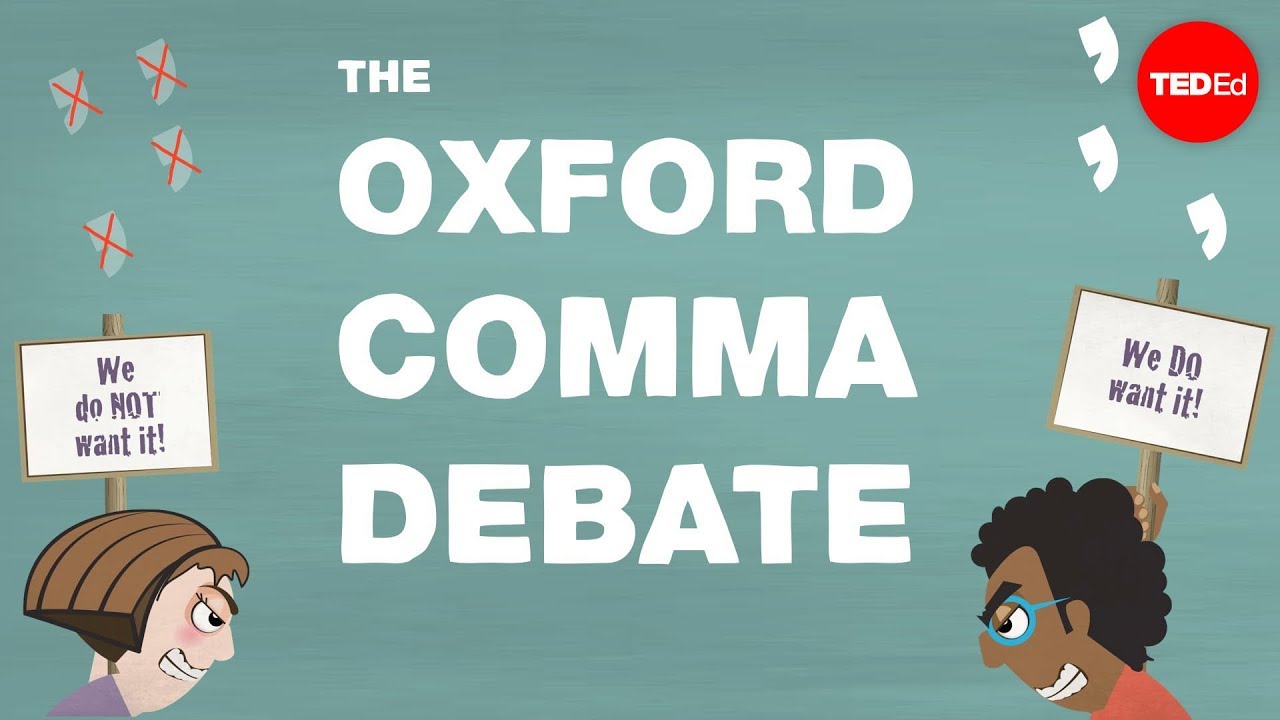
Grammar debates: arguing for and against the Oxford comma
1
Think about these questions before watching the video. Share your ideas with a partner.
- Describe a time when a minor linguistic ambiguity—like a misplaced comma or a poorly worded text—led to a significant or humorous misunderstanding. What was the fallout, and how could it have been averted?
- To what extent should language 'rules,' such as those for punctuation, be treated as rigid laws versus flexible guidelines? Consider the different demands of formal writing, digital communication, and creative expression.
- In our age of rapid-fire digital communication, clarity is often sacrificed for speed. What strategies do you employ to ensure your tone and meaning are not misconstrued, especially when punctuation is minimal or used unconventionally?
2
Watch the video carefully. Pay attention to the main ideas and key details.
3
Answer these questions in your own words. Support your answers with evidence from the video.
01In what way is the common usage of the 'Oxford comma' ironic, according to the video?
Sample answerThe irony lies in its name versus its actual prevalence. Despite being called the 'Oxford' comma, it's actually more widely used in the United States, where it's recommended by several major style guides. In the UK, most guides advise against it, with its namesake, the Oxford University Press, being a key exception.
02What are the primary arguments presented in the video for omitting the serial comma?
Sample answerThe video mentions a few key reasons. The main one is that the conjunction, like 'and', is usually sufficient to separate the final items in a list. Another point, particularly from a journalistic perspective, is that it takes up precious space and can make text look cluttered. Finally, it suggests that simply reordering the items in a list can often resolve any ambiguity.
03The video suggests a 'truce' has been reached, deeming the comma's use optional. Why does the narrator find this solution problematic?
Sample answerThe narrator finds this 'truce' flawed because of the principle of consistency. You're expected to either use the comma throughout a piece of writing or not use it at all. This means you can't just insert it selectively where you think it might prevent confusion, which undermines the idea of it being a truly optional tool. The narrator also finds the very idea of an optional grammatical rule to be a bit odd.
04Beyond formal rules, what does the video suggest ultimately shapes an individual's preference for the serial comma, and what is the video's concluding message about this debate?
Sample answerThe video concludes that personal preference is often shaped by one's upbringing and professional training—what your teachers or first editors insisted upon. The final message is that while the debate might seem like 'hairsplitting over a tiny squiggle,' and there are bigger problems in the world, these seemingly minor details in language can sometimes make a significant difference to meaning.
4
Decide if each statement is true or false. Correct the false ones.
01The Associated Press (AP) Style Book is presented as a prominent US publication that advocates for the use of the Oxford comma.
02The video opens with an anecdote about planning a party to demonstrate how omitting the serial comma can result in a fundamental misunderstanding.
03The primary objection journalists have to the serial comma, as stated in the video, is that it makes writing seem overly formal and academic.
04According to the video, one of the arguments against the serial comma is that, in certain contexts, it can paradoxically create ambiguity instead of preventing it.
05The video's final example involving 'ninjas, pirates, vikings, old and young' illustrates the confusion that can occur when the comma's application is not standardized.
5
Vocabulary
Vocabulary
These expressions will help you communicate more naturally about this topic.
Examples
A bone of contention — a subject or issue that people have strong disagreements about over a long period of time.
This is a common idiom used to describe a recurring point of conflict. For decades, the use of the Oxford comma has been a bone of contention among writers and editors.
To split hairs — to argue about very small, unimportant details or differences.
This idiom often has a slightly negative connotation, suggesting someone is being overly pedantic. Example: 'Frankly, arguing about this comma feels like splitting hairs when the overall meaning is clear.'
A stickler for something — a person who insists on strictly following a certain rule, principle, or way of doing things.
This is a common collocation. You can be a 'stickler for grammar', a 'stickler for punctuality', etc. It describes someone who is very precise and perhaps inflexible.
To err on the side of caution — to be deliberately more careful than necessary in order to avoid risk or potential problems.
A useful semi-formal phrase for explaining a careful decision. Proponents of the Oxford comma argue it's better to err on the side of caution and use it to prevent any possible misreading.
To leave something open to interpretation — to phrase something in a way that is ambiguous and can be understood in more than one way.
This phrase is key when discussing clarity. The main goal of punctuation rules is to avoid leaving sentences open to interpretation.
6
Grammar: Cleft Sentences
Grammar
Cleft sentences are used to emphasize a particular part of a sentence. They split a single clause into two, allowing you to focus the reader's attention on specific information. This is especially useful when discussing rules for clarity, such as the use of the Oxford comma mentioned in the video.
Examples
It's the potential for ambiguity that makes the Oxford comma so controversial.
This 'it-cleft' (It + be + emphasized part + that/who clause) highlights 'the potential for ambiguity' as the core reason for the debate.
What some style guides argue is that the conjunction 'and' is sufficient on its own.
This 'wh-cleft' (Wh-word + clause + be + emphasized part) focuses on the specific argument being made, rather than just stating the fact.
The thing that could have prevented the party disaster was a single, well-placed comma.
Structures like 'The thing that...' or 'The reason why...' are another common way to form cleft sentences to pinpoint specific information.
Key points
- Use cleft sentences to add emphasis or focus to a specific piece of information.
- The two main structures are 'it-clefts' (It is/was...) and 'wh-clefts' (What...).
- Common mistake: Overusing them. They are for special emphasis, not for every sentence.
7
Correcting the Details
Attention to detail is crucial in writing. Can you spot the subtle errors in these sentences?
Each sentence contains one error. Find and correct it.
01The use of the serial comma has long been a bone of argument between American and British publishers.
Corrected version
The use of the serial comma has long been a bone of argument contention between American and British publishers.
02It was the ambiguous phrasing, not the core idea itself, what left the entire contract open to interpretation.
Corrected version
It was the ambiguous phrasing, not the core idea itself, what that left the entire contract open to interpretation.
03My old journalism professor was a real stickler to the rules of the AP Stylebook.
Corrected version
My old journalism professor was a real stickler to for the rules of the AP Stylebook.
04The inconsistency among various style guides often leave professional writers feeling unsure about which rule to follow.
Corrected version
The inconsistency among various style guides often leave leaves professional writers feeling unsure about which rule to follow.
05Some might say we're splitting the hairs, but in legal documents, the placement of a single comma can change everything.
Corrected version
Some might say we're splitting the hairs, but in legal documents, the placement of a single comma can change everything.
06Having been trained as a technical writer, I'm not accustomed to see such creative and informal punctuation.
Corrected version
Having been trained as a technical writer, I'm not accustomed to see seeing such creative and informal punctuation.
07If the original text would have been clearer, we could have avoided this entire debate about its meaning.
Corrected version
If the original text would have had been clearer, we could have avoided this entire debate about its meaning.
8
Useful phrases: Clarifying Details in Written Work
Vocabulary
In a professional setting, you often need to discuss small but crucial details in reports, emails, or presentations. Like the Oxford comma debate in the video, a minor point of grammar or wording can create major confusion. These phrases will help you give and receive feedback constructively, ensuring everything is crystal clear.
Examples
"Could we take a quick look at the wording in this section?" — A gentle way to introduce a specific point of feedback.
Register: Neutral/Slightly Formal. Use this to open a discussion about a specific part of a document without sounding critical. It frames the feedback as a collaborative check.
"The way this is phrased could be read in two ways." — Highlights potential ambiguity without assigning blame.
Register: Neutral. This is a diplomatic way to point out that a sentence is unclear. It focuses on the text itself, not on the person who wrote it.
"Just to be crystal clear, perhaps we could rephrase it to..." — A constructive way to offer a specific solution.
Register: Collaborative/Neutral. Use this when you have a concrete suggestion. It emphasizes the shared goal of clarity rather than simply pointing out a problem.
"I know this might seem like a minor point, but it could make a real difference to how the client perceives this." — Justifies focusing on a small detail.
Register: Neutral/Persuasive. This is the perfect phrase to use when you want to avoid sounding like you're 'splitting hairs'. It connects a small change to a significant business outcome.
"You've got a point there; my suggestion might be overkill." — Acknowledges that your colleague's counter-argument is valid.
Register: Informal/Neutral. Shows you are listening and flexible. Using a word like 'overkill' (meaning 'more than is necessary') sounds natural and builds rapport.
"So, are we agreed on making that change for consistency's sake?" — Seeks confirmation and moves towards a conclusion.
Register: Neutral/Formal. A great way to wrap up a discussion on a specific edit. Providing a reason like 'for consistency's sake' is a common and professional way to justify changes.
9
Discuss these questions with a partner. Try to use vocabulary from the lesson.
- The video suggests a truce where the comma's use is optional. In professional or legal writing, do you think it's better to be a stickler for consistency with a chosen style guide, or should one always err on the side of caution and add the comma to prevent any possibility of misinterpretation, even if it makes the text slightly less concise?
- The Oxford comma is a significant bone of contention in English. Thinking about your native language, what are some similar grammatical or stylistic 'rules' that people are sticklers for? Are there debates that an outsider might consider splitting hairs, but that native speakers feel strongly about?
- The video notes that journalists dislike the comma as it takes up precious space. In today's digital age of tweets and instant messaging, is the debate over such rules becoming irrelevant? Or does the potential for rapid, widespread misunderstanding mean we should be even more careful not to leave things open to interpretation?