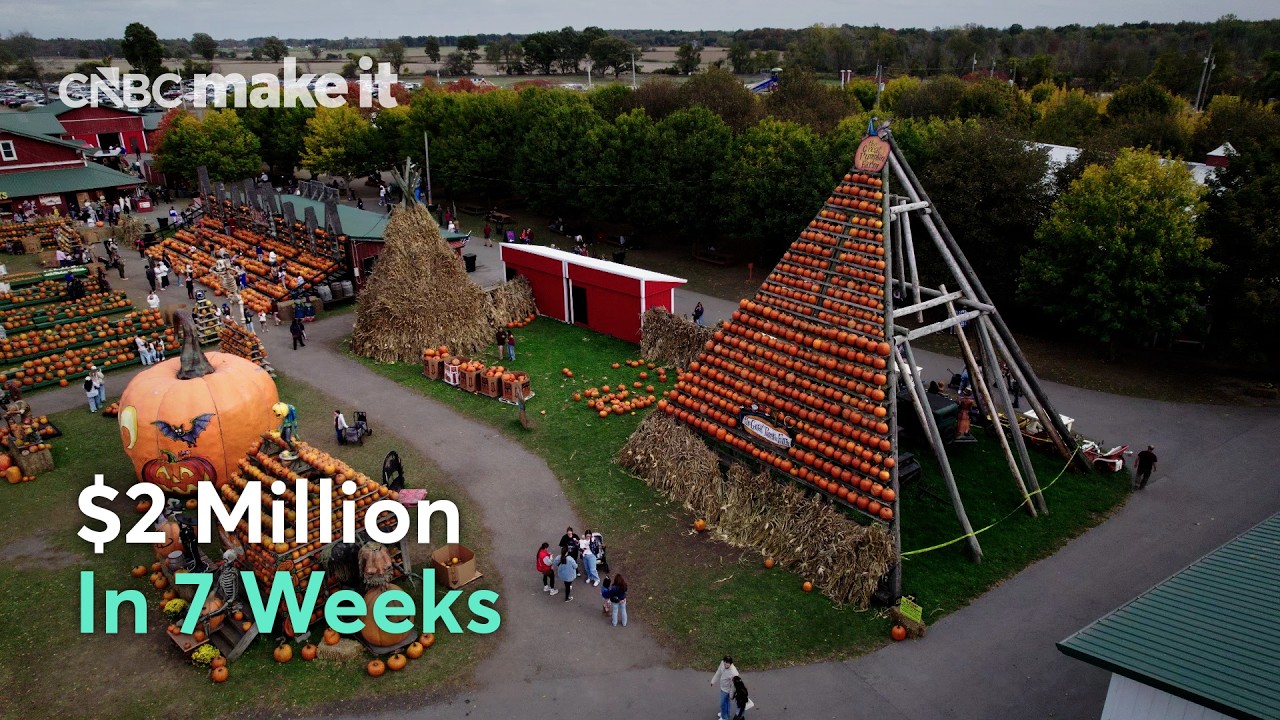
My pumpkin farm brings in $2 million in only 7 weeks
B2
60 min
Premium
1

Think about these questions before watching.

  1. Have you ever pursued a project or idea that others initially dismissed or thought was a bit 'crazy'? What was it, and what gave you the confidence to move forward despite their skepticism?
  2. The video features someone who saw potential in an existing, but poorly run, business model. Can you recall a time when you noticed a clear opportunity to improve something – a service, a product, or an event – that others seemed to overlook? What made you see that potential?
  3. Beyond traditional retail or services, what are some creative or unconventional ways people can generate significant income, perhaps even in a short timeframe or with a unique product? What kind of skills or resources would be essential for such ventures?
2

Watch the video carefully. Pay attention to the main ideas and key details.

Video script152 segments · click a timestamp to jump

When I told people I was going to

start up a pumpkin farm,

everybody thought I was crazy. A

pumpkin farm? What do you know

about pumpkins? I said, "Nothing,

but I'll learn. I'll figure it

out." My pumpkin farm brought in

$2 million in less than seven

weeks in 2025.

My business is basically the

antique business and auction

business. That's been my business

all my life. We start to open up

the pumpkin farm halfway through

September. We end October 31st.

You can buy just about any kind of

pumpkin here. You know, we've got

the gourds, we've got the minis,

we've got the jumbos.

It's well over 100,000 people that

visit the farm. The attendance is

generally increasing just about

every year.

That is very simple.

Take the apple. Oh yeah.

I decided to do a pumpkin farm

years ago. We went and visited a

pumpkin farm down in the Southern

Tier. They had muddy parking lots

and not a whole lot of restrooms,

but there were a zillion people

there. I mean, there were just all

over the place. And I looked

around and I said,

I could do this better than this.

I bought the pumpkin farm,

I believe it was around 1990.

This was just a cow farm.

It had some old barns and things

like that. We opened up the

pumpkin farm in 1996.

All of these trees we planted

about 25 years ago.

When I was a young kid, I grew a

couple of pumpkins, and I actually

went around and sold them to some

of the neighbors. But that really

had nothing to do with this

because I didn't know much at all

about growing pumpkins.

We do grow some pumpkins,

but we actually contract with a

lot of the local farmers to grow

them for us also because of the

quantity. When we first opened up

the first year, I called up a

gentleman who ran the World

Pumpkin Weigh-Off,

asked him to move his site up to

here. What we did is we bought

insurance to give us $50,000 to

somebody if they brought us a

1,000 pound pumpkin,

because the first year I wanted to

start with a bang.

At that time, the biggest pumpkin

ever grown had been about 800

pounds. So they gave us a policy.

And don't you know that the first

year that we ran here,

somebody brought in 1,061 pounder.

They won $50,000.

It was not local news or national

news. It was international news.

We were in magazines and

newspapers all over the world.

We have about 100 people that work

here. Hey, Joe, how are you?

Oh, jeez. Yes.

Now you're gonna have to try one

of these. One grilled cheese

sandwich. You want tater tots with

that? And you're gonna have to try

one of these. I only eat one

probably every week or so.

Or maybe it's every day or so.

It's wonderful to have somebody

working with you that is your son,

your daughter, this and that. You

know, Ben helps me in many,

many, many ways. He's worked with

me since he was a little kid.

My daughter has helped us out

periodically here,

so it's definitely a family event.

We could use some more pumpkins up

here on this pumpkin house.

We close down the farm right after

Halloween, and now we spend

probably literally a month

cleaning up, putting stuff away

for the next year. For the rest of

the year, between our antique

business, our auction business,

we also have 700 storage units

over here that we deal with.

So we've got about 20,

25 full-time people over there all

times. Coming to The Great Pumpkin

Farm during the week is free.

Weekends it's $20 a person to get

in. Gross revenue for The Great

Pumpkin Farm was over $2 million

in 2025.

The business has been profitable,

but we generally take most of the

money and try and put it back into

it. We've talked about opening up

an ice cream parlor that would be

open from April, go right through

along with the pumpkin farm.

We've talked about also putting up

a couple other event buildings,

eventually. We own about 300

acres. Right now,

we're maybe using 75 acres,

so we still have plenty of land to

add things over the next years if

we need to. I'm sure that the

pumpkin farm will be a

generational business.

My son is very, very much involved

with me. I mean, I wouldn't be

doing this anymore, probably if he

wasn't involved now.

Two of his sons are working along

with it. Running a pumpkin farm,

it's a lot more complicated than

what I would have thought it was,

just because of all the different

events, but it's still a lot of

fun. I think the most rewarding

part is when I walk through and I

see families with little kids,

and the little kids are jumping up

and down. I want to see this.

I want to see that. They're

laughing. They're having fun. We

have a wonderful, wonderful time.

And fall is by far and away,

I don't know of a better place you

can be.

3

Answer these questions in your own words. Support your answers with evidence from the video.

01How did the owner's previous business experience influence his decision to start a pumpkin farm, and what was his initial attitude towards learning about pumpkins?
Sample answerThe owner had a background in the antique and auction businesses. He admitted he knew 'nothing' about pumpkins at first, but he was confident he could learn and 'figure it out' as he went along.
02What unique strategy did the owner use in the first year to generate significant international attention for the pumpkin farm?
Sample answerIn its first year, the farm offered a $50,000 prize to anyone who could bring in a 1,000-pound pumpkin. This was a huge gamble because the world record was only 800 pounds at the time, but someone actually brought a 1,061-pound pumpkin, which made it international news.
03Beyond the pumpkin farm, what other business interests does the owner manage, and how do these activities fit into his annual schedule?
Sample answerAfter the pumpkin farm closes for the season and they spend about a month cleaning up, the owner focuses on his antique and auction businesses for the rest of the year. He also manages 700 storage units, which provides work for his full-time staff outside of the pumpkin farm's operating months.
04In what ways is the owner ensuring the long-term success and continuity of the pumpkin farm for future generations?
Sample answerThe owner reinvests most of the profits back into the farm and plans to expand by adding new attractions like an ice cream parlor and more event buildings, using their extensive unused land. Crucially, his son and two grandsons are already actively involved, making it a generational business.
4

Vocabulary

Vocabulary
These expressions will help you communicate more naturally about this topic.
take a leap of faith — to do something risky or difficult, trusting that it will work out well
This idiom is often used when someone decides to pursue a dream or a new opportunity despite uncertainties. It implies courage and optimism.
a lucrative venture — a business project or undertaking that generates a lot of money or profit
"Lucrative" is a more formal adjective than "profitable" and is often used in business contexts to describe investments or opportunities that bring in significant income.
learn the ropes — to learn how to do a particular job or activity, especially one that is new to you
This informal idiom is commonly used when someone is new to a role, industry, or skill and needs to understand the procedures and practicalities involved.
tap into a niche market — to identify and successfully use or exploit a small, specialized segment of a larger market
This phrase is common in business discussions. A "niche" refers to a specific group of customers with particular needs or interests that a business can cater to.
yield substantial returns — to produce a significant amount of profit or benefit from an investment or effort
"Yield" is often used in financial contexts for investments, while "substantial" emphasizes the large quantity. It's a semi-formal phrase to describe a very profitable outcome.
5

Complete the sentences with words from the box. One word is extra.

Word bank
01Starting a new business often requires you to and trust your instincts, even when the outcome is uncertain.
02The tech startup proved to be for its founders, generating millions in its first year.
03When you join a new company, it takes some time to and understand how everything works.
04Many successful entrepreneurs aim to by offering unique products or services to a specific group of customers.
05Investing in renewable energy projects can in the long run, benefiting both investors and the environment.
6

Match each word on the left with its natural partner on the right.

A
B
7

Grammar: modal perfects for past deductions, possibilities, and regrets

Grammar
Modal perfects combine a modal verb (such as 'must', 'might', 'could', 'should') with 'have' and the past participle of a verb. We use them to express deductions, possibilities, or regrets about past events, which is very useful when discussing business decisions and outcomes.
Starting a unique business like a pumpkin farm must have required a lot of courage and hard work.
Use 'must have' + past participle to express a strong deduction or certainty about something that happened in the past.
Many people might have doubted the idea at first, thinking it was too niche to be profitable.
Use 'might have' or 'could have' + past participle to express a possibility or speculation about a past event, indicating less certainty.
The founder shouldn't have listened to the skeptics; his vision clearly paid off.
Use 'shouldn't have' + past participle to express regret or criticism about a past action that was not taken, or a past action that was taken but was wrong.
Without careful planning, the business could have failed within its first season.
Use 'could have' + past participle to talk about a past possibility that didn't happen, or an alternative outcome.
  • Use 'must have + past participle' for strong deductions about past events.
  • Use 'might have / could have + past participle' for possibilities or speculations about the past.
  • Use 'should have / shouldn't have + past participle' to express regret, advice, or criticism about past actions.
8

Correcting errors in business and farming contexts

Read each sentence carefully. Each one contains a single error in grammar, vocabulary, or usage. Identify the error and write the corrected sentence.

Each sentence contains one error. Find and correct it.

01To succeed in a new industry, you often need taking a leap of faith.
Corrected version
To succeed in a new industry, you often need taking to take a leap of faith.
02The new business proved to be extreme lucrative, generating significant income.
Corrected version
The new business proved to be extreme extremely lucrative, generating significant income.
03It took him a while to learn the ropes about the agricultural sector.
Corrected version
It took him a while to learn the ropes about of the agricultural sector.
04Identifying and tapping in a niche market can be key to a startup's success.
Corrected version
Identifying and tapping in into a niche market can be key to a startup's success.
05The early investment in sustainable practices will hopefully yield substantially returns in the long run.
Corrected version
The early investment in sustainable practices will hopefully yield substantially substantial returns in the long run.
06He should had considered the risks before investing so much money in the project.
Corrected version
He should had have considered the risks before investing so much money in the project.
07A large number of visitors was surprised by the variety of pumpkins available at the farm.
Corrected version
A large number of visitors was were surprised by the variety of pumpkins available at the farm.
08The owner's vision for the farm was very unique, attracting many customers from nearby cities.
Corrected version
The owner's vision for the farm was very unique, attracting many customers from nearby cities.
9

Rewrite each sentence using a modal perfect to express past deductions, possibilities, or regrets, as indicated.

01The entrepreneur was extremely confident about his new business idea; he invested all his savings into it.
Rewrite using a modal perfect for a strong past deduction, incorporating 'take a leap of faith'.
Hint: What strong conclusion can you draw about his action given his confidence and investment?
02Perhaps the initial investment wasn't sufficient to cover all the startup costs for the farm.
Rewrite using a modal perfect to express a past possibility.
Hint: Think about a modal that expresses uncertainty about a past event.
03It was a mistake not to research the market thoroughly before launching the product.
Rewrite using a modal perfect to express past regret, incorporating 'tap into a niche market'.
Hint: What would have been a better action in the past?
04It's impossible that the new business became so profitable without a lot of strategic planning.
Rewrite using a modal perfect to express past impossibility, incorporating 'yield substantial returns'.
Hint: What modal perfect expresses something was definitely not possible?
05They had the option to hire experienced staff, but they decided to train new employees instead.
Rewrite using a modal perfect to express an unfulfilled past possibility, incorporating 'learn the ropes'.
Hint: What was an available option that wasn't chosen?
06I'm not certain if the founder expected such rapid growth for his seasonal enterprise.
Rewrite using a modal perfect for past speculation, incorporating 'a lucrative venture'.
Hint: Use a modal that expresses uncertainty or a weaker deduction about a past event.
10

Useful phrases: Discussing a new or unconventional business idea with others

Vocabulary
When you're considering starting a new business, especially one that might seem a bit out of the ordinary, it's helpful to have phrases ready to explain your vision, discuss potential challenges, and get feedback. These phrases will help you articulate your ideas clearly and confidently.
I've been exploring the idea of starting something new... — This introduces your business concept without revealing too much too soon, inviting the other person to ask for more details.
Register: Neutral. Use when you want to gently introduce a new business idea or venture you're considering, especially if it's still in the early stages.
I really believe there's a niche market we could tap into with this. — This highlights a key strategic advantage and shows you've thought about market potential.
Register: Neutral. Use when you want to explain the specific market opportunity you see for your business idea. It suggests careful consideration.
I know I'd have to learn the ropes quickly, but I'm confident I can. — This shows self-awareness about the learning curve while expressing determination.
Register: Neutral. Use when you're discussing a new field or industry where you might lack experience, but want to convey your commitment to acquiring the necessary skills.
If we execute this well, it could prove to be a very lucrative venture. — This emphasizes the financial upside and the importance of good execution.
Register: Neutral/Slightly formal. Use when you want to highlight the potential for significant profit or success from the business idea.
What are your initial thoughts on this? Do you see any major hurdles I might be overlooking? — This directly asks for constructive criticism and shows you value their perspective.
Register: Neutral. Use when you've presented your idea and want to actively solicit feedback, especially regarding potential problems or challenges.
It feels like a big step, but I'm ready to take a leap of faith. — This conveys your commitment and willingness to take a risk for the idea.
Register: Neutral/Informal. Use when you're acknowledging the risk involved in your venture but expressing your personal commitment and belief in its potential success.
11

Unconventional business success

This passage discusses the characteristics and strategies often needed to succeed with an unusual business idea.

Fill in each blank with the correct word from the word bank.

Word bank
Starting an unconventional business often requires significant courage and a willingness to the unknown. Many aspiring entrepreneurs initially hesitate to and pursue an idea that seems risky. However, with careful planning and a determination to , even an unusual concept can transform into . The key to success often lies in the ability to , identifying a specific group of customers with unmet needs or unique interests. When executed effectively, such an innovative approach can , demonstrating that creativity, even in unexpected areas like seasonal farming, can lead to remarkable financial success.
12

Complete the sentences with words from the box. One word is extra.

Word bank
01Starting a new business often requires you to and trust your instincts, even when the outcome is uncertain.
02Despite initial skepticism, the online course proved to be for the entrepreneur, generating significant income.
03When joining a new company, it usually takes a few weeks to and understand how everything operates.
04Many successful startups manage to by offering specialized products or services to a specific group of consumers.
05Investing in renewable energy projects can over the long term, benefiting both investors and the environment.
13

Words to take with you

Vocabulary
These expressions are not in the video but will help you discuss this topic more fluently.
agritourism — tourism that involves visiting working farms or agricultural operations for educational or recreational purposes
Use this term when discussing farms that open to the public, offering experiences like picking produce, corn mazes, or animal encounters. Example: "Many farms diversify their income through agritourism, offering unique experiences to visitors."
capitalise on (something) — to gain an advantage from something; to use a situation or event to your own benefit
This verb phrase is often used in business contexts to describe how companies make the most of market trends, seasonal demand, or unique resources. Example: "The pumpkin farm managed to capitalise on the growing popularity of autumn festivities."
seasonal boom — a period of rapid growth or increased activity that occurs during a specific season of the year
This noun phrase is useful for describing industries or businesses that experience significant demand or profitability at certain times, such as holiday retail or summer tourism. Example: "The farm experiences a seasonal boom every autumn, attracting thousands of visitors."
business acumen — the ability to make good judgments and quick decisions in a particular area, especially in business
Use this noun phrase to describe someone who is very skilled and insightful in business matters, often leading to successful ventures. Example: "Despite starting with no experience, the owner showed remarkable business acumen to turn the farm into a success."
reap the rewards — to enjoy the benefits or good results of something you have worked hard for
This idiom is commonly used when someone has put in a lot of effort, time, or investment and is now experiencing the positive outcomes. Example: "After years of planning and hard work, the entrepreneur is finally reaping the rewards of their innovative farm."
14

Business success: entrepreneurial vocabulary

The video discusses a highly successful business venture. Match the beginning of each sentence with its correct ending to complete common phrases and ideas related to entrepreneurship and business success.

Match each item on the left with the correct item on the right.

A
B
15

From dairy to lavender: a new agricultural venture

Exploring how innovative thinking can transform traditional businesses.

Read the passage below, then answer the comprehension questions.

When Sarah decided to convert a portion of her family's struggling dairy farm into a lavender field and agritourism spot, many thought she must have been out of her mind. The agricultural sector in their region had been in decline for years, and a lavender farm seemed like an incredibly risky undertaking. However, Sarah had done her research. She saw an opportunity to tap into a niche market for artisanal products and unique rural experiences. It was certainly a leap of faith, leaving behind generations of dairy farming, but she was convinced it could become a lucrative venture. She spent months reading, attending workshops, and visiting other farms to learn the ropes of lavender cultivation and event management. The first year was challenging; the weather could have been more cooperative, and marketing proved tougher than expected. Yet, by the third season, the farm was thriving, attracting visitors from across the state. The initial investment had begun to yield substantial returns, proving that sometimes, unconventional ideas, backed by thorough planning, can truly blossom.

01What kind of business did Sarah decide to start, and what was her initial motivation?
Sample answerSarah decided to convert her family's dairy farm into a lavender field and agritourism spot. Her motivation was to tap into a niche market for artisanal products and unique rural experiences.
02According to the passage, what specific challenges did Sarah encounter during the first year of her new venture?
Sample answerIn the first year, Sarah faced uncooperative weather and found that marketing her new business was more difficult than she had anticipated.
03Why might people have initially considered Sarah's plan to be a 'leap of faith'?
Sample answerPeople likely considered it a 'leap of faith' because the regional agricultural sector was in decline, and converting a traditional dairy farm into a lavender farm was an unconventional and risky undertaking, departing from a long family tradition.
04By the third season, how had Sarah's initial investment performed, and what does this suggest about her business strategy?
Sample answerBy the third season, her initial investment had begun to yield substantial returns. This suggests that her strategy of thorough planning and tapping into a niche market with an unconventional idea was successful and profitable.
16

Discuss these questions with a partner. Try to use vocabulary from the lesson.

  1. Is taking a leap of faith always necessary for a lucrative venture?
  2. What niche markets in your country could yield substantial returns?
  3. Is it better to 'learn the ropes' before starting, or just dive in?