Nike's comeback: discussing business strategy and turnarounds
1
Think about these questions before watching. Share your ideas with a partner.
- Think about a brand you've been loyal to for a long time, whether for clothing, technology, or something else. What specific factors have kept you as a customer, and what would it take for you to switch to a competitor?
- Describe a time when a product or brand you once loved seemed to lose its appeal or 'cool factor'. What do you think the company did wrong, and how did it change your perception of them?
- If a well-known company started to struggle, what's one key piece of advice you would give its leaders to turn things around? Consider aspects like product design, marketing, or customer focus.
2
Watch the video carefully. Pay attention to the main ideas and key details.
3
Answer these questions in your own words. Support your answers with evidence from the video.
01According to the video, what was the main strategic mistake Nike made that led to its problems, and what was the new CEO's core principle for fixing it?
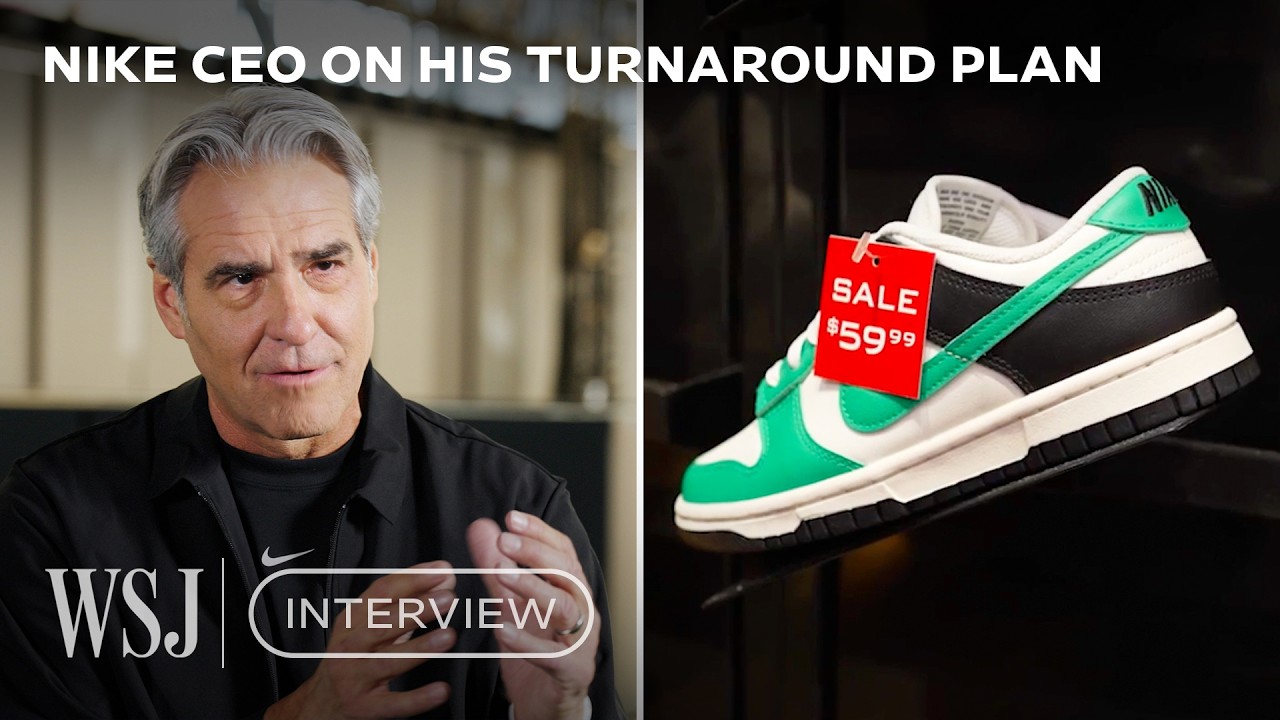
Sample answerThe main mistake was that the company lost its focus on athletics and innovation, concentrating too much on 'sneaker head culture'. The new CEO's plan was to fix this by putting the athlete back at the center of everything the company does.
02What problem did Nike create by becoming 'over reliant' on popular shoes like the Air Jordan 1 and the Dunk?
Sample answerThey produced too many of these popular shoes, which flooded the market. As a result, people lost interest, and now Nike has a lot of excess inventory that it needs to clear out, sometimes by putting them on sale.
03How is Nike's approach to working with retail partners like Amazon and Macy's different now compared to its previous strategy?
Sample answerPreviously, Nike focused heavily on selling directly to consumers. Now, they are working with retail partners again, but with a new strategy. They plan to offer a specific selection of products at each retailer that is tailored to the type of customer who shops there.
04In what way does the CEO believe his leadership has improved employee morale at the company?
Sample answerHe believes morale has improved because he brought back a focus on the company's original mission: serving the athlete. He also thinks employees respect his experience and that his competitive spirit has re-energized the workplace.
4
Vocabulary
Vocabulary
These expressions will help you communicate more naturally about this topic.
Examples
To right the ship — to fix a company or organization that is in a difficult situation.
Usage note: This is a common idiom in business contexts. It creates an image of a captain steering a ship out of a storm. You can say, 'The new CEO was brought in to right the ship after a year of poor sales.'
Market saturation — a situation where the supply of a product in a market is greater than the demand for it, making further growth difficult.
Usage note: This term is common in discussions about economics and business strategy. For example, 'When Nike flooded the market with Dunks, it led to market saturation and people lost interest.'
To double down on (something) — to commit even more strongly to a particular strategy or course of action, especially one that is risky.
Usage note: This phrase can be used positively or negatively. 'Instead of changing, the previous CEO doubled down on the failing strategy.' Or, 'The company decided to double down on its investment in R&D.'
To lose sight of (something) — to forget about an important idea or goal while you are busy with other things.
Paraphrase tip: This is a great alternative to 'lose focus on'. You can say a company 'lost sight of its core values' or a manager 'lost sight of the project's main objective.'
Course correction — a change made to a plan or strategy to improve it or deal with a problem.
Register: This is a semi-formal phrase often used in business and project management. It sounds less dramatic than a 'complete turnaround.' For example, 'We need to make a slight course correction in our marketing approach for the next quarter.'
5
Decide if each statement is true or false. Correct the false ones.
01The interview takes place at Nike's original research and development center, which has been open for over 35 years.
02To become more competitive, Nike is organizing its business by specific sports across its three main brands.
03Part of Nike's current strategy is to sell products through a variety of retail partners, not just directly to consumers.
04The CEO is confident that the Nike Dunk will become popular again within the next two years.
05The company is developing a signature shoe for basketball player Caitlyn Clark, but it has not been released yet.
6
Complete the sentences with words from the box. One word is extra.
Word bank
01After hiring a new CEO, the struggling company achieved a remarkable and became profitable within a year.
02The report analyzed the series of strategic that led to the company's loss of market share.
03With so many similar products available, the smartphone market is reaching a point of .
04The business became on a single supplier, which caused major problems when that supplier went bankrupt.
05To stay ahead of the competition, the tech firm must constantly and develop new technologies.
7
Choose the best answer based on what you heard in the video.
01According to the CEO, how does Nike plan to protect its premium brand image while selling through various retailers?
02What was a major financial consequence of Nike's previous strategy mentioned in the video?
03What is Nike's strategic response to the increased competition in the running shoe market?
04Which of the following is NOT mentioned in the video as part of Nike's current or future plans?
8
Business Challenges and Innovation
Test your understanding of key phrases and concepts from the discussion.
Match each item on the left with the correct item on the right.
A
B
9
Discuss these questions with a partner. Try to use vocabulary from the lesson.
- The video suggests Nike's main misstep was losing sight of its core mission. Do you think it's more important for a brand like Nike to double down on innovation for elite athletes or to cater to the fashion trends that drive mass sales? Why?
- Think about a major company in your country that had to right the ship after a period of struggle. What course correction did they make, and how successful was it? Did they face issues like market saturation or losing sight of their original values?
- Nike's strategy to fix market saturation involves reducing the supply of popular shoes to make them feel exclusive again. Do you believe this is a sustainable long-term strategy, or could it alienate loyal customers who can no longer buy the products they want?