Food and energy: talking about health
A2
60 min
Premium
1

Think about these questions before watching. Share your ideas with a partner.

  1. What kind of food gives you a lot of energy? What food makes you feel sleepy?
  2. Think about a normal day. What activities do you do that use a lot of energy?
  3. How do you decide if a food is healthy or unhealthy? Give an example.
2

Watch the video carefully. Pay attention to the main ideas and key details.

Video script71 segments · click a timestamp to jump

We hear about calories all the time.

How many calories are in this cookie?

How many are burned by 100 jumping jacks,

or long distance running,

or fidgeting?

But what is a calorie, really, and how many of them do we actually need?

Calories are a way of keeping track of the body's energy budget.

A healthy balance occurs when we put in about as much energy as we lose.

If we consistently put more energy into our bodies than we burn,

the excess will gradually be stored as fat in our cells,

and we'll gain weight.

If we burn off more energy than we replenish, we'll lose weight.

So we have to be able to measure the energy we consume and use,

and we do so with a unit called the calorie.

One calorie, the kind we measure in food, also called a large calorie,

is defined as the amount of energy

it would take to raise the temperature of one kilogram of water

by one degree Celsius.

Everything we consume has a calorie count,

a measure of how much energy the item stores in its chemical bonds.

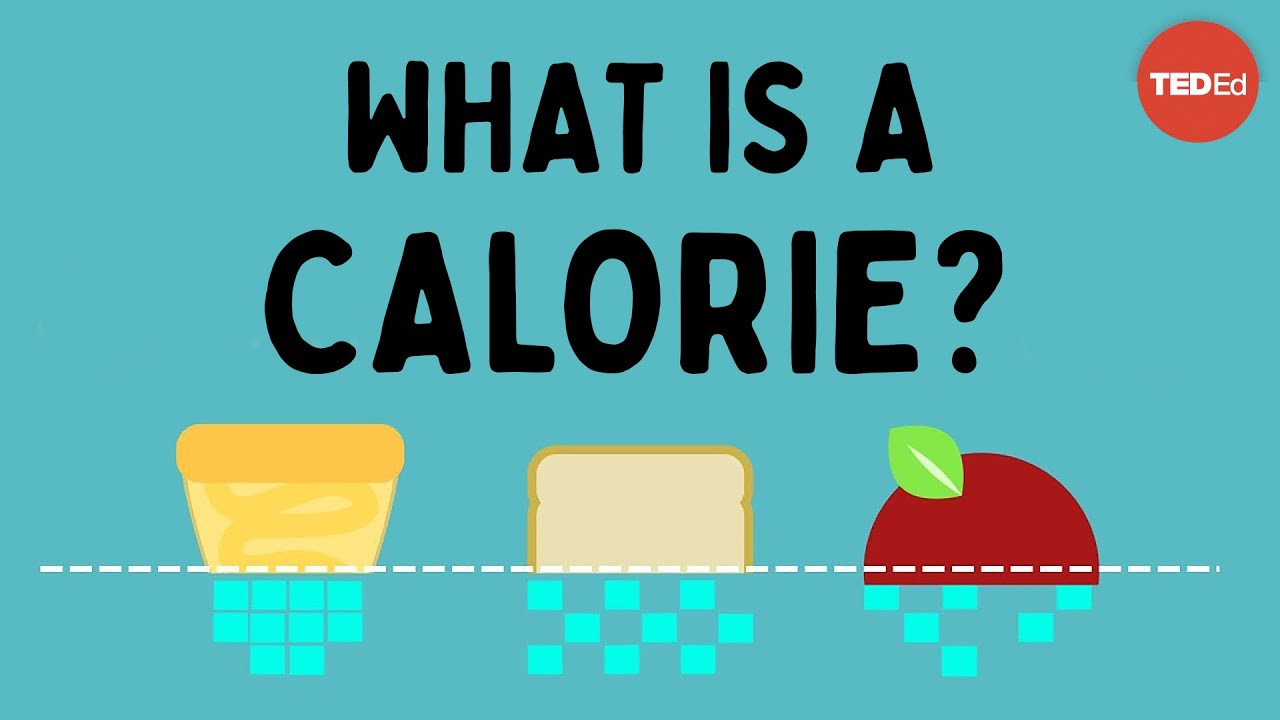
The average pizza slice has 272 calories,

there are about 78 in a piece of bread,

and an apple has about 52.

That energy is released during digestion,

and stored in other molecules

that can be broken down to provide energy when the body needs it.

It's used in three ways:

about 10% enables digestion,

about 20% fuels physical activity,

and the biggest chunk, around 70%,

supports the basic functions of our organs and tissues.

That third usage corresponds to your basal metabolic rate,

a number of calories you would need to survive

if you weren't eating or moving around.

Add in some physical activity and digestion,

and you arrive at the official guidelines

for how many calories the average person requires each day:

2000 for women and 2500 for men.

Those estimates are based on factors

like average weight, physical activity and muscle mass.

So does that mean everyone should shoot for around 2000 calories?

Not necessarily.

If you're doing an energy guzzling activity,

like cycling the Tour de France,

your body could use up to 9000 calories per day.

Pregnancy requires slightly more calories than usual,

and elderly people typically have a slower metabolic rate,

energy is burned more gradually, so less is needed.

Here's something else you should know before you start counting calories.

The calorie counts on nutrition labels measure how much energy the food contains,

not how much energy you can actually get out of it.

Fibrous foods like celery and whole wheat take more energy to digest,

so you'd actually wind up with less energy from a 100 calorie serving of celery

than a 100 calorie serving of potato chips.

Not to mention the fact that some foods offer nutrients like protein and vitamins,

while others provide far less nutritional value.

Eating too many of those foods

could leave you overweight and malnourished.

And even with the exact same food,

different people might not get the same number of calories.

Variations in things like enzyme levels,

gut bacteria,

and even intestine length,

means that every individual's ability to extract energy from food

is a little different.

So a calorie is a useful energy measure,

but to work out exactly how many of them each of us requires

we need to factor in things like exercise,

food type,

and our body's ability to process energy.

Good luck finding all of that on a nutrition label.

3

Answer the questions based on the video.

01What is a calorie a measure of?
Sample answerIt measures the energy in food and the energy our body uses.
02What are the three main ways our body uses energy?
Sample answerIt uses energy for digestion, for physical activity like walking, and for our organs to work.
03Why do different people need a different number of calories?
Sample answerBecause it depends on their activity and age. An athlete needs more calories and an older person needs less.
04Why is the calorie count on a food label not always exact for you?
Sample answerBecause some foods are harder to digest, and every person's body is a little different.
4

Key vocabulary

Vocabulary
These expressions will help you talk about food, energy, and health.
A balanced diet — eating a variety of healthy foods to get all the nutrients you need.
We often use the verbs 'have' or 'eat' with this phrase. For example: 'To be healthy, it's important to have a balanced diet.'
Cut down on (something) — to eat, drink, or do something less often.
This is a useful phrasal verb for talking about making healthier choices. For example: 'I'm trying to cut down on sugar.'
Full of energy — feeling active and strong, not tired.
You can use this to describe how you feel. For example: 'After a good night's sleep, I feel full of energy.'
Stay in shape — to keep your body healthy and fit through exercise and diet.
This is a common goal. For example: 'I go running three times a week to stay in shape.'
Junk food — food that is not very healthy because it has a lot of fat, sugar, or salt.
This is an informal term. Examples include chips, candy, and most fast food. For example: 'I only eat junk food on the weekend.'
5

Decide if each statement is true or false. Correct the false ones.

01The body uses most of its energy for physical activity like walking or running.
02If you use more energy than you eat, you will lose weight.
03Some people, like very active athletes, might need many more calories than the average person.
04According to the video, the average woman needs 2500 calories each day.
05You get the same amount of energy from 100 calories of celery and 100 calories of potato chips.
6

Discuss these questions with a partner. Try to use vocabulary from the lesson.

  1. Some people think the best way to stay in shape is to cut down on junk food. Others think exercise is more important. What is your opinion?
  2. Think about a traditional meal from your country. Does it give you a balanced diet? Does it make you feel full of energy?
  3. The video talks about counting calories. Do you think this is a good idea for being healthy, or is it too difficult? Why?