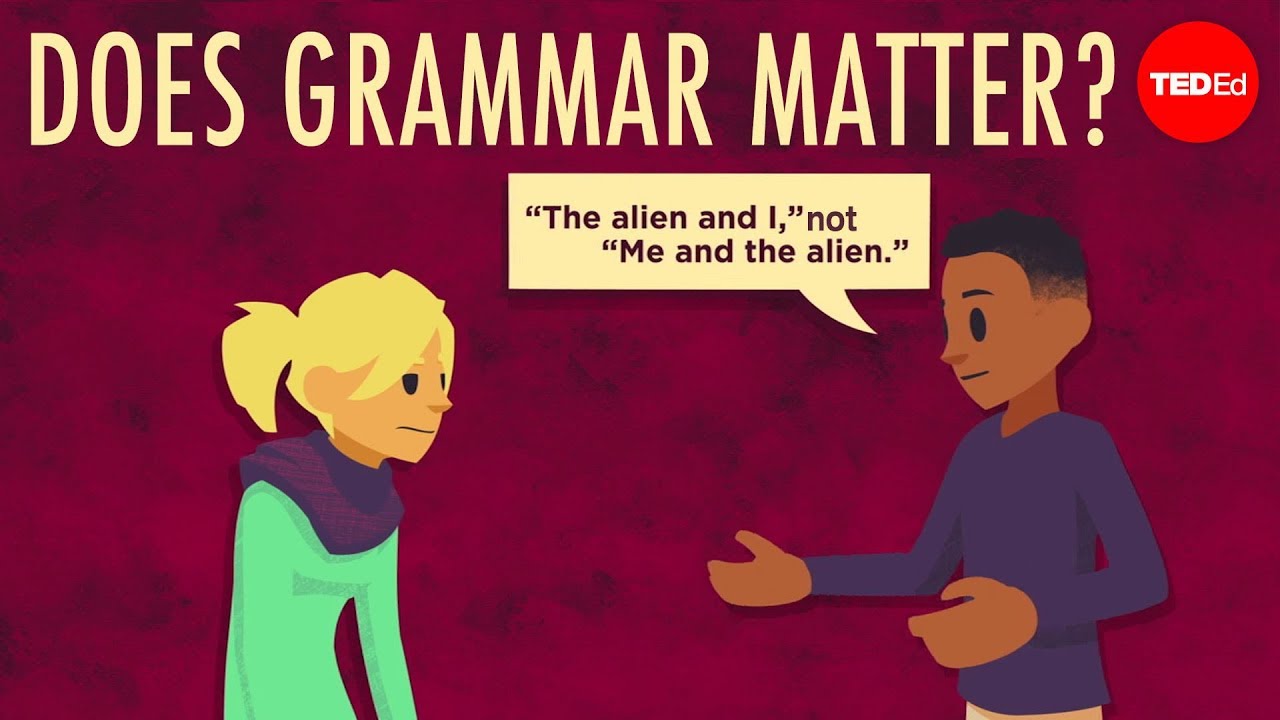
Grammar rules: describing language vs. prescribing it
1
Think about these questions before watching. Share your ideas with a partner.
- Think about a time someone corrected your grammar, or when you corrected someone else's. How did it feel, and what was the situation?
- In what situations do you think following strict grammar rules is essential, and in which situations is it less important? Provide some examples.
- How has technology, like texting and social media, changed the way you and people you know use language? Do you view these changes as positive or negative?
2
Watch the video carefully. Pay attention to the main ideas and key details.
3
Answer these questions in your own words. Support your answers with evidence from the video.
01According to the video, why was a standardized form of language initially developed?
Sample answerIt was developed mainly for writing as societies became more connected. A standard form was needed to ensure that people in different regions could communicate and understand each other clearly.
02What social consequence arose from applying standardized written rules to spoken language?
Sample answerIt created a social division. The standard form, often based on the language of the powerful, was seen as the only 'proper' way to speak. People who spoke differently were considered to have a low social status and were often pressured to change their speech.
03In what ways does the video describe spoken language as being more flexible than written language?
Sample answerThe video explains that speech is more flexible because it uses tone and intonation to add meaning. Also, speakers naturally adapt their language to be understood easily, for example by avoiding complicated sentences or simplifying sounds to speak more quickly.
04How does the video suggest that prescriptivism and descriptivism can both be useful?
Sample answerIt says they aren't mutually exclusive. Prescriptivism is useful for providing a common standard, which helps in formal situations and makes it easier for non-native speakers to communicate. Descriptivism is valuable because it helps us understand how language actually works and evolves, which shows us how our minds structure the world.
4
Vocabulary
Vocabulary
These expressions will help you communicate more naturally about this topic.
Examples
A stickler for the rules — someone who insists on following rules exactly.
This is often used to describe someone who is very precise, sometimes in a slightly annoying way. You can be a 'stickler for grammar', a 'stickler for punctuality', etc.
Get your point across — to successfully communicate an idea or message so that others can understand it.
A very common and useful phrase. It focuses on the success of communication, which is a key idea in descriptivism. For example: 'As long as you get your point across, a few small mistakes don't matter.'
A bone of contention — a subject or issue that people have disagreed about for a long time.
This idiom is perfect for describing the debate between prescriptivists and descriptivists. For example: 'The use of 'they' as a singular pronoun has become a real bone of contention.'
Common usage — the way language is actually used by most people in everyday situations.
This term is often used to justify a grammatical form that might be considered 'incorrect' by language purists. For example: 'Although it's technically wrong, its use is now accepted in common usage.'
Nitpicking — finding fault with small, unimportant details in a critical way.
This verb has a negative meaning. It describes the act of correcting someone's minor errors instead of focusing on their main message, like the friend in the video. For example: 'He was nitpicking my pronunciation instead of listening to what I was saying.'
5
Decide if each statement is true or false. Correct the false ones.
01According to the video, the standardized version of a language was often based on the way powerful people spoke.
02The video claims that scholars have successfully identified many linguistic universals common to all languages.
03The video suggests that people primarily learn to speak their native language through unconscious habit formation rather than by memorizing grammatical rules.
04The video uses English and Japanese as examples of languages with the same typical sentence structure.
05Descriptivism is presented as an approach that dictates how language should be used correctly.
6
Complete the sentences with words from the box. One word is extra.
Word bank
01My old English teacher was a real for grammar; she would get upset if you even split an infinitive.
02The most important thing in everyday communication is to get your point clearly, even if your grammar isn't perfect.
03The use of the singular 'they' has been a major among language purists for decades.
04Descriptivists argue that grammar rules should be based on common , not on outdated standards.
05Instead of focusing on the main idea, he was just over tiny details in the report.
7
Choose the best answer based on what you heard in the video.
01According to the video, what is the linguistic definition of grammar?
02What is the main point the video makes about the debate between prescriptivism and descriptivism?
03The video explains that most people learn to speak their native language primarily through...
04The video mentions several reasons why standardized written language became important. Which of the following reasons is NOT mentioned?
8
Grammar: Prescriptivism vs. Descriptivism
Test your understanding of key concepts related to grammar and language debates.
Match each item on the left with the correct item on the right.
A
B
9
Discuss these questions with a partner. Try to use vocabulary from the lesson.
- The video introduces the debate between prescriptivism and descriptivism. Which viewpoint do you agree with more? Is it better to be a stickler for the rules, or is it fine to bend them as long as you can get your point across?
- The video suggests that 'standard' language is often based on the dialect of those in power. In your country, is there a 'correct' version of your language that is considered more prestigious? Is this a bone of contention, and how does it affect people's opportunities?
- Considering the influence of the internet and social media, do you believe that common usage is becoming more important than 'correct' grammar? Can you think of any specific grammar rules that are often ignored today and might disappear in the future due to changing common usage?