Economic models: debating progressive capitalism
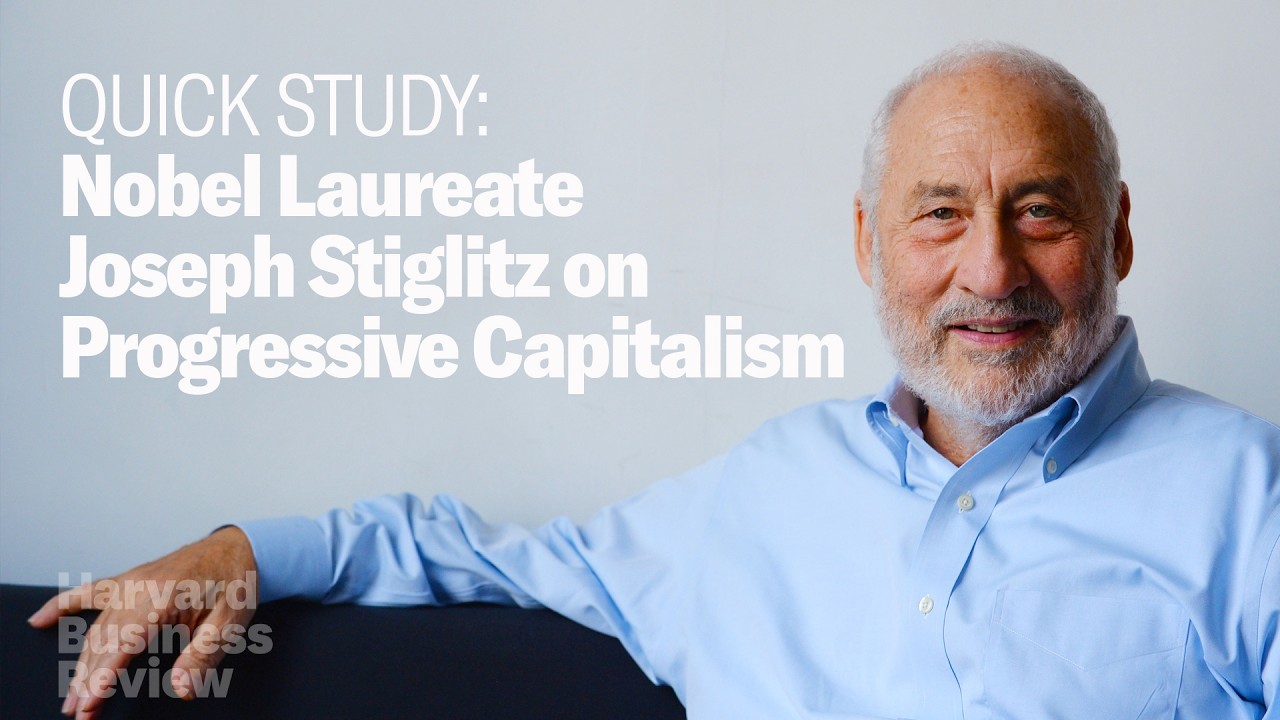
1
Think about these questions before watching. Share your ideas with a partner.
- If you were tasked with redesigning an economic system to prioritize the well-being of its citizens, what would be your top three priorities and why?
- To what extent do you believe a company's responsibility extends beyond its shareholders to encompass broader societal and environmental well-being?
- Considering your own country or community, can you identify a specific government regulation that you believe has had a significant positive or negative impact on innovation or daily life?
2
Watch the video carefully. Pay attention to the main ideas and key details.
3
Answer these questions in your own words. Support your answers with evidence from the video.
01According to the video, what are the core tenets of neoliberal capitalism that progressive capitalism seeks to counteract?
Sample answerThe speaker explains that neoliberal capitalism, which has been dominant for the last 40 years, prioritizes maximizing shareholder value. It also aims to minimize the role of the state, limit regulation, and pays very little attention to major issues like inequality or the environment. Progressive capitalism is presented as the antithesis to this.
02In what way does the speaker use the example of renewable energy to support his argument about the relationship between regulation and innovation?
Sample answerHe argues that good regulation actually promotes innovation. He points to regulations on carbon emissions, which created a clear societal goal. This spurred the private sector to innovate heavily in renewable energy, causing prices to plummet to the point where they are now competitive with, or even cheaper than, fossil fuels. This happened with very little direct government financial support.
03How does the speaker contrast the traditional corporate view of labor with the one proposed by progressive capitalism?
Sample answerHe suggests the traditional view treats labor simply as a cost center, where the goal is to lower wages and exploit workers as much as possible. In contrast, the progressive view sees employees as an asset. This involves empowering them, increasing their capabilities, and providing flexibility like family leave, which ultimately contributes to their well-being and is profitable for the company in the long run.
04Why does the speaker believe Friedrich Hayek's 'Road to Serfdom' thesis was incorrect, and what does he identify as the actual modern threat to freedom?
Sample answerHe refutes Hayek's idea that a strong welfare state leads to authoritarianism by pointing out that today's populist and authoritarian movements are rising in places where the government does too little, not too much. He argues that this governmental inaction leads to widespread discontent, which in turn threatens democracy. Therefore, the real threat is not an overreaching state, but one that fails to address society's major challenges.
4
Key vocabulary for discussing economic models
Vocabulary
These expressions will help you discuss the ideas from the video with greater precision and fluency.
Examples
To level the playing field — to create a situation where everyone has a fair and equal chance of succeeding.
Usage note: This metaphor is often used when discussing the role of regulation in ensuring fair competition. For example: 'Tighter regulations on multinational corporations are needed to level the playing field for smaller, local businesses.'
A rising tide lifts all boats — an economic idiom suggesting that improvements in the general economy will benefit all participants, both rich and poor.
Usage note: This phrase is typically used to defend free-market policies that prioritize overall growth. It's a useful expression to introduce or critique in a debate about economic inequality.
To be predicated on — to be based on a particular belief, idea, or principle.
Usage note: This is a formal and sophisticated alternative to 'to be based on'. It's well-suited for analytical discussions. For example: 'The speaker's entire theory is predicated on the assumption that markets are inherently self-regulating.'
To stifle innovation — to prevent or discourage new ideas, methods, or inventions from developing.
Usage note: A common collocation used in debates about business and government policy. A frequent argument against government intervention is that excessive 'red tape' can stifle innovation.
Social safety net — a system of government programs, such as unemployment benefits and public healthcare, that protect people experiencing financial hardship.
Usage note: This term is central to discussions about the welfare state. You can talk about 'strengthening', 'weakening', or 'dismantling' the social safety net.
5
Decide if each statement is true or false. Correct the false ones.
01The speaker advocates for a system where the state entirely replaces the role of markets to ensure societal well-being.
02The plummeting cost of renewable energy is presented as a direct result of substantial government financial support and subsidies.
03According to the speaker's model of progressive capitalism, the primary objective of an economy is to serve the well-being of society as a whole.
04The speaker contends that the rise of modern authoritarianism is linked to governments doing too little to address societal discontent, rather than doing too much.
05The speaker suggests that treating employees as assets by offering flexibility and responsibility is not only a moral imperative but also ultimately beneficial for a corporation's long-term profitability.
6
Complete the sentences with words from the box. One word is extra.
Word bank
01The entire economic theory is on the assumption that humans always act rationally in their own self-interest.
02Critics argue that excessive government regulation can innovation and discourage entrepreneurship.
03In times of economic downturn, a robust social is crucial to protect the most vulnerable members of society.
04Progressive taxation is one tool governments can use to the playing field and reduce wealth inequality.
05The politician's optimistic speech was based on the old belief that a rising lifts all boats, but many economists now question this assumption.
7
Choose the best answer based on what you heard in the video.
01According to the speaker, what is the fundamental role of markets within the framework of progressive capitalism?
02How does the speaker use the issue of climate change to illustrate a key principle of progressive capitalism?
03The speaker contrasts viewing labor as a 'cost center' versus an 'asset'. What broader shift in corporate philosophy does this example represent?
04Which of the following specific policy proposals is NOT mentioned by the speaker as an example of progressive capitalist action?
8
Progressive vs. Neoliberal Capitalism
Test your understanding of key concepts related to different economic philosophies.
Match each item on the left with the correct item on the right.
A
B
9
Discuss these questions with a partner. Try to use vocabulary from the lesson.
- The video argues that regulation can promote innovation, citing renewable energy as an example. To what extent do you agree with the idea that government intervention is necessary to solve major societal challenges, versus the view that such actions stifle innovation and are best left to the free market?
- Reflecting on your own country's economic system, to what extent is it predicated on the idea that 'a rising tide lifts all boats'? How effective is the existing social safety net in reality, and what changes, if any, would you advocate for?
- Considering the immense power of global tech companies, do you believe a 'progressive capitalist' approach is needed to level the playing field in the digital economy? What are the potential benefits and drawbacks of increased regulation in this sector?