AI regulation: debating the pros and cons
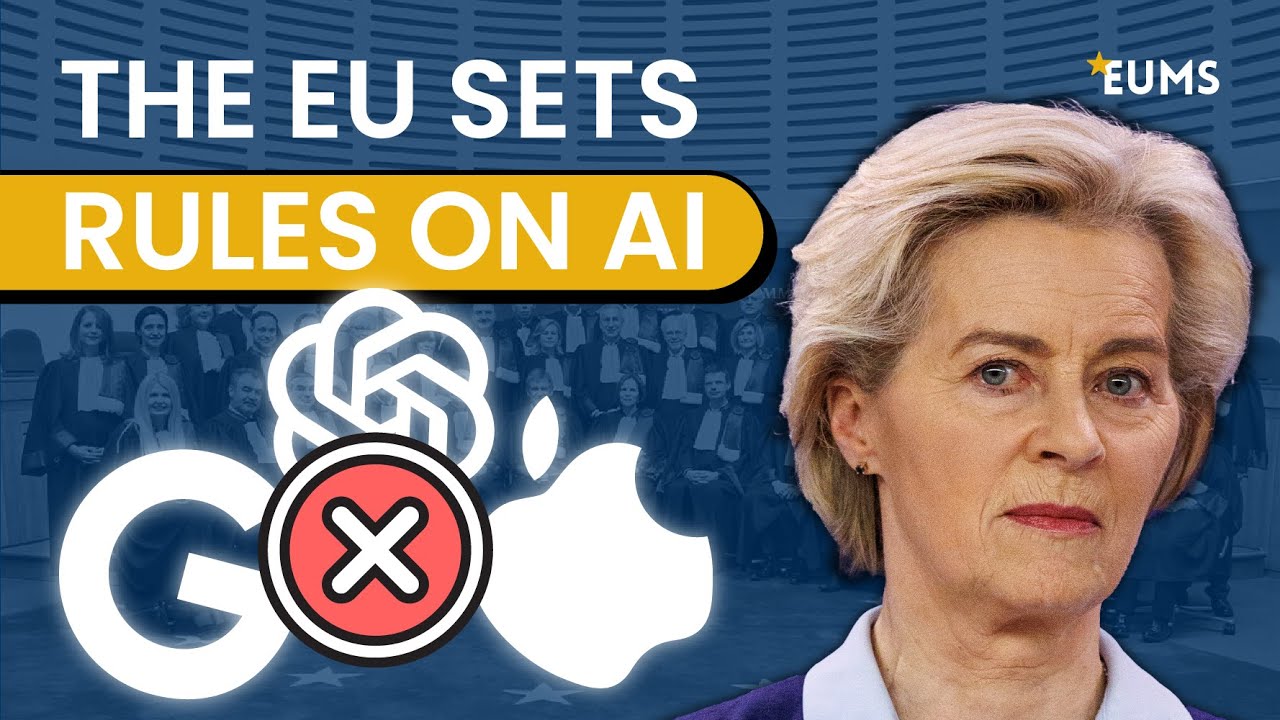
1
Think about these questions before watching. Share your ideas with a partner.
- When you hear the phrase 'tech regulation,' what's your initial reaction – a necessary safeguard for society or a bureaucratic hurdle that slows down progress? Justify your stance with an example from a technology you use.
- Reflect on your daily interactions with AI, from streaming recommendations to chatbots. At what point would an AI's influence over your choices feel like it crosses a line from helpful to intrusive, and who should be responsible for drawing that line?
- If you had to entrust a high-stakes decision—such as a medical diagnosis or a financial investment—to an AI system, what specific assurances or safeguards would you need in place to feel comfortable with its recommendation?
2
Watch the video carefully. Pay attention to the main ideas and key details.
3
Answer these questions in your own words. Support your answers with evidence from the video.
01According to the video, what is the fundamental difference in the regulatory approach between AI classified as 'limited risk' and 'high risk'?
Sample answerThe main difference is the level of oversight and potential impact. For 'limited risk' AI, like chatbots, the key rule is transparency—users just need to be aware they're interacting with AI. However, 'high risk' AI, which is used in critical sectors like healthcare and transportation, is subject to much stricter regulations, including thorough risk assessments, high-quality data usage, and the necessity of human oversight, because a mistake could have profound consequences.
02What key bodies and deadlines are mentioned for the implementation and consistent application of the AI Act across the EU?
Sample answerThe video outlines a clear timeline. Member states have until August 2025 to appoint their national authorities for enforcement. Then, the majority of the rules will come into effect in August 2026. To ensure consistency, a European Artificial Intelligence Board will oversee the application of the act, and a scientific panel of experts will provide technical advice and issue alerts.
03In what way does the video suggest the AI Act could benefit businesses despite being a regulation?
Sample answerIt suggests that by harmonizing standards across all EU member states, the act actually simplifies the regulatory landscape. Any company wanting to operate in the EU, regardless of its origin, has to follow the same set of rules. This creates a more predictable environment and ensures everyone is competing on a level playing field, which can be easier for businesses to navigate than a patchwork of different national laws.
04Why might the AI Act, despite its safety objectives, inadvertently create an uneven playing field for companies in the tech industry?
Sample answerThe video argues that the act could disproportionately affect smaller companies. The costs of compliance, estimated at 1 to 2.7% of revenue for small and medium enterprises, combined with the 'red tape' of paperwork and approvals, can be a significant burden. Larger, wealthier corporations can absorb these costs much more easily, potentially giving them an unfair advantage and stifling innovation from smaller players.
4
Vocabulary
Vocabulary
These expressions will help you communicate more naturally about this topic.
Examples
A double-edged sword — something that has both positive and negative effects.
Usage note: This idiom is perfect for introducing the complexity of a situation, showing that you understand both the advantages and disadvantages. For example: 'The AI Act is a double-edged sword; it protects citizens but could slow down European tech companies.'
Stifle innovation — to prevent or restrict creativity and the development of new ideas or products.
Usage note: This is a common collocation used to criticize excessive regulation or bureaucracy. You can also talk about something stifling creativity, growth, or debate.
Level the playing field — to create a fair situation where everyone has an equal opportunity to succeed.
Usage note: This idiom is often used in discussions about business, economics, and regulation. The video hints at the opposite, an 'uneven playing field', where some companies have an unfair advantage.
Far-reaching implications — significant consequences or effects that extend widely in scope or time.
Usage note: This is a semi-formal phrase used to emphasize the broad and serious impact of a decision, technology, or policy. It's more formal than saying 'it will affect a lot of things'.
Strike a balance (between A and B) — to find a compromise or a moderate position between two opposing things.
Usage note: A key phrase for discussing policy and complex issues. The central challenge of the AI Act is how to strike the right balance between ensuring safety and fostering innovation.
5
Decide if each statement is true or false based on the video. Correct the false ones.
01The primary regulatory requirement for AI systems classified as 'limited risk', such as chatbots, is the principle of transparency.
02According to the video, AI-powered spam filters are categorised as 'limited risk' and are subject to strict data quality assessments.
03AI systems used in critical sectors like transportation and healthcare are categorised as high-risk, necessitating measures such as detailed logging and the option for human intervention.
04Companies that breach the AI Act's regulations face potential fines equivalent to a maximum of 7% of their global annual turnover.
05The video states that social scoring systems are permissible within the EU, provided they are not used for governmental purposes.
6
Complete the sentences with words from the box. One word is extra.
Word bank
01Critics argue that overly strict regulations could the creativity and progress essential for technological advancement.
02The ethical of using AI in the justice system are vast and require careful consideration by lawmakers.
03Policymakers face the difficult task of striking the right between fostering innovation and protecting public safety.
04To prevent algorithmic bias, the new law mandates independent human for all high-risk AI applications.
05The AI Act is designed to implement robust against the misuse of facial recognition technology in public spaces.
7
Choose the best answer based on what you heard in the video.
01What is the stated primary objective of the EU's AI Act?
02According to the video, what is a key concern regarding the use of AI in education under the 'high-risk' category?
03The video suggests that the AI Act could stifle innovation primarily because...
04Which of the following is NOT mentioned in the video as a requirement for 'high-risk' AI systems?
8
The EU AI Act: Key Concepts
Test your understanding of the EU's approach to AI regulation.
Match each item on the left with the correct item on the right.
A
B
9
Discuss these questions with a partner. Try to use vocabulary from the lesson.
- The video presents the classic debate: regulation versus innovation. To what extent do you believe comprehensive regulations like the EU's AI Act will inevitably stifle innovation, or could they actually level the playing field for smaller, more ethical companies to compete with tech giants?
- Considering the 'high-risk' categories mentioned (transportation, healthcare, education, public safety), which area do you think is most in need of urgent AI regulation in your own country? Discuss the far-reaching implications of getting this regulation wrong and how your government should strike a balance between public protection and technological advancement.
- The EU's risk-based approach is presented as a way to ensure 'human-centric' AI. Do you see this model as a double-edged sword? For instance, could classifying AI systems into rigid risk categories inadvertently create loopholes or fail to adapt to the rapid pace of AI development? Propose an alternative or modified approach to regulation.