Corporate activism: discussing business ethics and values
B2
90 min
Premium
1

Think about these questions before watching. Share your ideas with a partner.

  1. To what extent do a company's social or political values influence your purchasing decisions? Can you think of a time you chose to buy or avoid a product for this reason?
  2. What role, if any, do you believe large companies should play in addressing social or political issues, or should their primary focus always be on maximizing profit?
  3. Consider a well-known brand from your country. What potential risks and benefits might it face if it publicly supported a controversial social cause?
2

Watch the video carefully. Pay attention to the main ideas and key details.

Video script156 segments · click a timestamp to jump

(pensive music) (spoon sliding)

- [Narrator] Phish Food, Chunky Monkey,

these quirky flavors are unmistakably Ben & Jerry's.

But what really sets the brand apart

is its activism despite being owned

by one of the largest food companies in the world.

- It's been really fascinating to see

that Ben & Jerry's has really held their ground.

- [Narrator] Companies that take a stance

on social and political issues

are becoming more important to consumers.

According to research by the polling firm Ipsos,

60% of consumers said they would be more likely

to consider a brand that's aligned

with their own views.

So how does the company blend activism

into its business model?

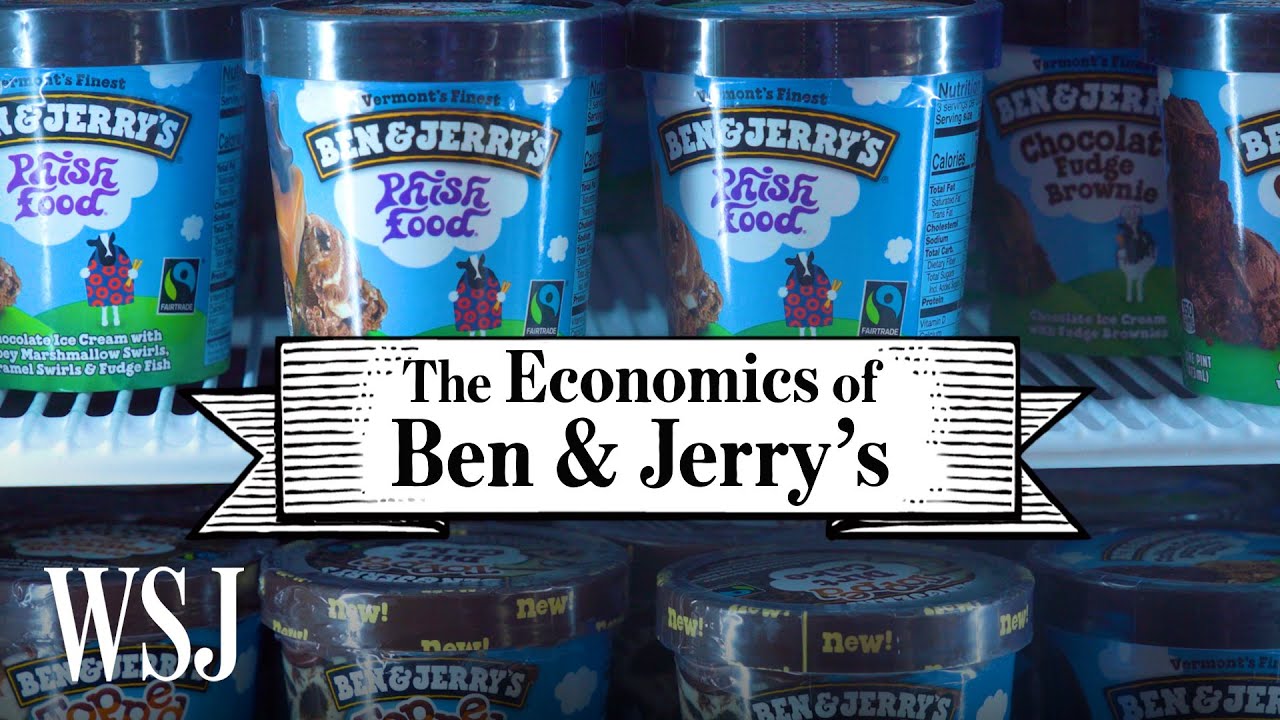
This is The Economics of Ben & Jerry's.

- Ben & Jerry's really takes a fairly liberal stance

on a lot of political issues.

And Ben & Jerry's has not shied away

from making those positions very public.

- [Narrator] The company's social mission

is rooted in the values of its two founders,

and their life experience having grown up in the 1960s.

- What's going on is genocide.

- [Narrator] Ben Cohen and Jerry Greenfield founded

the company in Burlington, Vermont in 1978.

Two years later, they were selling pints to grocery stores.

And in the late '80s, they began using their ice cream

to support social causes.

- They've spoken out about how they were advised

by counterparts in the industry

that speaking out and taking these activist positions

would hurt their bottom line.

This was just not something

that businesses were doing.

- [Narrator] But Ben & Jerry's pushed ahead

and by 1999, it reported $237 million in sales.

Today, the company says the overwhelming majority

of its sales comes from selling packaged ice cream

in supermarkets and convenience stores.

- What the company has shown over the years

is that if your product is delicious,

is attractive in other ways to consumers,

you can do these things

and still be a successful business.

- Hi. - Thanks so much.

- [Narrator] Ben & Jerry's centered its business

on an idea it calls linked prosperity,

which means that has the company profits,

its communities should too.

So when Ben & Jerry's needed investors

to build its first manufacturing facility in 1984,

it offered stock exclusively to Vermont residents first

as a way to give back to the community

where it got its start.

A year later, the Ben & Jerry's Foundation was born.

It received 7.5% of the company's annual pre-tax profits

to fund community-oriented projects.

In 2000, multinational food conglomerate Unilever

bought Ben & Jerry's for $326 million

but the ice cream maker negotiated a deal

where it could maintain

its own independent board of directors.

- While Unilever has made statements

over the years saying

that these are not the issues of the whole company,

they have not been able to stop Ben & Jerry's

from making statements on social media

that get a lot of attention

because of how controversial they are.

- [Narrator] After the killing of George Floyd in 2020,

many companies started posting on Instagram

to show their support for the Black Lives Matter movement.

While Ben & Jerry's released this statement,

saying "We must dismantle white supremacy."

- They were so much more direct than other companies

and that's where Ben & Jerry's

has continued to be different.

Because they've been doing this for decades,

they have that credibility.

- We need to have people sitting in at their Congress,

people's offices, at their senators' offices

and telling 'em we ain't leaving

'til you pass a Green New Deal.

(people cheering)

- [Narrator] But these bold statements

haven't been without backlash.

For example, in 2021, Ben & Jerry's announced

that it would stop selling its products

in Jewish settlements in the Israeli-occupied West Bank

and contested east Jerusalem.

This decision was criticized by Jewish communities

around the world.

- And I will give up on my Ben & Jerry

and everything that Unilever produces.

- [Narrator] And by Israeli politicians.

Two months later, several state funds sold

or threatened to sell their investments in Unilever

accusing the company of breaking state laws

that prohibit the boycott of Israel.

Unilever didn't respond to requests for comment.

At the time, the company declined to discuss the divestments

but reiterated its commitment to Israel.

In February, Ben & Jerry's posted

this tweet criticizing President Biden's decision

to send US troops to Ukraine.

- Unilever CEO said Ben & Jerry's needs

to stay in their lane basically

and said that they should not speak out about things

that they're not experts in.

- [Narrator] A spokesman from Ben & Jerry's said,

"We don't believe one must be a foreign policy expert

to promote the ideals of peace

and to oppose armed conflict

as a solution to solve problems."

(spoon banging)

In addition to its public statements,

the company's social justice initiatives

are also baked into every aspect of it business model,

how the ice cream is made,

how it's packaged and how it's served to consumers.

- There you are. No problem.

- Thank you, thank you very much.

- [Narrator] For example, the brownies that are used

in flavors like Half Baked come

from a bakery in New York

that hires people who face barriers to employment.

Ben & Jerry's also uses milk and cream

from family-owned dairy farms,

and all of its flavors are fair trade certified

which guarantees that farmers who grow vanilla,

cocoa and coffee beans get a fair price

for their harvest.

- There's a flavor that's gonna be supporting

the Poor People's Campaign.

- [Narrator] For special edition flavors,

Ben & Jerry's often works with nonprofit organizations.

- And a portion of the proceeds

will be donated to be supporting the campaign.

- So it's a real influence,

not just with consumers

but also by using their profits

to give back to these organizations.

- Can I please have a Mint Chocolate.

- [Narrator] Ben & Jerry's also has

about 215 independently owned scoop shops across the US.

As corporate activism becomes more important

to consumers, we might see more companies voice their social

and political stances online.

So does this mean it's the end of an era for Ben & Jerry's?

A spokesman from the company says,

"Ben & Jerry's acts on values it cares about

but trying to go at it solo was never the intention."

(lively music)

3

Answer these questions in your own words. Support your answers with evidence from the video.

01According to the video, what were two early examples of Ben & Jerry's "linked prosperity" business model?
Sample answerWhen they needed to build a factory, they offered stock to Vermont residents first to give back to the community. They also created a foundation that donated 7.5% of their pre-tax profits to community projects.
02In what way has Ben & Jerry's been able to maintain its activist stance since being bought by Unilever?
Sample answerWhen Unilever bought them, they negotiated a deal to keep their own independent board of directors. This allows them to make their own statements on social issues, even if the parent company doesn't agree.
03How does Ben & Jerry's integrate its social mission into the ingredients and creation of its ice cream?
Sample answerThey use brownies from a bakery that hires people facing employment barriers, get milk from family farms, and use fair trade certified ingredients like cocoa and vanilla to ensure farmers get a fair price.
04Why does the video suggest Ben & Jerry's statements on social issues have more credibility than those of other companies, and what has been a major consequence of their bold stances?
Sample answerTheir statements are seen as more credible because they have been taking activist positions for decades, long before it became common. A major consequence is facing significant backlash, like when investors threatened to pull money from Unilever after their decision related to Israel.
4

Key vocabulary

Vocabulary
These expressions will help you discuss corporate ethics and activism more effectively.
To vote with your wallet — to show support for or disapproval of a company by choosing where you spend your money.
This is an informal idiom used to talk about consumer power and ethical consumption. You can also say 'vote with your feet' to mean leaving a place or situation you disapprove of.
To walk the talk — to do what you say you will do; to act in a way that is consistent with your stated beliefs.
This is a common idiom, especially in business and politics, used to talk about authenticity and integrity. It's the opposite of 'paying lip service'.
To face backlash — to receive strong negative criticism or a hostile reaction from a group of people.
This is a common collocation in news and media. You can face backlash 'from' a group 'for' doing something. Example: 'The brand faced backlash from customers for its controversial ad campaign.'
To pay lip service to (a cause) — to say you agree with or support an idea, but not do anything to prove that support.
This phrase has a negative connotation, suggesting hypocrisy. It's often followed by a 'but' clause, e.g., 'The company pays lip service to sustainability, but its packaging is still 100% plastic.'
To align with (someone's) values — to be in agreement with the principles or standards that someone believes are important.
This is a semi-formal phrase often used in discussions about ethics, careers, and consumer choices. Common collocations include 'align with my personal values' or 'align with the company's mission'.
5

Decide if each statement is true or false. Correct the false ones.

01The founders were warned by others in the industry that taking public stances on social issues would harm their business financially.
02The CEO of Unilever publicly supported Ben & Jerry's right to comment on foreign policy issues like the conflict in Ukraine.
03According to research mentioned in the video, a majority of consumers are more inclined to support brands that share their personal views.
04Unilever acquired Ben & Jerry's in 1999 for over $300 million.
05The Ben & Jerry's Foundation was established to fund community projects by receiving a portion of the company's pre-tax profits.
6

Complete the sentences with words from the box. One word is extra.

Word bank
01After the CEO's controversial comments, the company faced a severe from the public on social media.
02Many modern consumers prefer to support companies whose ethical principles with their own personal beliefs.
03The corporation was accused of paying only to environmental causes, as its actual policies hadn't changed at all.
04If you disagree with a company's practices, you can always vote with your and choose to shop elsewhere.
05The company took a clear against child labour by refusing to work with suppliers who couldn't prove their ethical standards.
7

Choose the best answer for each question based on the video.

01What does the video suggest was the primary influence on the founders' values and the company's social mission?
02How did Unilever's CEO respond to Ben & Jerry's tweet about sending US troops to Ukraine?
03According to the video, where does the overwhelming majority of Ben & Jerry's sales come from?
04Which of the following details about Ben & Jerry's business practices is NOT mentioned in the video?
8

Corporate values in action

How do companies and consumers interact when it comes to social issues? Complete the sentences below.

Match the beginning of each sentence on the left with its logical ending on the right.

Drag or click to match
Definitions
9

Discuss these questions with a partner. Try to use vocabulary from the lesson.

  1. Is it possible for a huge company owned by a global corporation to genuinely walk the talk on social issues, or is it more likely that they are just paying lip service to a cause to attract customers who want to vote with their wallet?
  2. In your country, what kinds of social or political causes do companies typically support? Are there certain topics they avoid to prevent facing backlash? Discuss why some causes are considered safer for brands to align with than others.
  3. Imagine a popular local company known for its strong ethical stance is bought by a multinational giant. What is the best way for the original brand to continue to walk the talk and not just pay lip service to its founding values? What challenges might it face?