How Temu’s explosive growth is disrupting American e-commerce | WSJ
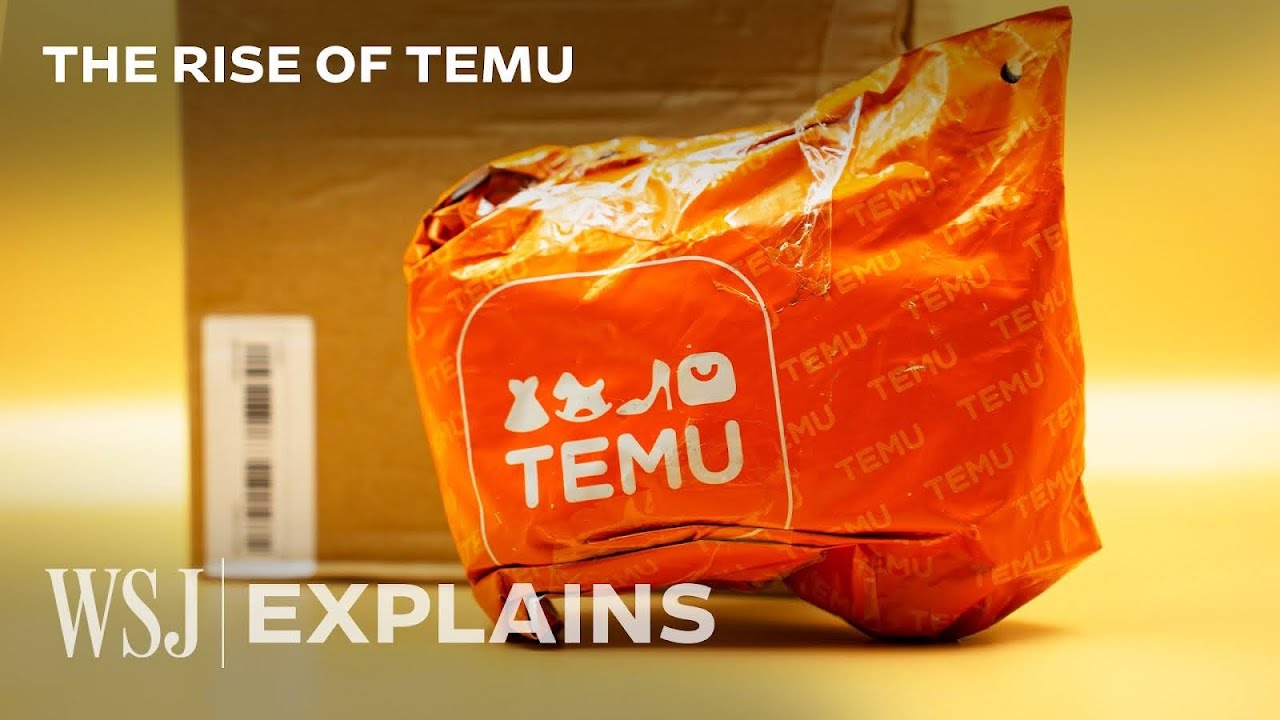
Video script201 segments · click a timestamp to jump
- [Narrator] It took discount retail app Temu a year to get
to 51 million monthly active users in the US.
That's approaching the 67 million user base
that Amazon spent decades building.
Temu gained ground by selling cheap goods shipped
from China, like this $20 coat
or $9 stainless steel water bottle.
And its positioning itself
to be a bigger player in the US E-commerce landscape.
- Anybody who's not Amazon is the short answer
of who should be worried.
- [Narrator] Here's how a 1-year-old brand
is keeping the e-commerce industry on watch
and how, just like Amazon, it's redefining
what it means to shop online.
- You are an internet user, you'll see Temu everywhere.
- [Narrator] In just over a year,
the retailer has flooded social feeds
with curious consumers.
- Is Temu a scam?
- She's a serial Temu user.
- I guess I'm known as a Temu girl now.
- It aired ads at back to Back Super Bowls.
(upbeat music)
- [Narrator] And stirred up debate
on how to even pronounce the name.
They're freaking gaslighting you.
The name of the company is Temu, not Temu.
- I'm gonna be honest, I don't think I'll ever say Temu.
- [Narrator] For the record,
the company confirmed it's now Temu.
That confusion hasn't slowed the company down.
It quickly acquired over 161 million monthly app
users across the world.
- It's pretty extraordinary.
It's a speed of adoption
we really haven't seen in the past online.
- When I first wrote about Temu,
we reported that it launched very quietly,
and now Temu is the opposite of being quiet.
- [Narrator] That omnipresence is by design.
It spent $1.7 billion to advertise in 2023,
and JP Morgan analysts estimate
that Temu could spend nearly $3 billion in 2024.
It can spend that big thanks to the deep pockets
of its parent company, PINDUODUO
or PDD, the Chinese e-commerce company,
raking in billions annually.
- PDD Holdings emerged out
of nowhere when China's e-commerce industry was already
dominated by two companies, Alibaba and JD.com.
- [Narrator] So Temu's strategy
of selling extremely cheap goods from China
to build market share, isn't entirely new.
- They're just hoping to replicate its strategies
that worked very well in China.
- Other China founded companies like Shein
and TikTok are also making their mark in US e-commerce.
But Temu sets itself apart
in how it gamifies shopping online.
- You open up the app and there's like a roulette wheel
that you spend and you get a prize.
And the prize is usually here's a whole bunch
of dollars to go buy stuff.
And then as you're searching through products, first off,
you're amazed at how low the prices are
and then you see a ticker of how much time is left
before you know this offer expires
or before they're sold out of that product.
- [Narrator] That strategy has paid off.
Temu amassed more users in six months
than Shein and has in eight years.
Research firm Alliance Bernstein estimates
that $17 billion worth of goods were sold on Temu in 2023.
That helped boost PDDs market value 74%,
allowing it to briefly overtake Alibaba
as China's most valuable e-commerce company.
In the US, Temu's growth is putting e-commerce
giants on watch.
Temu and Sheins' success tells us
that consumers are willing to wait as long
as the products are really cheap.
- [Narrator] Temu says its standard shipping takes
six to 22 days,
while express shipping is four to 11 days.
- [Speaker] Temu connects factories and wholesalers
with consumers directly, cutting the middleman.
- [Narrator] Meanwhile, the biggest e-commerce companies
in the US have been betting big on faster delivery.
Amazon's delivery time has more than halved since 2022
to less than two days on average.
Other retailers are catching up,
with an average of about 4.6 days in January.
As Amazon sets the standard on speed
and Temu takes on price.
- Expect price to get more competitive.
Everybody needs to focus in the e-commerce space about
making sure that they've got a distinctive value proposition
that appeals to a consumer
and not just the first time around,
but has them coming back for more.
- [Narrator] For now, Amazon's hold on the industry
is still ironclad,
but the e-commerce giant has made some changes.
In late 2023, Amazon announced it would reduce the fees
it charges sellers for clothing under $20.
- Some analysts believe
that Amazon's move shows it's worried about losing
suppliers as well as consumers to other platforms.
- [Narrator] In a statement, an Amazon spokesperson said
that the company reduced the referral fee to help drive
and incentivize even greater selection for customers
and competitive prices.
But it's not just cheap prices and seller fees
that's putting pressure on other companies.
(upbeat music)
- [Speaker] Download the Temu app
and shop like a billionaire.
It's driving up digital ad costs.
That means it's more expensive for everybody in the space
to acquire new users.
- [Josh] There's no question that Temu
and Shein are are having an impact in the market.
I think those two players are almost single-handedly
having an impact on the cost of advertising.
- [Narrator] Those digital ads are especially important
for e-commerce companies.
- They need to be there on social media,
making sure that they're right in front of the consumer
to either purchase or to download the app
whenever they're in a mood
to go buy something or they're more intentional.
- It's like a game of chicken.
And for companies like Etsy
that are not growing as fast as Temu,
they cannot keep up with this level
of ad spending at all.
- [Narrator] An Etsy spokesperson said
that the company is seeing a strong return on investment
for its marketing costs,
and the Etsy marketplace is profitable.
That's the short term threat Temu poses to its competitors.
But in the long term,
what it's done is that it's actually changed
or is changing the economics of what it means
to run an e-commerce business.
The existing incumbents in the global e-commerce landscape
aren't just going to lie down
and say, well, I guess we've lost the sale.
They're gonna have to make some hard decisions on whether
they're okay to maintain that with lower sales volume
or whether they wanna be more aggressive in acquiring
consumers and retaining those consumers.
- [Narrator] But some analysts say,
Temu stratospheric growth isn't sustainable.
A Morgan Stanley report noted
that the company's momentum is cresting.
- So what we really now need to see is can they drive
that repeat purchasing behavior?
And that's still very much an open-ended question.
- [Narrator] Still, Temu has cash to burn.
- It's willing to lose money to exchange
for market share to acquire users.
- [Narrator] Analysts estimate the company lost
about $7 per order in 2023.
In a statement, Temu said,
"That its business model boosts efficiency
and that the idea that Temu sells at a loss
to gain market share is simply not true."
But with explosive growth comes more eyes on the company
and more controversy.
- That junk was trash, the sizing is off.
It literally looked like the pattern that I asked
for was printed on it.
I think only one thing actually looked like what I ordered.
Everything else was trash.
- Consumers have been concerned about the product
safety and quality.
I think selling really cheap products is the first step
for Temu to acquire users.
- [Narrator] Temu said in a statement that it works closely
with our independent sellers to ensure
that their products meet the required standards
and the US government is already watching the fledgling
company thanks to its Chinese ties.
A 2023 report from a congressional commission called out
Temu for concerns around data risks,
exploiting trade loopholes and use of forced labor.
The company says that in regards to the trade loopholes,
it is open to and supportive of any policy adjustments made
by legislators that align with consumer interests.
It added that it considers privacy
and security to be core functions of the platform
and that it's committed to ethical labor practices,
but the company is still primed to keep growing.
- I think that's what Temu, Shein, TikTok,
are really gonna bring to the marketplaces.
They're gonna force everybody to level up their game.
And we're gonna see who's real
and who was just a pretender.
(soft music)
This lesson doesn't have exercises yet. Check back soon.