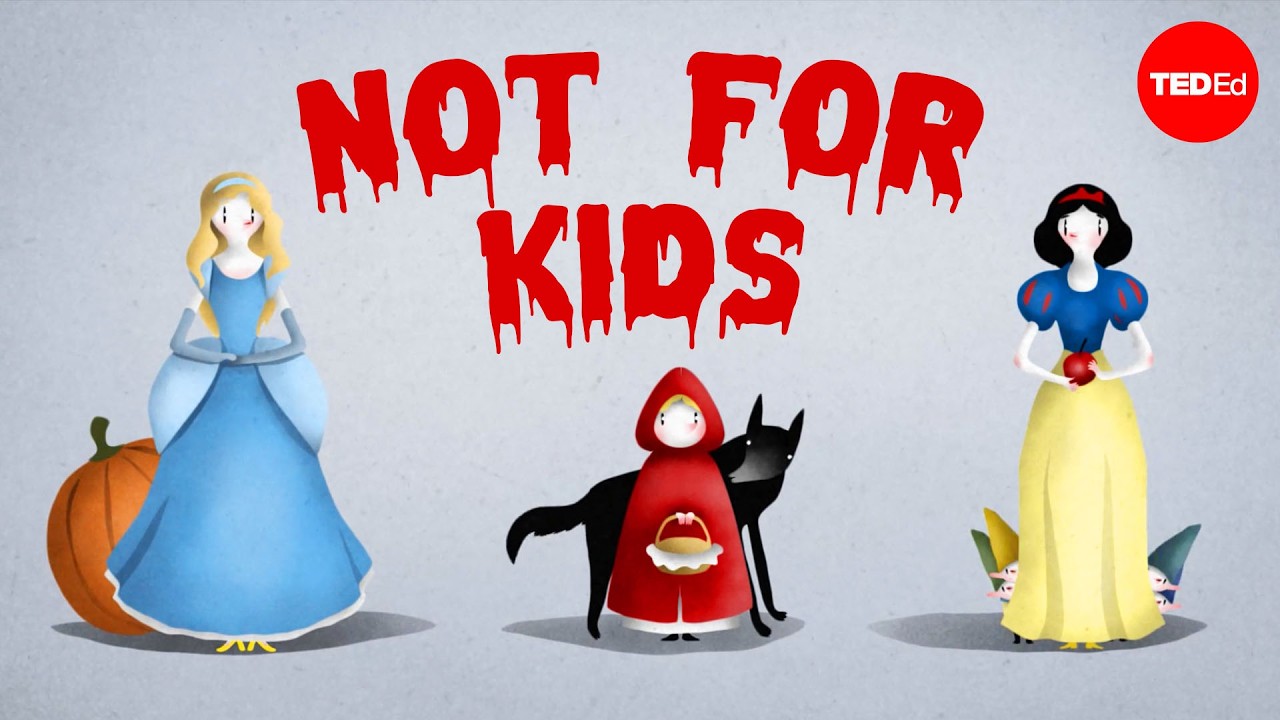
The dark origins of Disney fairy tales - Claudia Schwabe
B2
90 min
Free
1

Think about these questions before watching. Share your ideas with a partner.

  1. What fairy tales were popular in your childhood, and how do you think they shaped your understanding of good, evil, or life in general?
  2. Many traditional stories, including fairy tales, have changed significantly over generations. Why do you think societies adapt these stories, and what might be lost or gained in the process?
  3. Beyond entertainment, what deeper messages or cultural values do you think traditional stories like fairy tales convey? Can they tell us something about a society's history or beliefs?
2

Watch the video carefully. Pay attention to the main ideas and key details.

Video script83 segments · click a timestamp to jump

An evil stepmother demands a beautiful maiden’s lungs and liver;

a girl is ripped from a wolf’s stomach;

and sisters mutilate their feet to squeeze into a solid gold slipper.

During the early 1800s,

brothers Jacob and Wilhelm Grimm gathered these unflinchingly gory details

from stories circulating around what’s now Germany.

But as the tales amassed widespread fame, they morphed dramatically.

The Brothers Grimm were born in Hanau in the 1780s.

At the time, Germanic lands didn’t yet exist

as the unified nation-state of Germany,

but were instead divided into small, independent princedoms.

And French forces exerted significant control over the region

as a result of Napoleon's expansionist aims.

Meanwhile, European Romanticism was beginning to flourish,

accompanied by movements to preserve national languages and traditions.

In their teens, the Brothers Grimm enrolled to study law at university,

and soon became interested in how local rules and customs

were embedded in folk stories.

It wasn’t long before they began undertaking their own

Romantic-nationalist project,

soliciting all manner of German folklore,

striving, they said, “to penetrate into the wild forests of [their] ancestors.”

Their aim was to foster a unifying sense of German cultural identity.

They idolized the idea of stories from the so-called “common man,”

which they viewed as evidence of a national “unspoiled imagination”

and “inner purity.”

In practice, much of what they collected came from middle and upper class sources,

and some stories had traceably transnational origins.

But the Grimms received material spanning songs, jokes, fables,

and magic fairy tales,

from books and educated young women, as well as a painter and a former soldier,

though they probably collected the most from the wife of a tailor.

They published their first volume, “Children’s and Household Tales,” in 1812.

But from the stepmother who serves her husband his own son for dinner,

to the man who murders his brother in order to marry a princess

and then gets drowned in a sack,

these stories were far from cozy.

In fact, originally, the stories were for adults,

and often dealt with difficult realities,

like parents abandoning their children in the woods due to poverty

and weary soldiers deserting the army.

The happier turns were often escapist fantasies from harsh circumstances,

like a princess who throws a frog she's forced to marry against a wall,

only to reveal a dashing prince.

The first two volumes the Brothers Grimm published

tended to reflect the horror and strangeness of the tales

they originally collected.

But many readers found their content disturbing, and they didn’t sell well.

However, an English version that was shorter, heavily illustrated,

and geared towards children, did.

And as their financial and family obligations grew,

the brothers began to edit more actively.

In 1825, the Brothers Grimm published a “Small Edition”

that incorporated illustrations

and was intended to appeal to newer, Romantic ideals of childhood

and more conservative, middle and upper class Christian sensibilities.

A gory tale of kids “playing” pig and butcher, for example,

didn’t make the cut.

Meanwhile, the original negligent biological mothers

of “Snow White” and “Hansel and Gretel”

transformed into wicked stepmothers in later editions,

helping reinforce traditional gender roles

framing biological mothers as virtuous, feminine, and nurturing.

And while at first Rapunzel was revealed to have been entertaining

her princely visitor when she becomes pregnant;

with revision, she simply let slip about him—

no out-of-wedlock sex implied.

The brothers also accentuated some retributive violence,

making for more cautionary tales.

For example, the Grimms’ earliest version of Cinderella

ends after she is whisked away in her prince’s carriage,

while their last version concludes with birds pecking out her stepsisters’ eyes.

Over their lifetimes, the brothers published seven editions of the tales,

which became increasingly popular as they deleted and added stories

while intensively editing them to fit more puritanical tastes

and amplifying narrative and descriptive details.

Additional adaptations by others saw the stories evolve further.

No longer would Snow White be revived by a stumbling pallbearer,

but a prince’s kiss,

and henceforth her witchy stepmother wouldn’t dance herself to death

in iron shoes on a scorching bed of coals.

In other words, they'd grow to be not quite so unconventional

or grim as their origins.

3

Answer these questions in your own words. Support your answers with evidence from the video.

01What was the political and cultural context in the Germanic lands when the Brothers Grimm began collecting their stories?
Sample answerWhen the Grimms started, the Germanic lands weren't a united country but many small princedoms. French forces, because of Napoleon, had a lot of control. Also, European Romanticism was growing, which encouraged preserving national traditions.
02What kind of content did the Brothers Grimm's first published volume, "Children’s and Household Tales," contain, and who was it originally intended for?
Sample answerThe first volume had very dark and often disturbing stories, like parents abandoning children due to poverty. They were actually meant for adults, not children, and weren't "cozy" at all.
03Why did the Brothers Grimm decide to edit their stories more actively over time, and what kind of general changes did they make?
Sample answerThey started editing more because their first books didn't sell well and they had growing financial and family responsibilities. They made the stories less gory, like removing the "pig and butcher" tale, and changed original mothers into wicked stepmothers to fit more conservative ideas about childhood and family.
04In what ways did the Brothers Grimm change characters like Rapunzel, Snow White's mother, and Cinderella's stepsisters in later editions to fit "puritanical tastes" and "conservative sensibilities"?
Sample answerFor Rapunzel, they removed the implication that she had sex out of wedlock, just having her "let slip" about the prince. Snow White's biological mother became a wicked stepmother to make biological mothers seem more virtuous. And for Cinderella, they added more retributive violence, like birds pecking out the stepsisters' eyes, to make it more of a cautionary tale.
4

Vocabulary

Vocabulary
These expressions will help you communicate more naturally about this topic.
To sanitize content — To remove parts of a text, film, or story that are considered offensive, immoral, or too violent, often making it less impactful.
This verb is often used critically, suggesting that something has been made less authentic or powerful. It's common when discussing adaptations of classic stories or historical events.
Cultural heritage — The traditions, customs, beliefs, and artifacts of a country or group that are passed down through generations and are considered an important part of their identity.
This is a formal noun phrase, frequently used in discussions about history, national identity, and the preservation of cultural practices or historical sites.
To delve into the origins — To investigate or explore deeply the beginnings or source of something, often a story, tradition, or phenomenon.
This phrasal verb (delve into) implies thorough and serious research or inquiry. It's commonly used when discussing academic studies, historical investigations, or personal exploration of a topic.
Gory details — Descriptions of violence, blood, or injury that are shocking, disturbing, or unpleasant.
This is a common collocation used to describe content in books, films, or news reports. It often suggests a graphic or explicit depiction of violence, as mentioned in the video about the original Grimm tales.
To shape perceptions — To influence or determine the way people understand, interpret, or think about a particular person, event, or idea.
This semi-formal collocation is useful when discussing the impact of media, education, or cultural narratives on public opinion, beliefs, or individual viewpoints. For example, how fairy tales can shape a child's view of the world.
5

Understanding the Grimm legacy

Complete the sentences by matching the beginning with the correct ending.

Match each item on the left with the correct item on the right.

Drag or click to match
Definitions
6

Decide if each statement is true or false. Correct the false ones.

01The Brothers Grimm's primary motivation for collecting folk stories was to help establish a shared German cultural identity.
02The video states that the Brothers Grimm mainly gathered their stories from ordinary people, reflecting their belief in the "unspoiled imagination" of the common man.
03The initial volumes of "Children's and Household Tales" published by the Brothers Grimm were quite disturbing and did not sell well because they reflected the horror and strangeness of the original stories.
04Throughout their lives, the Brothers Grimm published five different editions of their tales, making edits to suit changing tastes.
05According to the video, additional adaptations of the stories by other authors made them even more unconventional and grim than the versions the Brothers Grimm had published.
7

Grammar: The passive voice

Grammar
The passive voice is used when the action itself, or the object of the action, is more important than the person or thing performing the action (the agent). It's very common when discussing historical events, processes, or when the agent is unknown or obvious.
These unflinchingly gory details were gathered by the Brothers Grimm in the early 1800s.
Here, the focus shifts from the Grimms to the details and their collection. The agent is included with 'by'.
As the tales gained widespread fame, they were dramatically morphed.
This emphasizes the transformation of the tales, rather than who or what morphed them.
Their first volume, 'Children’s and household tales,' was published in 1812.
This is a common structure for historical facts where the event is key, not necessarily the publisher.
  • Form the passive voice using a form of 'to be' + the past participle of the main verb.
  • Use it when the agent (who or what performs the action) is unknown, unimportant, or obvious from the context.
  • If you want to mention the agent, use 'by' + the agent.
  • The passive voice is frequently used in academic writing, news reports, and when describing processes or historical events.
8

Correcting errors in the dark origins of fairy tales

Test your knowledge of grammar and vocabulary related to the video.

Each sentence contains one error. Find and correct it.

01The video describes how the early versions of fairy tales contained unflinching gory details.
Corrected version
The video describes how the early versions of fairy tales contained unflinching unflinchingly gory details.
02The Brothers Grimm were interested on how local rules and customs were embedded in folk stories.
Corrected version
The Brothers Grimm were interested on in how local rules and customs were embedded in folk stories.
03Much of what they collected came from middle and upper class sources, despite they idolized the 'common man'.
Corrected version
Much of what they collected came from middle and upper class sources, despite although they idolized the 'common man'.
04Originally, the stories were for adults, and often dealt with difficult realities like parents abandoning their children for poverty.
Corrected version
Originally, the stories were for adults, and often dealt with difficult realities like parents abandoning their children for due to poverty.
05As the tales amassed widespread fame, they morphed dramatic.
Corrected version
As the tales amassed widespread fame, they morphed dramatic. dramatically.
06The original negligent biological mothers were transformed into wicked stepmothers, which helped reinforcing traditional gender roles.
Corrected version
The original negligent biological mothers were transformed into wicked stepmothers, which helped reinforcing reinforce traditional gender roles.
07The content of the tales was sanitized for appeal to newer, Romantic ideals of childhood.
Corrected version
The content of the tales was sanitized for to appeal to newer, Romantic ideals of childhood.
08A gory tale of kids 'playing' pig and butcher didn’t make the cut, showing the content's sanitise.
Corrected version
A gory tale of kids 'playing' pig and butcher didn’t make the cut, showing the content's sanitise. sanitization.
9

The evolution of Grimm's fairy tales

The video explores the fascinating transformation of the Brothers Grimm's stories over time, from their dark origins to the versions we often hear today.

Fill in each blank with the correct word from the word bank.

Word bank
The video into the origins of the Brothers Grimm's fairy tales, revealing how their initial collections were far from the sanitized versions we know today. Originally intended for adults, these stories often contained details, such as children being abandoned due to poverty or violent acts of revenge. As the tales gained popularity, especially after an illustrated English version for children, the brothers began to the content. They removed disturbing elements and altered characters, like transforming biological mothers into wicked stepmothers, which helped traditional gender roles. This process of editing and adapting the stories over time significantly influenced how generations have come to understand and interpret these narratives, ultimately shaping our of classic fairy tales and their place in our .
10

The evolving nature of fairy tales

The video you watched explored the surprising origins of well-known fairy tales. This passage offers further insight into how these stories changed over time.

Read the passage below, then answer the comprehension questions.

Most people associate fairy tales with enchanting princesses and happy endings, but their true beginnings were often far grimmer. When we delve into the origins of these stories, particularly those collected by the Brothers Grimm, we discover narratives originally intended for adults. These early versions were filled with harsh realities, including poverty, abandonment, and often gory details, reflecting the difficult lives of the common people. However, as the tales gained widespread popularity, especially among children, their content was gradually sanitized. Many of the shocking elements were removed, and the narratives were softened to align with evolving societal views on childhood and morality. This transformation profoundly shaped perceptions of what a fairy tale should be. What was once a raw, unvarnished piece of cultural heritage became a more polished, moralistic story. The shift from grim realism to whimsical fantasy was largely driven by a desire to make the tales more palatable for a younger audience, fundamentally altering their original character.

01Who was the original intended audience for the fairy tales collected by the Brothers Grimm?
Sample answerThe original intended audience for the fairy tales was adults.
02What kind of details were often removed when the fairy tales were sanitized?
Sample answerMany shocking elements and gory details, along with harsh realities like poverty and abandonment, were removed.
03According to the passage, how did the sanitization of these tales affect their role as cultural heritage?
Sample answerThe sanitization transformed the tales from a raw piece of cultural heritage into a more polished and moralistic story, fundamentally altering their original character and shaping perceptions of what a fairy tale should be.
04What was the main reason for the shift from grim realism to whimsical fantasy in later versions of the fairy tales?
Sample answerThe main reason was a desire to make the tales more palatable and suitable for a younger audience, aligning with changing societal views on childhood and morality.
11

Choose the best answer based on what you heard in the video.

01What did the Brothers Grimm initially study at university before becoming interested in folklore?
02Besides books and educated young women, which of the following individuals is mentioned in the video as a source for the Grimms' collected material?
03How did the ending of Cinderella's story change from the Grimms' earliest version to their last version?
04Which of these gruesome details from the original stories is NOT mentioned in the video's introduction?
12

Discuss these questions with a partner. Try to use vocabulary from the lesson.

  1. The video mentions how the Grimm tales were originally very dark and contained 'gory details' before being 'sanitized'. Do you think it's always necessary or beneficial 'to sanitize content' for younger audiences, or does it sometimes diminish the original message or 'cultural heritage' of a story? What are the pros and cons?
  2. The Grimm brothers aimed 'to delve into the origins' of German folklore to build a national identity. Can you think of traditional stories, myths, or legends from your own 'cultural heritage' that have played a significant role in 'shaping perceptions' of your country's identity or values? How have these stories evolved over time, and do they still resonate today?
  3. Considering how traditional stories like those collected by the Grimms can 'shape perceptions' and contribute to 'cultural heritage', do you believe it is more important 'to preserve' the original, sometimes 'gory details', or 'to sanitize content' to make them more accessible and palatable for modern audiences, especially children? Is there a risk of losing the true essence or historical context when stories are heavily adapted?