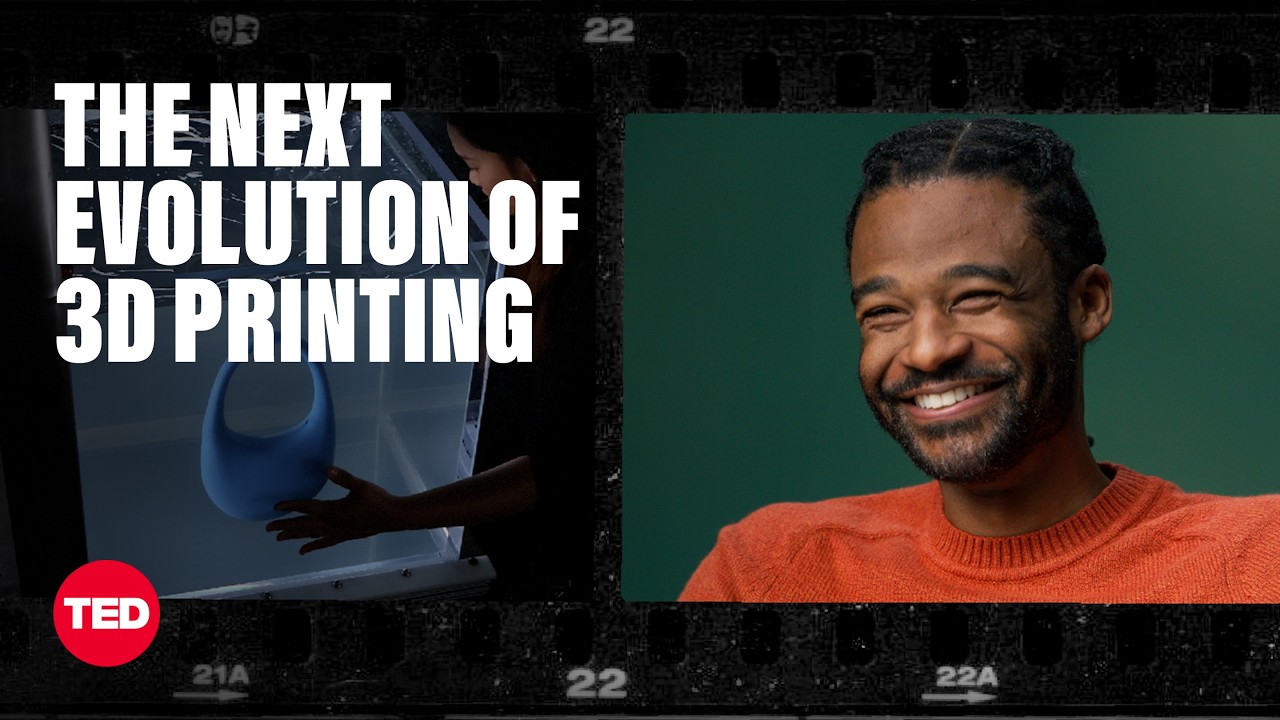
The gravity-defying future of manufacturing | Schendy Kernizan | TED
B2
60 min
Premium
1

Think about these questions before watching.

  1. Can you think of any everyday objects that have changed significantly in how they are manufactured over time? What improvements have you noticed?
  2. Imagine you're designing a new product. What kind of challenges do you think engineers and designers face when trying to turn an idea into a physical object, considering factors like materials, cost, or even physics?
  3. Many new technologies aim to make production faster, cheaper, or more efficient. How do you think advancements in manufacturing technology might impact our daily lives or the environment in the future?
2

You only need to watch the highlighted section below — the exercises focus on this part.

▶ You only need to watch 0:25–4:20. The exercises focus on this part.
Video script97 segments · click a timestamp to jump

I’m Schendy Kernizan.

I'm creating a new way of manufacturing objects.

I'm part of a company called Rapid Liquid Print

that is rethinking how products are made.

3D printing -- for those who are not familiar with it --

has been a technology

that's really taken off in the past 30 years.

Traditional manufacturing was using a method

that's just been so outdated,

not digitized.

3D printing became kind of the new way of making that.

People said, "Oh, this is going to replace traditional manufacturing."

But the issue is that you need to build on a platform.

So you always need a surface that you're starting with

in order to create an object.

And the more complex that geometry becomes,

gravity starts to become a limitation of what you can make.

And in order to circumvent that, you need to actually create supports --

and then you need to remove those supports.

So it's really kind of a manual effort of cleaning those pieces

that are then discarded.

And it's quite wasteful.

So 3D printing has almost become kind of this system

that's great for prototyping,

but hasn't really created that bridge from prototyping to production.

We solved that by printing inside of this gel

that holds the shape that you're drawing.

You're able to eliminate gravity.

Think of the ability of, you know --

if I have an idea in my mind, and I have a pencil,

can I draw it in space and then have that shape there?

So you go on the computer, you draw the geometry that you want,

and that information gets sent to the printer.

And as the machine is moving --

think of your arm moving that pencil around --

the material is coming out of it,

and the machine knows how fast or how slow it needs to go

and where it needs to be drawing it inside of the tank.

The gel is mostly water that’s been transformed into gelatin.

And think of hand sanitizer consistency

where it can move, but it has structure to itself.

And the viscosity is strong enough

where whatever you extrude inside of it doesn't just pull out the bottom.

And when it's done,

you just let it there until it fully cures.

You're literally doing calligraphy in space.

You're able to make parts faster.

You can customize the colors that you want.

You can blend colors, create gradients of colors.

And instead of having this mold that you then need to discard or put away

because your design is different the next time that you build something,

with this gel, it's reusable.

So you can extract that part, you rinse it with water

and you're reusing the gel to make more parts.

So it's a reusable process and sustainable way of making things.

As human beings, anything I touch, even from your phone case,

usually having some kind of flexibility and give to it

feels more relatable

than having a hard surface that you're touching.

Early days, there was another research group at MIT

that was doing a lot of prosthetics, orthotics.

They saw our process and thought,

"Hey, this could be actually beneficial for us."

And that led us to talk to more clinicians out there,

more people in that space.

People said customization would be really beneficial,

but [they] don’t have a way to do that easily.

Most of the time, what's really pushed on the patient

is to wear, you know, small, medium, large,

because it's faster and easier to do.

The downside to that is that you're being squeezed into something

that doesn't fit you well.

So we started printing and testing parts for them.

And I remember seeing the first time they showed us pictures of their patients

trying something that we had printed in our garage at the time

and hearing how, like, "This is the best fit I've ever had.

This really feels great on my body.”

That patient needed such a custom solution

and being able to scan [a] patient in the morning,

print in the afternoon and have something ready the next day,

it was exactly something that they were looking for

that they couldn't do before.

I think myself and others in the world,

we would love everything to be customized to our bodies and our needs.

Making mass customization more accessible to people is how I see the future.

There are a lot of industries that can benefit from this,

from toys to fashion, how cars are made, rockets were made,

consumer goods and things that we interact with.

Ways that we grow things or make things are going to be different.

One of the things that I dream about is the idea that we can create new things

that will inspire further travel, for example, in space,

or even habitats in space

we can kind of explore in

and come up with new solutions that maybe we haven't thought of.

It does excite me to see that people want to use this tool

to push their industry forward

and try new things that they couldn't do before.

3

Answer these questions in your own words. Support your answers with evidence from the video.

01According to the video, what were the main limitations of traditional 3D printing that prevented it from bridging the gap between prototyping and production?
Sample answerTraditional 3D printing had several issues. You always needed a flat surface to start, and gravity made it difficult to create complex shapes. To get around this, you had to add and then manually remove 'supports,' which was a wasteful and time-consuming process. This made it good for testing designs but not efficient for making many final products.
02How does the Rapid Liquid Print method, as described in the video, overcome the challenge of gravity in manufacturing complex objects?
Sample answerThe Rapid Liquid Print method solves the gravity problem by printing objects inside a special gel. This gel is thick and structured, similar to hand sanitizer, so it can hold the shape of the material as it's being drawn. This means the printer can 'draw in space' without the object collapsing or needing external supports.
03Beyond eliminating gravity, in what ways does the use of the gel contribute to a more efficient and sustainable manufacturing process?
Sample answerThe gel makes the process more efficient and sustainable because it's reusable. After a part is printed and extracted, you can rinse it with water and then reuse the same gel to make more parts. This also means you don't need to create and discard molds for every new design, and it allows for faster production and easy customization of colors and gradients.
04Why was the Rapid Liquid Print process particularly beneficial for patients needing prosthetics or orthotics, and what was the impact on their experience?
Sample answerIt was beneficial because patients often had to settle for standard sizes like small, medium, or large, which didn't fit them well. The Rapid Liquid Print process allows for highly customized solutions. A patient can be scanned in the morning, and a perfectly fitting prosthetic or orthotic can be printed by the afternoon and ready the next day, leading to a much more comfortable and personalized experience, with patients saying it was the 'best fit I've ever had'.
4

Vocabulary

Vocabulary
These expressions will help you communicate more naturally about this topic.
rethink an approach/process — to consider an idea, method, or plan again, especially in order to change it and improve it.
Usage note: This phrase is commonly used in business, technology, and problem-solving contexts when discussing innovation or finding new solutions. For example, 'Companies are rethinking their manufacturing processes to be more sustainable.'
bridge the gap — to connect two things or groups that are separate or different, or to make a difference between them smaller or less important.
Usage note: This idiom is often used when discussing solutions that connect different stages (e.g., prototyping and production), ideas, or groups of people. For example, 'New technologies can bridge the gap between complex designs and practical manufacturing.'
push the boundaries — to try to go beyond what is currently accepted, known, or possible in a particular field.
Usage note: This idiom is frequently used in science, technology, and art to describe innovative work that challenges existing limits. For example, 'Engineers are constantly pushing the boundaries of what 3D printing can achieve.'
streamline a process — to make a process, organization, or system more efficient by making it simpler, faster, or more direct.
Usage note: This is a formal verb commonly used in business, engineering, and administrative contexts when discussing improvements in efficiency and productivity. For example, 'Automating certain tasks can help streamline the production process.'
scale up production — to increase the size, amount, or rate of something, especially a business activity or the manufacture of goods, to meet higher demand or expand operations.
Usage note: This phrasal verb is crucial in business and manufacturing discussions, referring to the expansion of capacity from a smaller scale (like prototyping) to a larger, commercial scale. For example, 'The company plans to scale up production of its new eco-friendly product next quarter.'
5

Matching exercise: manufacturing innovations

Explore key concepts in modern manufacturing.

Match each item on the left with the correct item on the right.

A
B
6

Complete the sentences with words from the box. One word is extra.

Word bank
01To remain competitive in the global market, many companies find it essential to their entire manufacturing strategy.
02Innovative software solutions often help to between complex design concepts and practical production realities.
03In advanced robotics, engineers continue to the boundaries of what machines can achieve in terms of precision and autonomy.
04The new management system aims to the workflow, making operations more efficient and less prone to errors.
05Following positive market feedback, the company plans to production significantly to meet the growing consumer demand for its innovative products.
7

Grammar: Future perfect and future continuous

Grammar
The future perfect tense describes an action that will be completed before a specific point in the future. The future continuous tense describes an action that will be in progress at a specific point in the future. Both are essential for discussing predictions, ongoing developments, and completed innovations in the field of manufacturing.
By 2040, many companies will have fully embraced gravity-defying manufacturing techniques.
This action (embracing techniques) will be completed before the year 2040. It focuses on the result.
Next year, researchers will be developing even more advanced materials for 3D printing.
This action (developing materials) will be ongoing at some point next year. It focuses on the process.
In five years' time, traditional factories will be gradually disappearing, as new technologies will have transformed the industry.
Combines both tenses: 'will be disappearing' (ongoing process) and 'will have transformed' (completed action by a future point).
  • Use the future perfect (will have + past participle) for actions that will be finished before a future time.
  • Use the future continuous (will be + -ing verb) for actions that will be in progress at a future time.
  • Avoid confusing the two: use future perfect for completion by a future deadline, and future continuous for an activity happening at a future moment.
8

Rewrite each sentence using the future perfect or future continuous tense, as indicated in the prompt. Remember to use the vocabulary provided in the lesson.

01Engineers are currently developing a new method to push the boundaries of 3D printing.
Rewrite using the future continuous tense, starting with 'By this time next year...'
Hint: Focus on an action that will be in progress at a specific point in the future.
02The company aims to scale up production significantly by 2030.
Rewrite using the future perfect tense, starting with 'By 2030...'
Hint: Think about an action that will be finished before a specific time in the future.
03Researchers are trying to bridge the gap between traditional and advanced manufacturing techniques.
Rewrite using the future continuous tense, starting with 'In the coming decade...'
Hint: Use 'will be' + the -ing form of the main verb to describe ongoing future action.
04Many industries are rethinking their approach to supply chains.
Rewrite using the future perfect tense, starting with 'By the time the new regulations are implemented...'
Hint: The future perfect describes an action completed before another future event.
05Manufacturers are working to streamline their processes to reduce waste.
Rewrite using the future continuous tense, starting with 'Next year, manufacturers...'
Hint: What action will be ongoing at that future time?
06The new technology will completely transform how products are designed.
Rewrite using the future perfect tense, starting with 'Within the next five years...'
Hint: Consider the state of transformation at the end of the five-year period.
9

Correcting errors in manufacturing contexts

Read each sentence about the future of manufacturing. One word or phrase in each sentence is incorrect.

Each sentence contains one error. Find and correct it.

01By 2050, advanced automation will have been taken over most routine factory jobs, significantly changing the workforce.
Corrected version
By 2050, advanced automation will have been taken over most routine factory jobs, significantly changing the workforce.
02To stay competitive, manufacturers must rethink their approach for sustainable production methods.
Corrected version
To stay competitive, manufacturers must rethink their approach for to sustainable production methods.
03Implementing AI in quality control will streamline the production process efficient, reducing waste and errors.
Corrected version
Implementing AI in quality control will streamline the production process efficient, efficiently, reducing waste and errors.
04Researchers in material science is constantly pushing the boundary of what advanced manufacturing can achieve.
Corrected version
Researchers in material science is are constantly pushing the boundary boundaries of what advanced manufacturing can achieve.
05After securing new investment, the startup plans to scale up production on a global level within the next year.
Corrected version
After securing new investment, the startup plans to scale up production on to a global level within the next year.
06By this time next year, engineers will be design the next generation of gravity-defying manufacturing systems.
Corrected version
By this time next year, engineers will be design designing the next generation of gravity-defying manufacturing systems.
07If manufacturers would not bridge the gap between traditional methods and innovative technologies, they risk falling behind.
Corrected version
If manufacturers would do not bridge the gap between traditional methods and innovative technologies, they risk falling behind.
08A future of manufacturing will likely involve highly customized products made on demand.
Corrected version
A The future of manufacturing will likely involve highly customized products made on demand.
10

Words to take with you

Vocabulary
These expressions are not in the video but will help you discuss this topic more fluently.
disruptive technology — a new technology that significantly changes the way an industry or market operates, often creating new markets and value networks.
Use this to describe innovations that fundamentally alter existing processes or business models, rather than just improving them. For example: "3D printing was initially seen as a disruptive technology that could revolutionize manufacturing."
cutting-edge — extremely modern and advanced; at the forefront of development.
This adjective is used to describe the most advanced or innovative products, research, or techniques. It implies being ahead of the curve. For example: "The company is investing heavily in cutting-edge robotics for its new production line."
proof of concept — evidence, typically derived from an experiment or pilot project, which demonstrates that a design concept or theory is feasible.
This term is crucial in research and development. It refers to the stage where an idea is shown to work in practice, even if not yet fully developed. For example: "Before investing millions, they needed to see a clear proof of concept for the new manufacturing method."
embrace innovation — to readily accept and adopt new ideas, methods, or technologies.
This phrase describes a proactive attitude towards change and progress, often by companies or individuals. It's about being open to new ways of doing things. For example: "To stay competitive, businesses must embrace innovation and adapt to new market demands."
overcome a hurdle — to successfully deal with a difficulty or problem that is preventing progress.
This idiom is useful when discussing challenges and solutions in development or production. A 'hurdle' is a metaphorical obstacle. For example: "Engineers are working to overcome a significant hurdle related to material strength in their new design."
11

Use the word in brackets to form a new word that fits each gap.

01
The constant of existing methods is crucial for innovation in manufacturing.
02
New technologies are essential for the gap between current capabilities and future demands in production.
03
Engineers are always trying to push the of what's possible with new materials.
04
The new software aims to create a more workflow, reducing delays and costs.
05
The new manufacturing process is highly , allowing for rapid increase in output.
06
Mass of these advanced components will revolutionize several industries.
12

Innovation in manufacturing: beyond traditional limits

The video you watched discussed how new technologies are overcoming physical limitations in manufacturing. This passage explores broader trends in how industries are adapting and evolving.

Read the passage below, then answer the comprehension questions.

For decades, traditional manufacturing relied on methods that, while effective, often presented significant limitations, particularly in design complexity and material waste. Now, however, innovative technologies are allowing engineers to rethink their entire approach to production. Techniques like additive manufacturing, beyond conventional 3D printing, are emerging, promising to push the boundaries of what's possible. These advancements aim to bridge the gap between intricate digital designs and physical reality, enabling the creation of objects with previously unimaginable geometries.

By 2030, many factories will have streamlined their processes considerably, integrating AI and robotics to optimize every stage from conception to delivery. We will be seeing a shift towards highly customized, on-demand production, drastically reducing inventory and waste. This evolution will also allow companies to scale up production of specialized items much more efficiently, meeting niche market demands without the prohibitive costs of mass production. The future of manufacturing isn't just about making things faster; it's about making them smarter, more adaptable, and ultimately, more sustainable.

01What are two limitations of traditional manufacturing mentioned in the first paragraph?
Sample answerTraditional manufacturing was limited by design complexity and material waste.
02According to the passage, what is the purpose of new manufacturing advancements like additive manufacturing?
Sample answerTheir purpose is to push the boundaries of what's possible and bridge the gap between digital designs and physical reality.
03What major change will have occurred in factory operations by 2030, and what technologies will contribute to this?
Sample answerBy 2030, factories will have streamlined their processes considerably by integrating AI and robotics.
04Besides speed, what three qualities will define the future of manufacturing, according to the final sentence?
Sample answerThe future of manufacturing will be smarter, more adaptable, and more sustainable.
13

Discuss these questions with a partner. Try to use vocabulary from the lesson.

  1. How might the video's technology rethink global manufacturing processes?
  2. Is scaling up production with this new method a realistic goal?
  3. What local innovations streamline processes or push the boundaries?