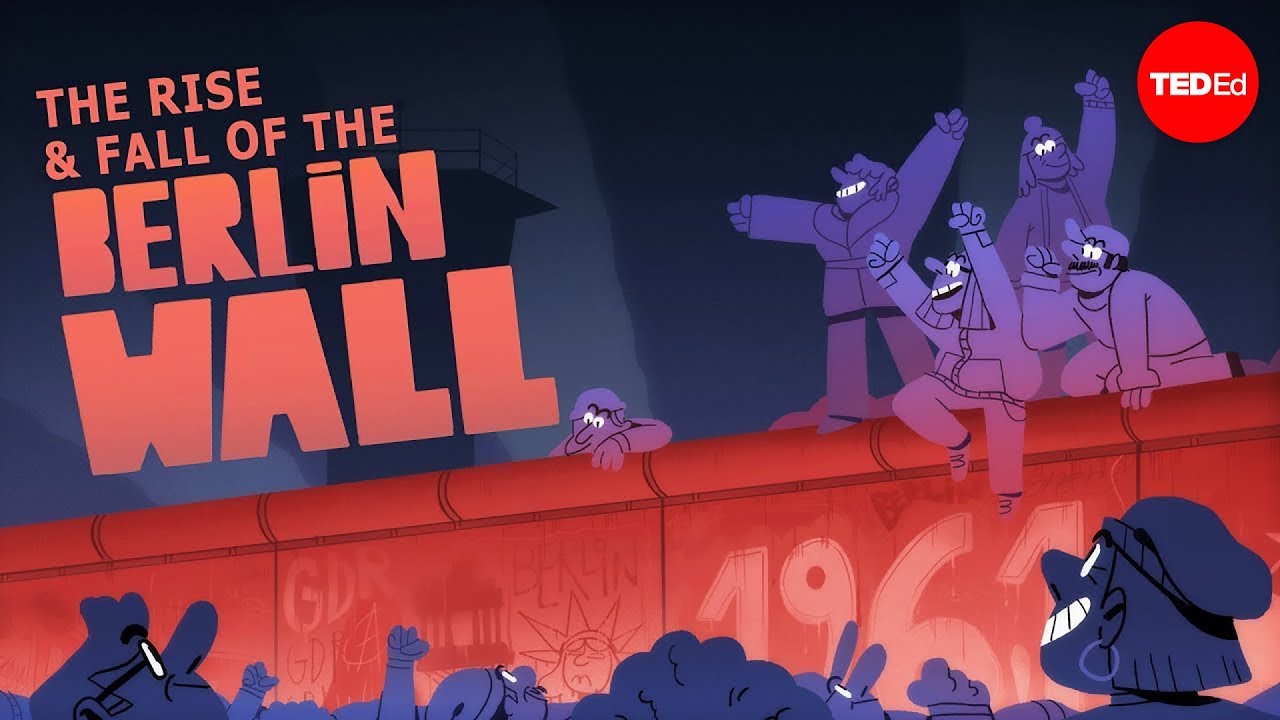
How do physical or invisible borders, whether between countries, cities, or even communities, influence people's sense of identity and belonging?
What does 'freedom of movement' mean to you personally, and can you think of any historical or current situations where this freedom has been severely restricted for a large population?
Throughout history, societies have sometimes been divided by political ideologies or conflicts. What do you believe are the most significant long-term consequences of such divisions, and how might they impact future generations?
2
Watch the video carefully. Pay attention to the main ideas and key details.
Video script109 segments · click a timestamp to jump
In the early hours of August 13, 1961,
East German construction workers flanked by soldiers and police
began tearing up streets and erecting barriers throughout the city of Berlin
and its surroundings.
This night marked the beginning of one of history's most infamous dividing lines,
the Berlin Wall.
Construction on the wall continued for the next decade
as it cut through neighborhoods,
separated families,
and divided not just Germany, but the world.
To understand how we got to this point,
we have to go back to World War II.
America, Britain, and France
joined forces with the Soviet Union against the Axis Powers.
After they defeated Nazi Germany,
each of the victorious nations occupied part of the country.
The division was meant to be temporary,
but the former allies found themselves at odds
over their visions for post-war Europe.
While Western powers promoted liberal market economies,
the Soviet Union sought to surround itself with obedient Communist nations,
including a weakened Germany.
As their relations deteriorated,
the Federal Republic of Germany was formed in the West
while the Soviets established the German Democratic Republic in the East.
The Soviet satellite countries restricted Western trade and movement,
so a virtually impassable border formed.
It became known as the Iron Curtain.
In the former German capital of Berlin, things were particularly complicated.
Although the city lay fully within the East German territory of the GDR,
the post-war agreement gave the allies joint administration.
So America, Britain, and France created a Democratic enclave
in Berlin's western districts.
While East Germans were officially banned from leaving the country,
in Berlin, it was simply a matter of walking,
or riding a subway, streetcar or bus,
to the Western half,
then traveling on to West Germany or beyond.
This open border posed a problem for the East German leadership.
They had staked a claim to represent the Communist resistance against Hitler
and portrayed Western Germany as a continuation of the Nazi regime.
While the U.S. and its allies poured money into West Germany's reconstruction,
the Soviet Union extracted resources from the East as war reparations,
making its planned economy even less competitive.
Life in East Germany passed under the watchful eye of the Stasi,
the secret police whose wiretaps and informants monitored citizens
for any hint of disloyalty.
While there was free health care and education in the East,
the West boasted higher salaries,
more consumer goods,
and greater personal freedom.
By 1961, about 3.5 million people, nearly 20% of the East German population,
had left, including many young professionals.
To prevent further losses,
East Germany decided to close the border, and that's where the Berlin Wall came in.
Extending for 43 kilometers through Berlin,
and a further 112 through East Germany,
the initial barrier consisted of barbed wire and mesh fencing.
Some Berliners escaped by jumping over the wire
or leaving from windows,
but as the wall expanded, this became more difficult.
By 1965, 106 kilometers of 3.6-meter-high concrete barricades had been added
topped with a smooth pipe to prevent climbing.
Over the coming years, the barrier was strengthened with spike strips,
guard dogs,
and even landmines,
along with 302 watchtowers and 20 bunkers.
A parallel fence in the rear set off a 100-meter area called the death strip.
There, all buildings were demolished and the ground covered with sand
to provide a clear line of sight for the hundreds of guards
ordered to shoot anyone attempting to cross.
Nevertheless, nearly 5,000 people in total managed to flee East Germany
between 1961 and 1989.
Some were diplomats or athletes who defected while abroad,
but others were ordinary citizens who dug tunnels,
swam across canals,
flew hot air balloons,
or even crashed a stolen tank through the wall.
Yet the risk was great.
Over 138 people died while attempting escape.
Some shot in full view of West Germans powerless to help them.
The wall stabilized East Germany's economy by preventing its work force from leaving,
but tarnished its reputation,
becoming a global symbol of Communist repression.
As part of reconciliation with the East,
the Basic Treaty of 1972 recognized East Germany pragmatically
while West Germany retained its hope for eventual reunification.
Although the Eastern regime gradually allowed family visits,
it tried to discourage people from exercising these rights
with an arduous bureaucratic process and high fees.
Nonetheless, it was still overwhelmed by applications.
By the end of the 1980's,
the liberalization of other Eastern Bloc regimes
caused mass demonstrations for free travel and demands for democracy.
On the evening of November 9, 1989,
East Germany tried to defuse tension by making travel permits easier to obtain.
But the announcement brought thousands of East Berliners
to the border crossing points in the wall,
forcing the surprised guards to open the gates immediately.
Rejoicing crowds poured into West Berlin
as people from both sides danced atop the wall.
And others began to demolish it with whatever tools they could find.
Although the border guards initially tried to maintain order,
it was soon clear that the years of division were at an end.
After four decades, Germany was officially reunified in October 1990.
And the Soviet Union fell soon after.
Today, parts of the wall still stand as a reminder
that any barriers we put up to impede freedom,
we can also break down.
3
Answer these questions in your own words. Support your answers with evidence from the video.
01Why did East Germany decide to build the Berlin Wall in 1961?
Sample answerEast Germany built the wall because a significant portion of its population, nearly 20% or 3.5 million people, had already left for the West by 1961. Many of these were young professionals, and the government wanted to prevent further losses of its workforce and citizens.
02In what ways did the Berlin Wall's construction and defenses evolve over time, making escape increasingly difficult?
Sample answerInitially, the wall was just barbed wire and mesh fencing, which some people could jump over or escape from nearby windows. However, it quickly became much more fortified. By 1965, it included 3.6-meter-high concrete barricades topped with a smooth pipe. Later additions included spike strips, guard dogs, landmines, 302 watchtowers, and 20 bunkers, along with a 'death strip' where guards had orders to shoot anyone attempting to cross.
03What were the main differences between life in East and West Germany that motivated so many East Germans to leave before the wall was built?
Sample answerThe video explains that while East Germany offered free healthcare and education, West Germany had higher salaries, more consumer goods, and greater personal freedom. The Soviet Union also extracted resources from East Germany as war reparations, which made its planned economy less competitive compared to West Germany, where the U.S. and its allies invested heavily in reconstruction.
04How did a seemingly minor announcement on November 9, 1989, lead to the unexpected opening of the Berlin Wall?
Sample answerOn that evening, East Germany announced that travel permits would be easier to obtain, intending to defuse tension. However, this announcement caused thousands of East Berliners to immediately gather at the border crossing points. The sheer number of people overwhelmed the surprised guards, who, despite initial attempts to maintain order, were forced to open the gates, leading to the wall's collapse.
4
Decide if each statement is true or false. Correct the false ones.
01After World War II, the victorious allies, including the US, Britain, France, and the Soviet Union, each occupied a part of Germany, initially intending this division to be temporary.
02Despite Berlin being located entirely within East German territory, the city was solely administered by the Soviet Union after World War II.
03Before the Berlin Wall was constructed in 1961, approximately 3.5 million people, representing nearly 20% of the East German population, had already left the country.
04The "death strip" was a 100-meter area along the Berlin Wall where buildings were kept intact to provide shelter for those attempting to escape.
05The Berlin Wall, while stabilizing East Germany's economy by preventing emigration, also severely damaged its international reputation, becoming a global symbol of Communist repression until Germany's reunification in 1990.
5
Vocabulary
Vocabulary
These expressions will help you communicate more naturally about this topic.
Examples
the Iron Curtain — a political, military, and ideological barrier that separated the Soviet bloc and Western Europe from 1945 until the end of the Cold War in 1991.
Usage note: This is a metaphorical term, not a physical wall, used in historical discussions to describe the division between communist Eastern Europe and capitalist Western Europe.
to be at odds with — to disagree or be in conflict with someone or something.
Usage note: This phrase is common in both formal and informal contexts. It's often followed by 'with' and then the person, group, or idea you disagree with. Example: The two political systems were constantly at odds with each other.
to stifle dissent — to prevent or suppress people's disagreement or opposition, often by force or strict control.
Usage note: This phrase is typically used in political or historical discussions, especially when talking about authoritarian governments trying to maintain power. Example: The regime worked hard to stifle any form of public dissent.
a watershed moment — a turning point or a moment of significant change, after which things are never the same.
Usage note: This is a semi-formal expression used to describe important historical or personal events. It emphasizes the lasting impact of a particular moment. Example: The fall of the wall was a watershed moment for Germany and Europe.
to tear down (a wall/barrier) — to intentionally destroy or dismantle a structure like a wall or building.
Usage note: This phrasal verb is commonly used when talking about removing physical barriers or even metaphorical ones. It implies a deliberate act of destruction or removal. Example: People gathered to tear down sections of the wall.
6
Matching exercise: the Berlin Wall and its legacy
Match each beginning of a sentence on the left with its correct ending on the right.
Match each item on the left with the correct item on the right.
A
B
7
Complete the sentences with words from the box. One word is extra.
Word bank
01For decades, symbolized the ideological and physical division between Eastern and Western Europe.
02After the war, the former allies began each other over the future of Germany.
03The authoritarian regime worked hard among its population, using surveillance and strict laws.
04The collapse of the Soviet Union was that reshaped global politics for generations.
05Citizens gathered at the border, determined the wall that had separated their families for so long.
8
Grammar: Third conditionals
Grammar
Third conditionals are used to talk about hypothetical situations in the past that did not happen, and their imagined past consequences. We use them to speculate about how historical events, like the building or fall of the Berlin Wall, might have unfolded differently if certain conditions had been met.
Examples
If the Western powers had reacted more forcefully in 1961, the Berlin Wall might not have stood for so long.
This speculates about a different past action (stronger reaction) and its potential past outcome (the wall not standing).
Many families wouldn't have been separated if the division of Germany hadn't become permanent after World War II.
Here, the 'if' clause comes second, showing flexibility in sentence structure. It highlights a past reality and its tragic consequence.
If East Germans hadn't risked so much to escape, the world might not have understood the desperation caused by the wall.
This example emphasizes the importance of past actions (risking escape) in shaping global perception.
Key points
Structure: 'If + past perfect (had + past participle), would have + past participle'.
Purpose: To discuss imagined past situations and their hypothetical past results, often expressing regret, criticism, or alternative history.
Common mistake: Do not use 'would have' in the 'if' clause; use the past perfect instead.
9
Rewrite each sentence using the third conditional to imagine a different past.
01The former allies were at odds with each other, so they didn't agree on a unified Germany.
Rewrite using the third conditional.
Hint: Identify the past condition (being at odds) and its past result (not agreeing).
02The East German government actively stifled dissent, preventing citizens from openly protesting the wall.
Rewrite using the third conditional.
Hint: What was the condition that stopped the protests?
03The construction of the Berlin Wall further intensified the division of Europe, solidifying the Iron Curtain.
Rewrite using the third conditional.
Hint: Consider the impact of the wall's construction on the Iron Curtain.
04The unexpected announcement allowed people to gather at the wall, leading to its eventual tearing down.
Rewrite using the third conditional.
Hint: What was the crucial event that enabled the wall's destruction?
05The fall of the Berlin Wall was a watershed moment, fundamentally changing the geopolitical landscape.
Rewrite using the third conditional to imagine a different past.
Hint: What was the crucial outcome that defined this moment?
06Many people risked their lives to cross the wall because they desperately wanted freedom.
Rewrite using the third conditional.
Hint: What was the underlying motivation for their dangerous actions?
10
Correcting errors: the Berlin Wall
Read each sentence about the Berlin Wall and the Cold War. Each sentence contains one error related to grammar, vocabulary, or usage. Identify the error and write the correct sentence.
Each sentence contains one error. Find and correct it.
01After World War II, the former allies found themselves in odds with each other over Germany's future.
Corrected version
After World War II, the former allies found themselves in at odds with each other over Germany's future.
02The government's strict policies were designed to stifling dissent among the population.
Corrected version
The government's strict policies were designed to stifling stifle dissent among the population.
03If the Western powers would have reacted more strongly, the wall might not have stood for so long.
Corrected version
If the Western powers would have had reacted more strongly, the wall might not have stood for so long.
04The fall of the Berlin Wall represented a watershed moment for the world, changed the geopolitical map.
Corrected version
The fall of the Berlin Wall represented a watershed moment for the world, changed changing the geopolitical map.
05The desire for tearing down the wall grew stronger among East Germans in the late 1980s.
Corrected version
The desire for tearing to tear down the wall grew stronger among East Germans in the late 1980s.
06The political climate in post-war Europe was extreme tense, leading to the division of Germany.
Corrected version
The political climate in post-war Europe was extreme extremely tense, leading to the division of Germany.
07The Iron Curtain was a symbolic barrier that divided Europe in two political spheres.
Corrected version
The Iron Curtain was a symbolic barrier that divided Europe in into two political spheres.
11
Words to take with you
Vocabulary
These expressions are not in the video but will help you discuss this topic more fluently.
Examples
ideological divide — a significant difference in beliefs, principles, or political systems that separates groups of people.
This noun phrase is often used to describe fundamental disagreements between political or social systems, such as capitalism and communism. Example: "The Berlin Wall was a physical manifestation of the deep ideological divide between East and West."
to impose restrictions — to officially force rules or limitations on people or activities.
This verb phrase highlights the act of an authority limiting freedom or choice. It is commonly followed by 'on' or 'upon'. Example: "The authorities continued to impose strict travel restrictions on East German citizens for decades."
to defect — to abandon one's country or cause in favor of an opposing one.
This verb is specific to leaving a country, especially for political reasons, often to an enemy state or a state with a different political system. Example: "Many people risked their lives trying to defect from East Germany to the West."
a climate of fear — an atmosphere or situation in which people are afraid, often due to political repression or violence.
This expression describes a pervasive feeling of apprehension and insecurity within a society, usually caused by an oppressive regime or dangerous circumstances. Example: "Living under constant surveillance created a climate of fear for many residents of East Berlin."
to bridge a divide — to reduce or eliminate differences or disagreements between two groups or things; to connect them.
This metaphorical phrase is used when efforts are made to bring together people, ideas, or regions that were previously separated or in conflict. Example: "After the wall fell, there was a huge effort to bridge the divide between the former East and West German societies."
12
Odd one out: the Berlin Wall's legacy
Think about the historical context and the meaning of each word or phrase.
Which word or phrase does not belong in each group? Think about the common connection.
01with the nounActions of division
02with the nounPolitical systems and control
03with the nounExpressions of disagreement
04with the nounDescribing historical importance
05with the nounActions with barriers
06with the nounConcepts of political division
13
Discuss these questions with a partner. Try to use vocabulary from the lesson.
What 'Iron Curtains' or divisions exist in your society?
Is it ever justified to 'stifle dissent' for stability?
What makes a historical event a 'watershed moment'?
This lesson is for Lessonpills members
Sign in at learn.lessonpills.com to print lessons or save them as PDF.