International trade: discussing economic news and consequences
1
Think about these questions before watching. Share your ideas with a partner.
- How do you think international trade disputes, like imposing taxes on imported goods, might affect your daily life or the prices of products you buy?
- Think about a popular product in your country that is made somewhere else. What are the benefits and drawbacks of your country importing so much of it?
- Some people argue that countries should protect their own industries by limiting foreign competition. Others believe in completely open markets. What's your perspective on this?
2
Watch the video carefully. Pay attention to the main ideas and key details.
3
Answer these questions in your own words. Support your answers with evidence from the video.
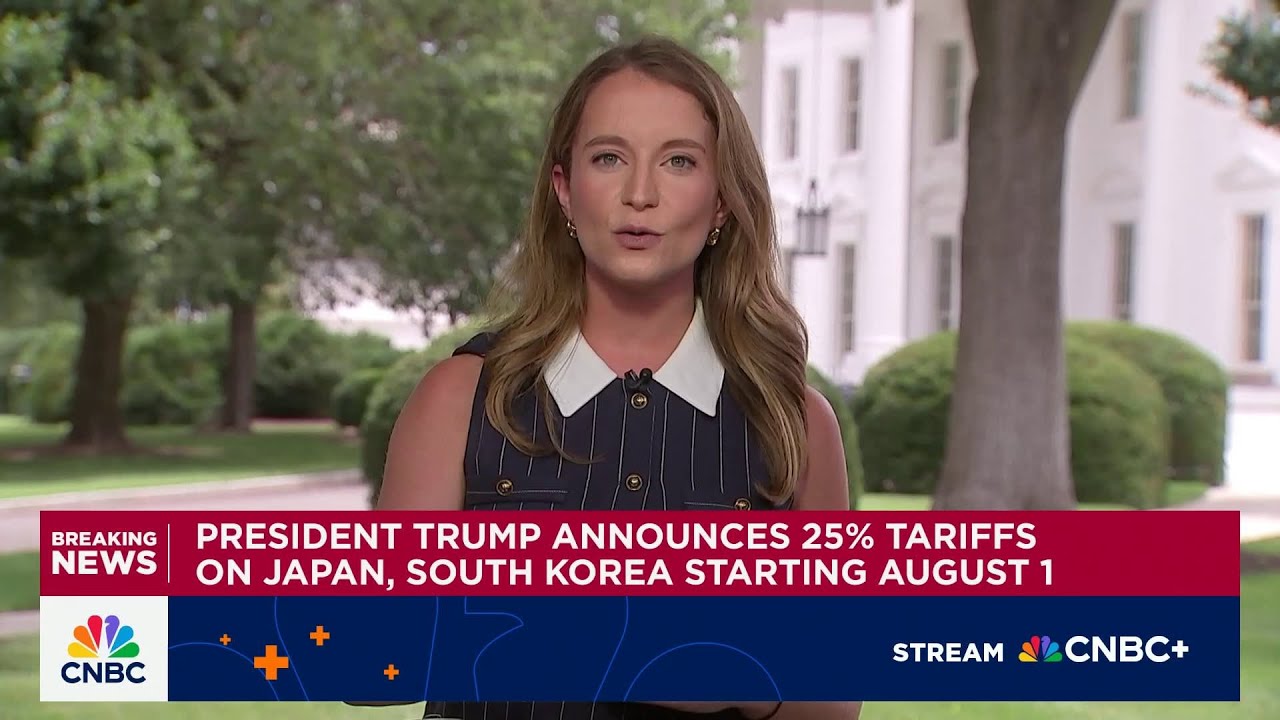
01According to the report, what are the main conditions of the new tariffs being imposed on Japan and South Korea?
Sample answerThe video says there will be a 25% tariff on all their exports to the U.S. starting on August 1st. It also mentioned this is an additional tariff on top of any that are already in place, and that the rate could increase if those countries retaliate.
02In what way does the president's announcement create uncertainty for investors and the market?
Sample answerIt creates uncertainty because the president hinted that the tariff rates could go up or down. He said it depends on the 'relationship' with the country and if they open their markets, so there's no fixed plan, which investors don't like.
03What challenge does the U.S. face when dealing with smaller trading partners, and what is the likely outcome for them?
Sample answerThe main challenge is that there are too many small countries to negotiate with individually; they don't have the 'bandwidth.' So, it's likely they will just apply a general 'blanket tariff' to all of them instead of making specific deals.
04Why does the reporter suggest the market has been 'shrugging off' the tariff news, despite the recent announcement?
Sample answerThe reporter thinks it's because the tariffs haven't actually started yet. Even though the announcement sounds serious, the deadline was delayed from July to August. This delay gives more time for negotiations, so investors might believe the tariffs won't actually happen.
4
Key vocabulary for discussing trade
Vocabulary
These expressions will help you communicate more naturally and precisely about international trade and its consequences.
Examples
To level the playing field — to create a situation where everyone has a fair and equal chance of succeeding.
Usage note: this is a common idiom in business and politics. It's often used to justify policies like tariffs, arguing they make competition fairer.
Trade barrier — a government-imposed restriction on the free international exchange of goods or services.
Usage note: this is a key term. Tariffs (taxes on imports) and quotas (limits on the quantity of imports) are common examples of trade barriers.
Retaliatory measures — actions taken by one country against another that has harmed it, especially in trade.
Usage note: this is a more formal way of saying 'getting back at someone'. Common verbs used with it are 'take', 'impose', or 'face'. For example: 'The government threatened to take retaliatory measures.'
Ripple effect — a situation in which one event causes a series of other, often unintended, events to happen.
Usage note: use this to describe the widespread, indirect consequences of an economic decision. For example: 'The new tariffs had a ripple effect on consumer prices.'
Supply chain disruption — an unexpected problem that interrupts the normal flow of goods and materials from suppliers to consumers.
Usage note: this is a very common term in modern business and economics. Trade disputes are a major cause of supply chain disruption.
5
Trade and Tariffs: Matching Exercise
Test your understanding of key terms and phrases related to international trade and tariffs.
Match each item on the left with the correct item on the right.
A
B
6
Grammar: reported speech
Grammar
We use reported speech (or indirect speech) to tell someone what another person said, without using their exact words. It's essential for discussing news and official statements, where we often report on announcements from politicians, analysts, or companies. This usually involves changing verb tenses, pronouns, and time expressions.
Examples
The finance minister announced that the new tariffs would be effective on August 1st.
Notice the tense shift. The original statement 'will be' changes to 'would be' in reported speech.
The reporter asked if the government had considered the impact on consumers.
When reporting questions, the word order changes to a normal statement structure (not a question structure).
The trade representative warned that any retaliation could lead to a trade war.
Using specific reporting verbs like 'warned', 'claimed', or 'explained' provides more context than just using 'said'.
Key points
- Verb tenses typically shift one step back in time (e.g., present simple becomes past simple).
- Remember to change pronouns and time/place expressions to fit the new context (e.g., 'today' becomes 'that day').
- A common mistake is forgetting to change the word order when reporting a question.
7
Correct the mistakes
Read the sentences below about international trade and economics.
Each sentence contains one error. Find and correct it.
01The finance minister told reporters that the new trade deal will be signed the following week.
Corrected version
The finance minister told reporters that the new trade deal will would be signed the following week.
02The government's retaliation measures included higher taxes on imported luxury goods.
Corrected version
The government's retaliation retaliatory measures included higher taxes on imported luxury goods.
03Imposing new tariffs to foreign cars could lead to a trade war.
Corrected version
Imposing new tariffs to on foreign cars could lead to a trade war.
04The ripple effect of the sanctions were felt almost immediately in the global markets.
Corrected version
The ripple effect of the sanctions were was felt almost immediately in the global markets.
05The goal of the agreement is to flat the playing field for small and large businesses alike.
Corrected version
The goal of the agreement is to flat level the playing field for small and large businesses alike.
06The recent supply chain disrupted has caused significant delays for many companies.
Corrected version
The recent supply chain disrupted disruption has caused significant delays for many companies.
07Many economists believe that trade barriering harms both economies involved in the long run.
Corrected version
Many economists believe that trade barriering harms barriers harm both economies involved in the long run.
8
Useful phrases: discussing the impact of economic news
Vocabulary
When talking about news related to trade, tariffs, or the economy, you'll often need to share your opinion, agree or disagree with others, and speculate on the consequences. These phrases will help you do that naturally and effectively in a professional or academic setting.
Examples
Did you see the latest on the new trade tariffs? — To introduce the topic of recent economic news.
Register: Neutral/Informal. A perfect way to start a conversation with a colleague or classmate. You can easily replace 'trade tariffs' with any other current event (e.g., 'interest rates', 'the stock market report').
From where I'm standing, this is bound to have a significant impact on consumer prices. — To state your opinion or analysis of the consequences.
Register: Neutral. This phrase introduces your perspective in a thoughtful way. 'Bound to' shows you feel very certain about the outcome. You can replace 'consumer prices' with any other affected area.
You've hit the nail on the head. And on top of that, we also have to consider... — To strongly agree with someone's point and add your own related idea.
Register: Informal. The idiom 'hit the nail on the head' means 'you are exactly right'. It's a natural way to show enthusiastic agreement before expanding on the point.
I can see why you'd say that, but I'm not entirely convinced that's the whole picture. — To politely challenge someone's opinion and introduce a counter-argument.
Register: Neutral/Formal. This is a soft way to disagree. It acknowledges the other person's viewpoint first, which is effective in professional or academic discussions.
It's hard to say for sure, but my guess is that we'll see a lot of uncertainty in the markets. — To speculate about future consequences when the outcome is unclear.
Register: Neutral. This phrase shows you are thinking critically but not claiming to have all the answers. It's useful for discussing unpredictable situations like market reactions.
At the end of the day, it all comes down to how businesses react. — To summarize the discussion and identify the most important, fundamental point.
Register: Neutral/Informal. A common way to conclude a line of thought by focusing on what you believe is the core issue. It simplifies a complex topic to its most essential part.
9
The consequences of trade tariffs
Read the passage about the effects of international trade policies.
Fill in each blank with the correct word or phrase from the word bank.
Word bank
When a country imposes a tariff, it is creating a significant designed to protect its domestic market. The official goal is often to and give local businesses a fairer chance to compete. However, this can trigger from trading partners, who may impose their own tariffs in response. This escalating conflict can have a widespread , impacting industries far beyond those initially targeted. One major consequence is , which can halt production and increase costs for consumers.
10
Discuss these questions with a partner. Try to use vocabulary from the lesson.
- Some argue that imposing a `trade barrier` like a tariff is a necessary tool to `level the playing field` in international trade. Others believe it only leads to `retaliatory measures` and hurts everyone. Which perspective do you agree with more, and why?
- Can you think of a recent `supply chain disruption` that affected your country? Describe the `ripple effect` it had on prices, the availability of goods, and local businesses.
- The video mentions market uncertainty. If you were the CEO of a company that imports products from Japan or South Korea, what strategies would you consider to protect your business from the negative `ripple effect` of these sudden tariffs?