Global business: comparing and contrasting economies
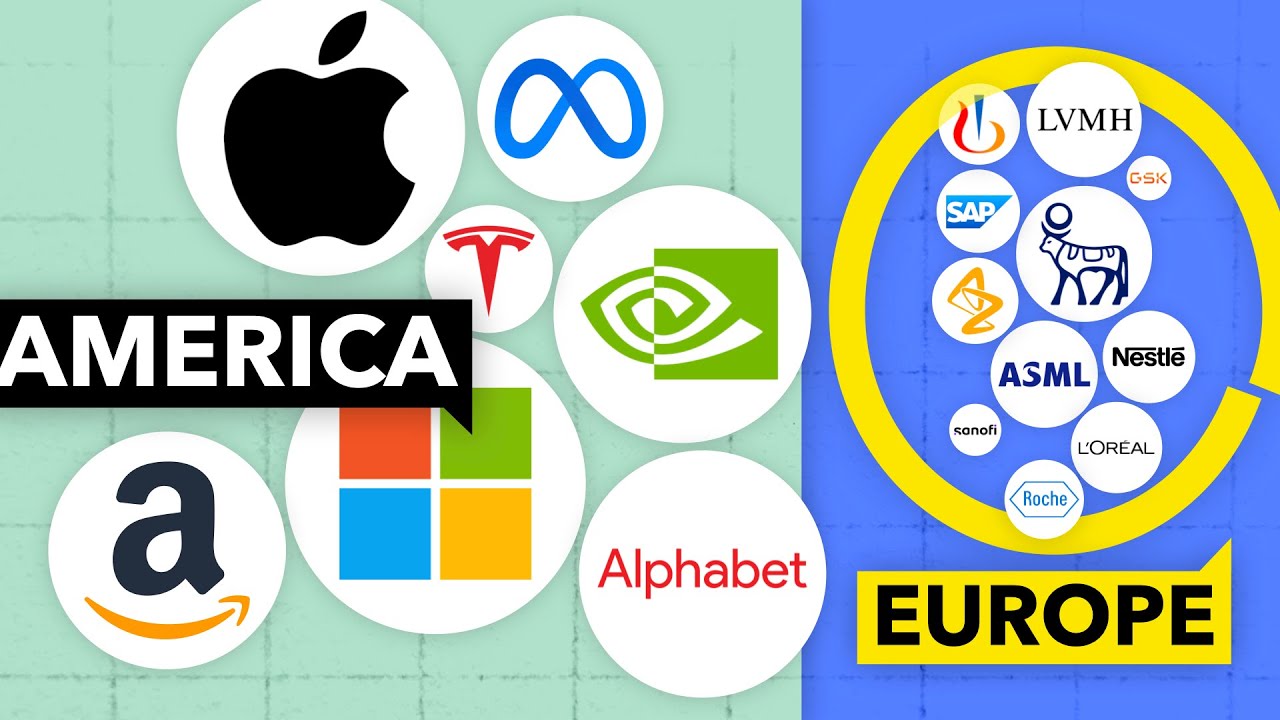
1
Think about these questions before watching. Share your ideas with a partner.
- When you think of a 'global brand', which companies first come to mind and from what countries? What factors do you think make a company a household name worldwide?
- Consider the most dominant companies in your own country. Are they primarily in technology, manufacturing, finance, or another sector? What might this suggest about your country's economic strengths?
- Some argue that for a country to be a global economic leader, it must have a world-class technology industry. To what extent do you agree with this perspective?
2
Watch the video from 2:45 to 5:20. Pay attention to the main ideas, key vocabulary, and examples in this section.
3
Answer these questions in your own words. Support your answers with evidence from the video.
01According to the video, what are the initial challenges a business faces when trying to expand across Europe?
Sample answerThey have to translate their products or services for each country, which costs a lot of time and money. They also have to adapt to different legal regulations and distinct markets, which isn't a problem if you're only operating in America.
02In what way does the video describe the US market as being more advantageous for a new business compared to the European market?
Sample answerThe video says the US is one large, homogeneous market, giving a business immediate access to 300 million potential customers. In contrast, Europe is made up of many different markets with different cultures and languages.
03The video uses the example of a social media app for Dutch people. Why would it be difficult for such an app to scale up and become as large as an American tech company?
Sample answerBecause it's designed for a specific culture and language. What works for Dutch people might not appeal to people in Spain or Germany. This makes it hard to grow across the whole continent, unlike in the US where a single product can reach a huge, more uniform audience.
04What does the video suggest can happen to a successful European tech company when it starts to compete with a major American one?
Sample answerThe video explains that the American company, which is often much bigger, can simply buy the European company. It gives the examples of Microsoft buying Skype and eBay buying a Dutch website, which means the European product becomes part of a US company.
4
Vocabulary
Vocabulary
These expressions will help you communicate more naturally about this topic.
Examples
To gain a foothold in the market — to establish a secure, initial position in a new business or market area.
Usage note: This is a common business collocation. It's often used when discussing the challenges of entering a competitive market. You can also say 'establish a foothold' or 'secure a foothold'.
A one-size-fits-all approach — a single solution or strategy that is applied to all situations, often inappropriately.
Usage note: This phrase is typically used to criticize a strategy that ignores local differences. The video argues a one-size-fits-all approach that works in the US fails in Europe.
To tap into a new market — to access and start taking advantage of a new group of potential customers or a new sales area.
Usage note: This is a dynamic phrasal verb suggesting proactive expansion. For example, 'The company developed a new app to tap into the youth market'.
To navigate the regulatory landscape — to successfully deal with a country's or region's complex system of laws and official rules.
Usage note: This is a semi-formal phrase that emphasizes the difficulty of complying with regulations. 'Navigating the landscape' is a common metaphor for managing complex systems.
A level playing field — a situation of fair competition, where no single company or person has an unfair advantage.
Usage note: This is a common idiom in business and politics. People often talk about the need to 'create' or 'ensure' a level playing field for all competitors.
5
Decide if each statement is true or false. Correct the false ones.
01The video describes the American market as being large and relatively uniform.
02According to the video, businesses in Europe only need to translate their products and don't have to worry about different legal systems.
03The video mentions that Microsoft, an American company, acquired the European tech product Skype.
04The video argues that the need to adapt products for numerous languages and cultures in Europe makes it difficult for businesses to scale up quickly.
05When eBay entered the Dutch market, it successfully competed with and eventually replaced the local website marktplaats.net.
6
Complete the sentences with words from the box. One word is extra.
Word bank
01It can be incredibly difficult for a small startup to gain a in a market dominated by multinational corporations.
02Because customer preferences vary so much between countries, a marketing strategy is rarely effective in Europe.
03The company hopes to the growing demand for sustainable products by launching a new eco-friendly line.
04International businesses need experienced legal teams to help them the complex regulatory landscape of foreign markets.
05Smaller companies argue that tax breaks for large corporations do not create a level for everyone.
7
Choose the best answer based on what you heard in the video.
01According to the video, the need to adapt to different languages and legal systems in Europe primarily creates a significant hurdle for which type of business?
02How does the video contrast the consumer markets of the US and Europe?
03What strategy did eBay eventually use to establish a foothold in the Dutch market?
04Which of the following is NOT mentioned in the video as a reason for Europe's lack of dominant tech companies?
8
Business Giants: US vs. Europe
Test your understanding of key terms and concepts from the video.
Match each item on the left with the correct item on the right.
A
B
9
Discuss these questions with a partner. Try to use vocabulary from the lesson.
- Considering the dominant industries in your country, what challenges would a local company face trying to gain a foothold in the market globally? Do you think the government does enough to create a level playing field for local businesses against international giants?
- The video contrasts the US economy's reliance on a few tech giants with Europe's more diversified top companies. Which model do you believe is more resilient and sustainable? Is it better for a country to support a dominant sector that can easily tap into new markets, or to ensure a level playing field for various industries?
- Imagine a successful European company wants to significantly expand into the US or Asia. Why might a one-size-fits-all approach fail, and what specific challenges would they face in trying to navigate the regulatory landscape of a new continent?