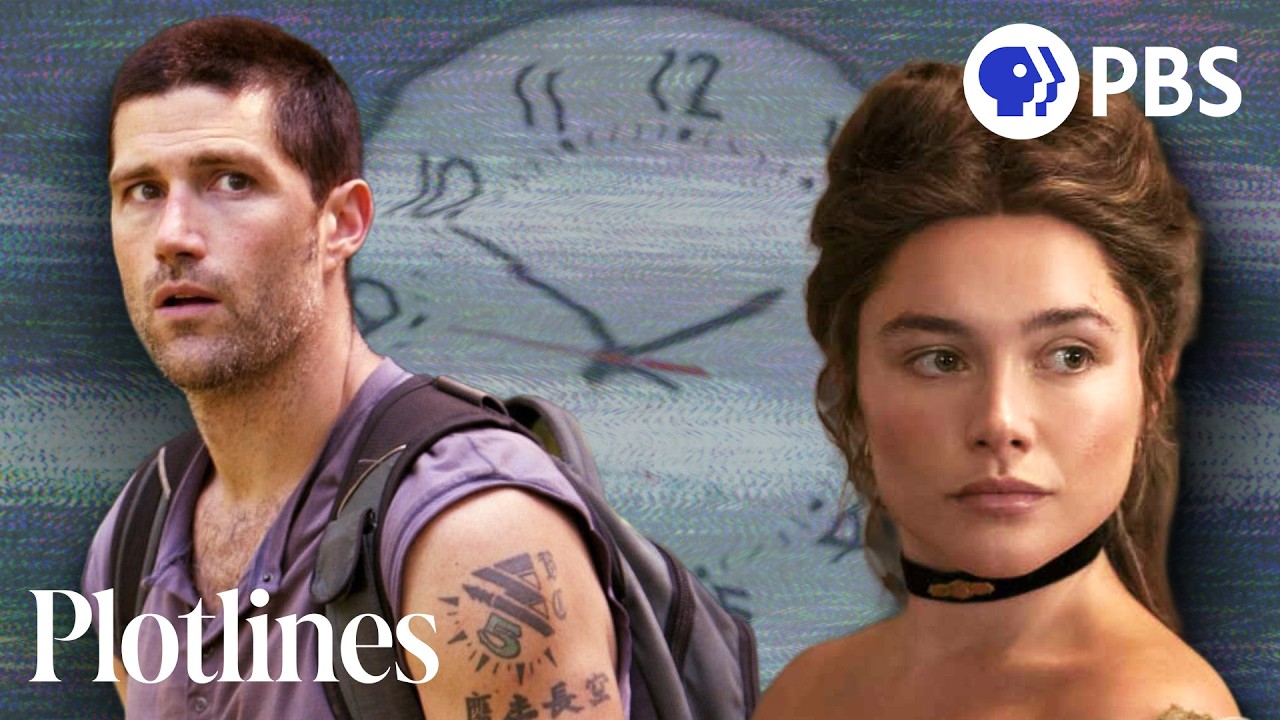
Why TV can't tell stories chronologically | Plotlines
B2
60 min
Premium
Scan to watch
1
Think about these questions before watching the video.
Think about TV shows or movies you’ve watched recently. Have any of them used flashbacks, flashforwards, or jumped between different timelines? How did this affect your viewing experience?
Some people find non-linear storytelling exciting and engaging, while others find it confusing or even frustrating. What do you think are the advantages and disadvantages of telling a story out of chronological order?
Why do you think filmmakers or writers choose to tell stories in a non-chronological way? What specific effects might they be trying to achieve by not following a simple timeline?
2
You only need to watch the highlighted section below — the exercises focus on this part.
▶ You only need to watch 0:45–3:45. The exercises focus on this part.
Video script306 segments · click a timestamp to jump
- The Irish novelist, Colm Toibin, once said
that Jane Austen was a great writer
because she never needed to rely on the clumsiness
of the flashback.
"You can't read any book now," he said,
"without suddenly, on chapter two,
[the writer] taking you back
to where everybody was 20 years ago.
How their parents met, how their grandparents met."
If flashbacks have ruined novels for this guy,
I hope he doesn't watch streamers
because modern TV shows bounce around time
more than Bill and Ted in a broken phone booth.
Sci-fi series like "Fallout,"
thrillers like "Mr. Robot,"
dramas like "Orange is the New Black,"
even comedies like "Only Murders in the Building"
all rely heavily on nonlinear storytelling
for exposition, character development, and worldbuilding.
There's a bit of a debate online
about whether flashbacks are a cheap trick
or a legitimate storytelling technique.
I'm gonna admit,
I can understand why Toibin finds them frustrating.
There you are, feeling the momentum,
excited to know what's gonna happen next,
and suddenly you're going the wrong way-
(car clangs)
getting further from your destination.
But flashbacks have a long literary legacy,
with some famous examples by revered writers,
so what's the difference?
Why are some flashbacks effective and others annoying,
and why do we seem so obsessed with them right now?
(dramatic music) (paper rustles)
(static hisses) (computer mouse clicks)
Even if you haven't read "The Odyssey,"
you're probably familiar
with some of the most famous moments.
Odysseus stabbing the cyclops in the eye,
Circe turning his men into pigs,
the ship sailing past the sirens,
but did you know that all of those events
take place in flashback?
The epic poem begins with Odysseus missing in action
after the Trojan War
and his family wondering where in the Hades he is.
We find out that he's a prisoner of the nymph, Calypso,
and after an eventful escape,
he winds up in the land of the Phaeacians.
Grateful for their hospitality, he tells them a long tale
of all the adventures he's had since the war ended.
A lot of his most fantastic escapades
come from his own mouth,
leading us to wonder whether it all really happened
or whether he's doing a bit of embellishing,
and it makes us, the readers,
feel like we're part of the audience listening to his story.
"After he finished, all were silent, spellbound,
sitting inside the shadowy hall."
This structure is also an example of in medias res,
which is Latin for "in the middle of things."
We're dropped right into the thick of Odysseus' adventures,
which grabs the audience's attention
and makes them curious about how we got there.
Mary Shelley's "Frankenstein" uses a similar framing device.
The novel begins with the letters of a sea captain
whose ship is traveling through the Arctic.
One morning, the crew discovers
a bedraggled man floating on an ice floe
and takes him aboard.
"His limbs were nearly frozen
and his body dreadfully emaciated by fatigue and suffering.
I never saw a man in so wretched a condition."
The wretched man turns out to be Victor Frankenstein,
who's nursed back to health
and recounts his whole life story to the captain
as essentially a flashback.
It's a much more exciting way to start a book
than with Victor's kinda boring childhood.
So, this combination of in medias res and flashback
has been with us for a long time,
but when it comes to modern TV,
it really took off in the early 2000s with ABC's "Lost."
I don't know if it gets much more in medias res
than a plane crash.
While the survivors navigated the dangers
and mysteries of the island,
we learned all about their pasts and futures
through a series of flashbacks,
flash-forwards, and even flash-sideways.
The success of "Lost" may have inspired Vince Gilligan
to begin his show, "Breaking Bad,"
in medias res as well.
The first time we see Walter White,
he's fleeing the cops through the desert in an old RV,
wearing nothing but a gas mask and his tighty whities.
Shortly thereafter,
we learn that just three weeks ago,
he was a respected high school teacher with a loving family.
The pattern was repeated,
which is a good fit for the premise,
because the whole show is about transformation.
We know what Walter White will become.
The fun is finding out how he gets there.
By the late 2010s, this structure was so commonplace
that it felt mandatory,
as if writers were so afraid of audiences getting bored
that they had to assure them right at the top
that something exciting was going to happen.
"White Lotus" creator, Mike White,
said of his previous show.
- [Mike] Had I only known
if I'd put a dead body at the beginning of "Enlightened,"
maybe people would've watched "Enlightened."
I don't know.
- The literary critic, Gerard Genette,
was fascinated with how the order
in which the events of a story are related
can be different from the order
in which they actually happen.
He popularized the term analepsis
for when the reader learns things that happen
before the current point in the storyline,
what we'd call flashbacks,
and prolepsis for things that happen in the future,
what we might call flash-forwards or in medias res.
For instance, a Sherlock Holmes book might end
with the famous detective describing
how the killer pulled off his crime,
but technically, that event took place at the beginning,
so analepsis.
Genette was also interested in how these events
are relayed to the audience.
Victor Frankenstein is a character in the story
that he is telling,
making him an intradiegetic narrator.
The same goes for the primary narrator
of "Wuthering Heights,"
a housekeeper named Nelly Dean,
who tells her new boss the whole melodramatic history
of the house.
- It began 40 years ago.
- In one of the most haunting scenes
from Ernest Hemingway's "For Whom the Bell Tolls,"
the guerrilla leader, Pilar, describes her part
in the brutal execution of fascist sympathizers
near the beginning of the Spanish Civil War.
Intradiegetic analepsis
can feel more immediate and personal.
You don't just hear about past events,
but also how characters feel about them.
As Pilar says, "It was a thing one is sorry to have seen,"
but they also raise questions
about how reliable the information is.
In the 1995 crime film, "The Usual Suspects,"
most of the action occurs in flashback
during a police interview with the sole survivor
of a heist gone wrong.
It's only at the very end that we learn, spoiler alert,
virtually everything we've seen was an elaborate lie.
But analepses don't have to be literally told
from one character to another.
Memories can also be a kind of intradiegetic flashback.
"The Lord of the Rings" films use very few flashbacks,
but almost all of them are presented as memories
that characters are reliving at that moment.
- Gandalf, what is it? - Nothing, Frodo.
- Sometimes, memory flashbacks are triggered
by an event or sensation.
In Marcel Proust's "In Search of Lost Time,"
the taste of madeleine cake dipped in tea
mentally propels the narrator
back to the town he spent time in as a child.
"Immediately, the old gray house upon the street
rose up like the scenery of a theater."
It's a famous passage
that might have inspired the scene in "Ratatouille,"
when the dour food critic, Anton Ego,
is whisked to his own childhood by Remy's cooking.
(air whooshes)
Memory flashbacks don't always have to reveal
new information.
They might just remind us that the character is haunted
by something from the past,
like Robby's frequent flashbacks to the COVID-19 pandemic
in HBO's "The Pitt."
Some novels take this even further
by fracturing the sense of time completely.
Kurt Vonnegut's "Slaughterhouse-Five"
and Toni Morrison's "Beloved"
both employ chaotic, jumbled timelines
to show how trauma constantly invades
and interrupts the present.
As Faulkner said, "The past is never dead.
It's not even past."
But most TV shows don't bother
with any kind of intradiegetic justifications.
Flashbacks aren't usually framed as memories or stories.
They just kind of happen,
and as they've become longer and more common,
we've come up with a new term for it:
multiple timelines.
Shows like "Yellowjackets," "Station Eleven,"
"Once Upon a Time," "Westworld," and "This Is Us"
don't even have a main storyline.
They are constantly alternating
between one or more time periods.
HBO's "The Staircase" used four separate timelines
to tell one true crime story,
and in Netflix's "The Haunting of Hill House,"
very few consecutive scenes
take place in chronological order.
It seems like this would be a nightmare to write,
and it can be confusing for audiences
who have to keep track of what happened when,
so why do it?
Well, maybe it has to do
with the nature of the format itself.
In the 20th century, TV shows were pretty static.
The networks assumed that audiences
wanted comfort and familiarity.
Of course, there were shows
where big changes happened regularly,
like soap operas and their prime time cousins,
but for the most part, at the end of every episode,
characters were pretty much back to where they started.
Today's TV is more focused on long-form storytelling,
but it's under the same pressure to be familiar.
Audiences learn to like a certain cast of characters
with certain relationships,
and as a brand, you don't wanna mess with a winning formula.
On top of that, a lot of current TV
is inspired by classic film genres:
the Western, the gangster flick,
the '80s Spielbergian sci-fi adventure.
Many are even direct adaptations.
They take premises that were designed for a two-hour runtime
and stretch them over multiple 10-hour seasons.
So, TV writers have a tough job.
How do you keep things as static as possible,
but make the audience feel like they're getting somewhere?
Flashbacks allow writers to create the perception of change.
The setting is new.
The characters look different.
We might learn surprising details or solve mysteries,
but the core conflicts and relationships
haven't shifted that much.
But there are some shows bucking this trend.
The creator of "The Pitt" said
they would not use flashbacks in the second season,
preferring to keep all the action in a tight little box.
In Netflix's "Adolescence,"
each episode consists of one long, unbroken shot,
making flashbacks basically impossible.
In a particularly riveting scene,
13-year-old Jamie describes to a psychologist
the events that led him to murder a classmate.
If this had been shown as a flashback,
we would've missed out on the tension
of him having to tell the story
and her having to listen to it.
These restrictions on space and time
force writers to reveal backstory
through dialogue and performance,
much the way it's been done on stage for hundreds of years.
When the ghost of Hamlet's father
describes his own murder to his son,
we're witnessing two events at once:
the murder and Hamlet's reaction to it,
and we can sympathize with his doubts.
"This spirit may be the devil
and perhaps abuses me to damn me."
Another haunted analepsis occurs
in Charles Dickens' "A Christmas Carol,"
when the Ghost of Christmas Past
literally takes Scrooge back in time
to observe key moments of his life.
It's a sort of magical metaphor for the power of memory,
and I think a perfect example
of what makes a good flashback,
because we're not just watching the events
of Scrooge's youth;
we're watching him watch the events of his youth.
Good flashbacks don't just exist in the past.
They are the effect of the past on the present.
As Scrooge says after his transformation,
"I will live in the past, the present, and the future."
So, I think I actually disagree with Colm Toibin
about Jane Austen.
I think she actually did use flashbacks.
When Elizabeth Bennet reads Mr. Darcy's letter
about his history with Mr. Wickham,
we are learning about events of the past
that completely transform our understanding of the present.
But Darcy's decision to write the letter
is an event of the present,
as is Elizabeth's emotional reaction to it.
Unlike the clumsiness of so many TV flashbacks,
there's no cut to black in between timelines.
They exist together, intertwined,
the way we experience the past in real life:
through story, through memory, through trauma.
Jane Austen's flashbacks are so elegant and organic,
you don't even notice they're there.
(lively music)
3
Answer these questions in your own words. Support your answers with evidence from the video.
01According to the video, why do some people, like Colm Toibin, find flashbacks frustrating in storytelling?
Sample answerThey can be frustrating because you're following the story's momentum, excited to see what happens next, but then a flashback takes you back in time, making you feel like you're moving away from the main plot or 'destination.'
02How does "The Odyssey" use flashbacks and the concept of 'in medias res' to tell its story?
Sample answerThe epic poem starts 'in medias res,' meaning in the middle of the action, with Odysseus already missing. Then, he tells the Phaeacians about his past adventures, like fighting the cyclops, which are presented as flashbacks. This makes the reader feel like they're part of the audience listening to his tales.
03In what way does using a flashback structure improve the beginning of Mary Shelley's "Frankenstein" compared to a chronological start?
Sample answerThe video suggests it makes the beginning much more exciting. Instead of starting with Victor's childhood, which the narrator calls 'kinda boring,' the story begins with him in a terrible condition, which immediately grabs the reader's attention and makes them curious about his past.
04Although flashbacks have a long history, what does the video identify as a key turning point for their widespread use in modern television?
Sample answerThe video explains that while flashbacks have existed for a long time in literature, their use in modern TV really 'took off' in the early 2000s, specifically mentioning the ABC show 'Lost' as a significant example of this trend.
4
Vocabulary
Vocabulary
These expressions will help you communicate more naturally about this topic.
Examples
nonlinear narrative — a storytelling approach where events are presented out of their chronological order.
This is a formal term, often used in film and literary analysis. You can also use "nonlinear storytelling" or refer to "a nonlinear plot".
to jump back and forth (in time) — to frequently switch between different time periods or perspectives within a story.
This phrasal verb is often used to describe how a film or book's plot moves. It implies a lack of strict chronological order.
to flesh out a character/storyline — to add more details, information, or depth to a character or plot, making them more complete and believable.
This phrasal verb is commonly used when discussing the development of fictional elements. It suggests making something more substantial.
to keep someone on the edge of their seat — to make someone feel very excited or anxious because they want to know what happens next in a story.
This idiomatic expression is often used to describe thrilling or suspenseful stories that hold the audience's attention completely.
a narrative device — a technique or tool used by a writer or filmmaker to tell a story, often to achieve a specific effect, such as creating suspense or revealing character.
This is a semi-formal term. Common narrative devices include flashbacks, foreshadowing, and 'in medias res' (starting in the middle of the action).
5
Complete the sentences with words from the box. One word is extra.
Word bank
01Many modern TV shows employ a to reveal character backstories gradually, adding layers of complexity.
02The constant between different time periods can be confusing for some viewers, but it often enhances the mystery.
03The series excels at its secondary characters, giving them rich backgrounds and believable motivations.
04The show's masterful suspense relies on unexpected twists and turns, a technique aimed at throughout every episode.
05The use of an unreliable narrator is a clever that adds intrigue and forces the audience to question everything.
6
Use the word in brackets to form a new word that fits each gap.
01
Many modern TV shows avoid telling stories in a strictly order, preferring to jump between timelines.
02
The of the story was complex, with many flashbacks used to explain character motivations.
03
Flashbacks are often used as a key character device to give viewers more insight into characters' pasts.
04
The of the plot, with its multiple timelines, kept viewers on the edge of their seats.
05
A good storyteller knows how to the audience from the very first scene, regardless of chronological order.
06
The sudden of a hidden truth can dramatically change a character's path in a nonlinear story.
7
Grammar: Third and mixed conditionals
Grammar
Third conditionals describe hypothetical situations in the past that didn't happen and their imagined past results. Mixed conditionals combine a past condition with a present result, showing how a different past choice would affect the present. Both are useful for discussing alternative narrative structures and their impact on a story.
Examples
If the series had been told chronologically, the audience wouldn't have understood the protagonist's motivations until much later.
This third conditional imagines a different past storytelling choice and its past consequence.
If the writers hadn't included those crucial flashbacks, viewers would be completely confused about the characters' current relationships.
This mixed conditional links a hypothetical past narrative decision to a present-day understanding.
The plot twist wouldn't have been nearly as impactful if the director hadn't skillfully used non-linear editing.
The 'if' clause can come at the end without changing the meaning. This is another third conditional.
If the studio had insisted on a strictly linear plot, the show wouldn't be as critically acclaimed for its innovative structure today.
This mixed conditional shows how a past hypothetical decision has a present hypothetical result.
Key points
Third conditional: 'If + past perfect', 'would have + past participle' (imagined past condition, imagined past result).
Mixed conditional: 'If + past perfect', 'would + base verb' (imagined past condition, imagined present result).
Remember to use the correct past perfect in the 'if' clause and 'would have' or 'would' in the main clause, depending on whether the result is past or present.
8
Correcting plotline descriptions
The video discusses how TV shows use different storytelling methods. Read each sentence below, which describes aspects of plotlines and narrative devices. Each sentence contains one error in grammar, vocabulary, or usage. Find the error and correct it.
Each sentence contains one error. Find and correct it.
01Many modern TV shows prefer a non-linear narratively, which can sometimes be confusing for viewers.
Corrected version
Many modern TV shows prefer a non-linear narratively, narrative, which can sometimes be confusing for viewers.
02If the director would have jumped back and forth in time less, the plot would have been easier to follow.
Corrected version
If the director would have had jumped back and forth in time less, the plot would have been easier to follow.
03Flashbacks are often used to flesh out on a character's backstory, adding depth to their motivations.
Corrected version
Flashbacks are often used to flesh out on a character's backstory, adding depth to their motivations.
04The constant time jumps kept the audience on edge of their seats, eager to discover the truth.
Corrected version
The constant time jumps kept the audience on the edge of their seats, eager to discover the truth.
05Using a nonlinear narrative as a main narrative device often require careful planning by writers.
Corrected version
Using a nonlinear narrative as a main narrative device often require requires careful planning by writers.
06If they would have chosen a more linear plot, the series would be finished by now, but it's still ongoing.
Corrected version
If they would have had chosen a more linear plot, the series would be finished by now, but it's still ongoing.
9
Rewrite each sentence using the structure indicated.
01The director didn't use a nonlinear narrative, so the audience found the plot predictable.
Use the third conditional.
Hint: Remember to use 'had + past participle' in the 'if' clause and 'would have + past participle' in the main clause.
02The show didn't jump back and forth in time, which meant it couldn't fully flesh out the characters' pasts.
Use the third conditional.
Hint: Consider the negative meaning of the original sentence when forming the conditional.
03The writer didn't flesh out the main character's backstory, so viewers didn't understand his motivations.
Use the third conditional.
Hint: The past perfect tense is crucial in the 'if' clause for past hypothetical situations.
04The constant time shifts kept the audience on the edge of their seat, which is why the show is so popular now.
Use a mixed conditional.
Hint: The 'if' clause refers to a past condition, but the main clause refers to a present result.
05The director chose not to use a nonlinear narrative as a narrative device, so the story lacked depth.
Use the third conditional.
Hint: Think about the cause and effect in the past.
06The series presented events chronologically, so it failed to create enough suspense for the viewers.
Use the third conditional.
Hint: You can use 'might have' instead of 'would have' to show a possibility.
10
Words to take with you
Vocabulary
These expressions are not in the video but will help you discuss this topic more fluently.
Examples
backstory — the history or background of a character or a situation in a story.
Use it to refer to events that happened before the main plot begins but are crucial for understanding it. Often revealed through flashbacks or dialogue. Example: "The video game reveals the hero's tragic backstory through a series of fragmented memories."
to piece together the narrative — to gradually understand a story or sequence of events by combining separate pieces of information.
This phrase describes the audience's active role, especially in complex or non-linear stories where information is not given chronologically. Example: "Watching the series, you have to actively piece together the narrative from different timelines."
a compelling narrative — a story that is very interesting, engaging, and holds your attention strongly.
Use this adjective + noun phrase to describe a story that is well-told and captivating, regardless of its structure. It emphasizes the story's power to draw the audience in. Example: "Despite its complex structure, the show offers a truly compelling narrative that keeps viewers hooked."
to build tension — to gradually create a feeling of excitement, nervousness, or anxiety in a story, often leading to a climax.
This verb phrase describes a common goal of writers and directors. Non-linear storytelling is often used as a technique to build tension by withholding information or revealing events out of order. Example: "The director uses sudden shifts in time to effectively build tension throughout the film."
a plot twist — a sudden and unexpected change in the direction or outcome of a story's plot.
This noun phrase refers to a surprising turn of events that often recontextualizes previous scenes. Non-linear narratives can be particularly effective at setting up powerful plot twists. Example: "The final episode delivered an incredible plot twist that nobody saw coming."
11
Storytelling techniques: matching exercise
Modern TV shows often use complex storytelling methods. Match each term or phrase on the left with its correct description or outcome on the right.
Match each item on the left with the correct item on the right.
A
B
12
Useful phrases: Discussing TV shows and movies
Vocabulary
When talking about your favorite series or films, it's common to discuss not just what happens, but how the story is told. These phrases will help you share your opinions on narrative styles, character development, and plot complexity with friends or colleagues.
Examples
"What did you make of the way they told the story in [show name]?" — This asks for someone's opinion on the narrative style.
Register: Neutral to informal. Use when you want to invite a friend or colleague to share their thoughts on a show's storytelling approach. Can be followed by your own opinion, e.g., 'I found it...'.
"I found the nonlinear narrative really kept me on the edge of my seat." — This expresses a positive opinion about the effectiveness of a nonlinear narrative.
Register: Neutral. Use when you want to convey excitement or suspense caused by the storytelling structure. Directly uses 'nonlinear narrative' and 'kept me on the edge of my seat'.
"The way they jumped back and forth in time really helped to flesh out the main character's backstory." — This explains why a specific narrative technique (jumping timelines) was effective for character development.
Register: Neutral. Use to explain the purpose or benefit of a storytelling choice. Incorporates 'jumped back and forth' and 'flesh out a character'.
"While I appreciate the use of flashbacks as a narrative device, I sometimes found it a bit confusing to follow." — This expresses a nuanced or slightly critical opinion, acknowledging a positive aspect while also pointing out a drawback.
Register: Neutral. Use when you want to offer a balanced critique, showing you understand the intention but also experienced difficulty. Uses 'narrative device'.
"If you're into complex plotlines and don't mind a story that doesn't unfold chronologically, you should definitely check it out." — This recommends a show, specifically highlighting its narrative complexity and non-chronological structure.
Register: Informal to neutral. Use when suggesting a show to someone, especially if you know they might appreciate or need a heads-up about its unique storytelling. 'Doesn't unfold chronologically' is another way to describe a nonlinear narrative.
13
Match each word on the left with its natural partner on the right.
A
B
14
The art of nonlinear storytelling in television
Modern television often challenges traditional narrative structures. Read about how and why.
Read the passage below, then answer the comprehension questions.
Modern television has truly embraced the nonlinear narrative, transforming how audiences engage with stories. Gone are the days when every plot unfolded strictly from beginning to end. Today, many acclaimed series jump back and forth in time, weaving together past events with present dilemmas. This isn't merely a stylistic choice; it's a powerful narrative device designed to enrich the viewing experience.
By strategically revealing information out of sequence, writers can flesh out characters more deeply, providing crucial backstory that explains current motivations or unresolved conflicts. If a story were always told chronologically, it might struggle to build the same level of intrigue or suspense. The constant shifting of timelines helps keep viewers on the edge of their seats, piecing together the puzzle as the plot gradually unravels. Had screenwriters not explored these innovative structures, the depth and complexity we now expect from television dramas might never have materialized, leaving audiences less captivated by predictable, straightforward tales.
01According to the passage, what is one key reason modern TV uses nonlinear narratives?
Sample answerOne key reason is to enrich the viewing experience and provide crucial backstory that helps flesh out characters.
02How does the passage suggest that a strictly chronological story might differ from a nonlinear one in terms of audience engagement?
Sample answerIt suggests a chronological story might struggle to build the same level of intrigue or suspense, potentially leaving audiences less captivated.
03What does the phrase 'flesh out characters' imply about the information provided through nonlinear storytelling?
Sample answerIt implies that nonlinear storytelling adds more details, depth, and background to characters, making them more complete and understandable.
04What is the author's implied opinion regarding the adoption of nonlinear storytelling by screenwriters?
Sample answerThe author implies a positive opinion, suggesting that these innovative structures have led to greater depth and complexity in television dramas, which might not have materialized otherwise.
15
Exploring nonlinear storytelling
Many modern TV shows and films use complex plot structures to engage viewers.
Fill in each blank with the correct word from the word bank.
Word bank
Modern television often employs a narrative, moving away from a simple chronological sequence of events. This approach allows creators to back and forth in time, revealing crucial information when it has the most impact. It's a powerful device, enabling writers to gradually out characters and their motivations, adding depth and complexity. While some viewers prefer straightforward storytelling, many find that a well-executed nonlinear plot can truly them on the edge of their seat, building suspense and encouraging deeper engagement with the story.
16
Complete the sentences with words from the box. One word is extra.
Word bank
01Many modern TV series employ a to gradually reveal information and build suspense.
02The director chose between different eras, offering viewers glimpses into the characters' pasts and futures.
03Flashbacks can be an effective way by providing crucial background information and motivations.
04The thrilling cliffhangers at the end of each episode were designed until the next week.
05The unreliable narrator is often used as to challenge the audience's perception of events.
17
Discuss these questions with a partner. Try to use vocabulary from the lesson.
Are flashbacks usually a cheap trick or a valuable narrative device?
When has a nonlinear narrative kept you on the edge of your seat?
How do flashbacks help flesh out characters or storylines in the video?
This lesson is for Lessonpills members
Sign in at learn.lessonpills.com to print lessons or save them as PDF.