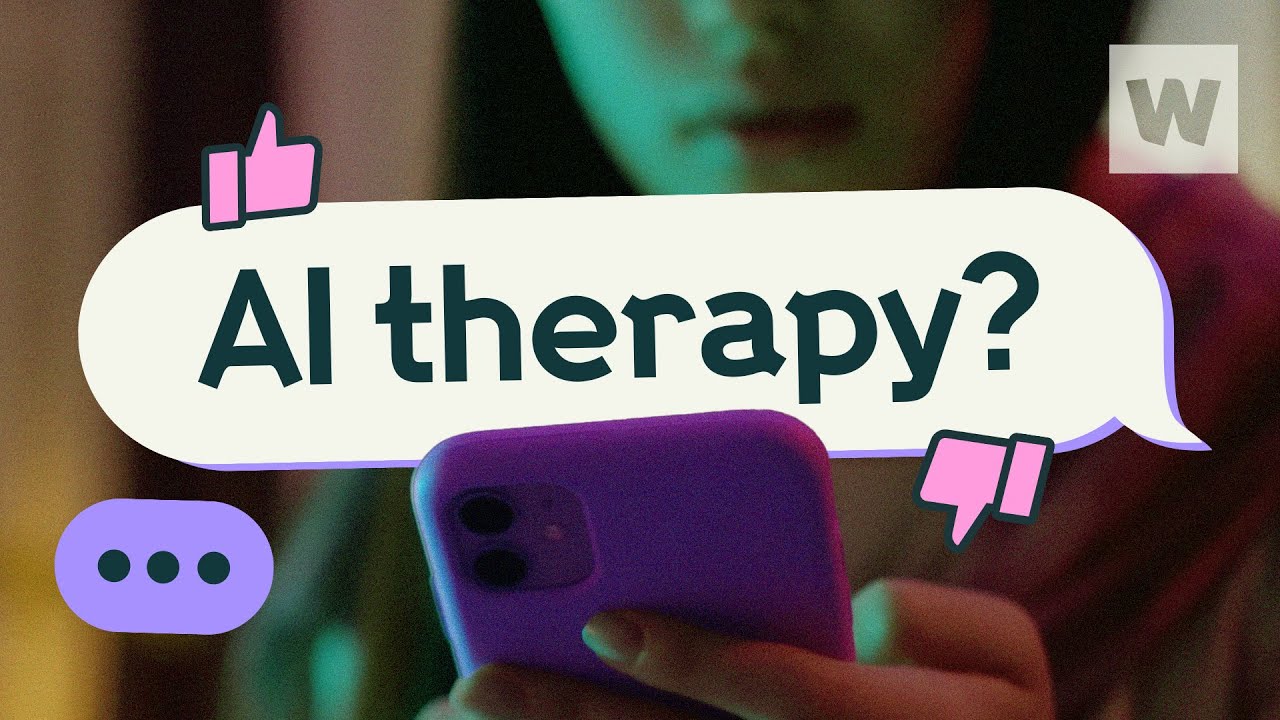
Would you use an AI therapist?
1
Think about these questions before watching.
- Many people use technology to stay healthy or manage stress. What kind of apps or digital tools do you currently use for your well-being, and what do you find most helpful or challenging about them?
- Artificial intelligence is becoming more common in many aspects of our lives. In your opinion, what are some areas where AI could be genuinely beneficial, and where should we be more cautious, especially when it comes to sensitive topics like mental health?
- Imagine a future where AI-powered tools are widely used to support mental health. What do you think would be the biggest advantages of this? What potential drawbacks or ethical concerns might arise if people relied on AI for therapy?
2
Watch the video carefully. Pay attention to the main ideas and key details.
3
Vocabulary
Vocabulary
These expressions will help you communicate more naturally about this topic.
Examples
reframe negative thoughts — to change the way you think about a situation, especially by looking at it from a more positive or constructive perspective.
Usage note: This is a common concept in therapy, particularly cognitive behavioral therapy (CBT). You can say 'help someone reframe their thoughts' or 'learn to reframe a situation'.
a double-edged sword — something that has both advantages and disadvantages, or that can have both good and bad consequences.
Usage note: This idiom is useful when discussing topics with clear pros and cons. For example, 'AI in therapy can be a double-edged sword, offering convenience but lacking human empathy'.
foster a connection — to help develop a relationship or a feeling of understanding and trust between people.
Usage note: This semi-formal phrase is often used when discussing relationships, community, or support systems. For instance, 'A human therapist can foster a deeper connection than a chatbot'.
raise ethical questions — to bring up moral issues or dilemmas that need to be considered and discussed.
Usage note: This collocation is common when talking about new technologies, scientific advancements, or controversial topics. You can also say 'raise concerns about' or 'raise privacy issues'.
narrow cultural view — a limited understanding or perspective that doesn't consider the beliefs, values, or experiences of people from different cultures.
Usage note: This phrase describes a lack of diversity in perspective, often leading to misunderstandings or inappropriate advice. It's frequently used when discussing data, research, or AI systems.
4
Complete the sentences with words from the box. One word is extra.
Word bank
01One of the potential benefits of AI therapy is its ability to help users by offering alternative perspectives on challenging situations.
02While AI offers convenience and accessibility in mental health support, its use can be considered due to concerns about empathy and data security.
03Many argue that AI chatbots struggle to truly with users, which is crucial for effective long-term therapeutic relationships.
04The increasing reliance on AI for sensitive mental health support continues to about responsibility, accountability, and the nature of care.
05If AI models are primarily trained on Western data, they might possess a that fails to understand the diverse needs and contexts of global users.
5
Match each word on the left with its natural partner on the right.
A
B
6
Useful phrases: Discussing AI in sensitive fields
Vocabulary
The video explores the fascinating and complex topic of using AI chatbots for mental health support. As this technology becomes more common, it's crucial to be able to discuss its benefits, limitations, and ethical implications clearly and thoughtfully. These phrases will help you express nuanced opinions and engage in productive conversations about AI in sensitive fields.
Examples
The video really got me thinking about the potential of AI in mental health. What are your initial thoughts? — This phrase helps you open a discussion and invite others to share their opinions.
Register: Neutral, conversational. Use when introducing a topic for discussion and wanting to hear others' perspectives.
It seems like a double-edged sword, doesn't it? On one hand, there's clear potential, but on the other, significant concerns. — This acknowledges that something has both advantages and disadvantages, using the vocabulary 'double-edged sword'.
Register: Neutral. Use when discussing a topic with both positive and negative aspects, showing a balanced view.
While it's great that AI might help reframe negative thoughts, I'm not sure it can truly foster a genuine human connection. — This phrase allows you to acknowledge a positive point ('while it's great...') before expressing a reservation or concern, incorporating 'reframe negative thoughts' and 'foster a connection'.
Register: Neutral. Use to politely express a reservation or partial disagreement after acknowledging a valid point.
One of the biggest ethical questions for me is how we ensure these AI models don't reinforce harmful stereotypes or have a narrow cultural view. — This helps you highlight a critical concern or a key ethical dilemma, using 'ethical questions' and 'narrow cultural view'.
Register: Neutral, slightly more assertive. Use when you want to emphasize a crucial problem or a moral issue that needs to be addressed.
Ultimately, it comes down to balancing innovation with the need for safety and genuine human understanding. — This phrase is useful for summarising the core challenge or offering a concluding thought on a complex issue.
Register: Neutral. Use to wrap up a point, offer a final perspective, or identify the most important aspect of a discussion.
7
Would you use an AI therapist?
The video (1:47 – 6:25) explores the evolving role of Artificial Intelligence in mental health care. This exercise focuses on the benefits and challenges of integrating AI into therapy.
Fill in each blank with the correct word or phrase from the word bank.
Word bank
The video explores the growing role of AI in mental health care, highlighting its potential to offer accessible support. Studies suggest that AI can help individuals and provide advice, sometimes proving as effective as human therapists for certain conditions. However, the use of AI in therapy is often described as because it presents both significant advantages and considerable risks. While AI can offer convenience, it can be challenging for it to truly with patients, potentially increasing feelings of isolation. Furthermore, the reliance on training data, often from a , means AI might overlook crucial cultural nuances or even reinforce harmful stereotypes. This situation about inclusivity and safety, emphasizing the need for careful development and ethical oversight.
8
Words to take with you
Vocabulary
These expressions are not in the video but will help you discuss this topic more fluently.
Examples
therapeutic alliance — the trusting and collaborative relationship that develops between a therapist and a client, which is crucial for effective treatment.
Use this term when discussing the quality of the relationship in therapy, especially when comparing human therapists to AI. For example: 'Building a strong therapeutic alliance is often seen as the foundation of successful therapy.'
data privacy concerns — worries or issues related to the protection and confidentiality of personal and sensitive information.
This phrase is used when discussing the risks of using AI, particularly regarding the security of sensitive information shared with chatbots. For example: 'Many people have legitimate data privacy concerns when considering AI for mental health support.'
emotional intelligence — the ability to understand, use, and manage your own emotions in positive ways to relieve stress, communicate effectively, empathize with others, overcome challenges, and defuse conflict.
Use this when comparing human therapists to AI, highlighting what humans bring to the table that AI currently lacks. For example: 'A human therapist's emotional intelligence allows them to pick up on subtle cues that an AI might miss.'
bridge the gap — to connect two things or groups that are separate or different; to reduce the differences or distance between them.
This idiom is useful when talking about how AI could make mental health support more accessible or fill a need. For example: 'AI chatbots could potentially bridge the gap for people who can't access traditional therapy due to cost or location.'
superficial interaction — an interaction that is not deep or meaningful, dealing only with the obvious or surface aspects rather than profound understanding.
Use this phrase when discussing the limitations or negative experiences some people have with AI therapy, suggesting a lack of genuine connection. For example: 'Some users find that conversations with AI therapists feel like a superficial interaction, lacking genuine understanding.'
9
Use the word in brackets to form a new word that fits each gap.
01
One of the potential benefits of AI chatbots in therapy is their ability to assist users in negative thoughts.
02
While AI therapy offers convenience, its aspects, such as a lack of human empathy, are often highlighted.
03
Many users find it challenging to foster a genuine with an AI, preferring human interaction for emotional support.
04
The deployment of AI in mental healthcare raises significant questions regarding privacy and responsibility.
05
If training data has a narrow view, AI might ignore important nuances in messages from diverse users.
06
Critics worry that replacing human therapists with chatbots could lead to increased feelings of among vulnerable individuals.
10
Grammar: Reported speech (statements and questions)
Grammar
Reported speech allows us to share what someone else said or thought without quoting their exact words. It's particularly useful when discussing opinions, research findings, or conversations, especially in contexts like mental health and AI, where conveying information accurately is important.
Examples
One person mentioned that they liked the warmth and companionship of the chatbot.
This reports a statement. The original direct speech might have been: 'I like the warmth and companionship of the chatbot.' Notice how 'I' changes to 'they' and 'like' changes to 'liked'.
A study concluded that chatbots were just as effective as human therapists for some conditions.
Here, we report a research finding. The original direct statement would have been: 'Chatbots are just as effective as human therapists.' 'Are' shifts to 'were' in reported speech.
Researchers questioned whether replacing a human therapist with a chatbot could increase isolation.
This reports a 'yes/no' question. The original direct question was: 'Could replacing a human therapist with a chatbot increase isolation?' We use 'whether' (or 'if') and change the question word order to a statement.
The video warned that AI might ignore important nuances if its training data has a narrow cultural view.
When reporting statements with modal verbs like 'might', 'could', 'would', or 'should', these modals usually remain unchanged.
Key points
- Tense changes: Often, the verb tense shifts back one step in reported speech (e.g., present simple to past simple, present perfect to past perfect).
- Pronoun and time/place changes: Remember to adjust pronouns (e.g., 'I' to 'he/she') and expressions of time/place (e.g., 'today' to 'that day', 'here' to 'there').
- Reporting questions: For 'yes/no' questions, use 'if' or 'whether'. For 'wh-' questions, use the 'wh-' word. The word order changes from question to statement.
- Common mistake: Don't use quotation marks in reported speech, and avoid using 'that' directly after 'said' when reporting a command or question.
11
Rewrite each sentence using the structure indicated.
01One study found, 'An AI model has the potential to help people reframe their negative thoughts.'
Rewrite the following in reported speech.
Hint: Remember to change the tense of the verb 'has'.
02Researchers at MIT and OpenAI stated, 'Replacing a human therapist with a chatbot could increase isolation.'
Rewrite the following in reported speech.
Hint: 'Could' usually doesn't change in reported speech.
03A student asked, 'Do these chatbots always foster a strong connection with users?'
Rewrite the following in reported speech.
Hint: For yes/no questions, use 'if' or 'whether' and change the word order to statement form.
04The expert explained, 'AI models trained on a narrow cultural view might ignore important nuances.'
Rewrite the following in reported speech.
Hint: 'Might' usually doesn't change in reported speech.
05Many users commented, 'AI therapy is a double-edged sword because it offers both advantages and disadvantages.'
Rewrite the following in reported speech.
Hint: Remember to change the tense of the verb 'is'.
06The panel questioned, 'Will the widespread use of AI in therapy raise ethical questions about privacy and accountability?'
Rewrite the following in reported speech.
Hint: For yes/no questions, use 'if' or 'whether' and change 'will' to 'would'.
12
Sort each item into the correct category.
Potential benefits of AI therapy
Potential drawbacks of AI therapy
Risking increased user isolation.Providing a safe space for open discussion.Increasing accessibility to therapy services.Providing companionship and advice.Offering immediate, 24/7 mental health support.Being trained on a narrow cultural view.Struggling to foster a genuine connection.Raising ethical questions about data privacy.The technology being a double-edged sword.Helping users to reframe negative thoughts.Conversations feeling empty or generic.Potentially reinforcing harmful stereotypes.Being as effective as human therapists for some conditions.
13
Discuss these questions with a partner. Try to use vocabulary from the lesson.
- Is AI therapy a double-edged sword for mental health support?
- Can AI genuinely foster a connection essential for therapy?
- Does AI risk a narrow cultural view, affecting therapy in your country?